Florida SC.6.L.15.1
The Standard
Analyze and describe how and why organisms are classified according to shared characteristics with emphasis on the Linnaean system combined with the concept of Domains.
Florida Next Generation Sunshine State Standards for Science
Teacher's field guide
What This Standard Means
What Students Need to Do
- Students compare organisms using cell type, number of cells, body structures, and how they get energy. They sort organisms into the three domains and nested taxonomic ranks. They explain how shared traits support each placement and help scientists organize living things.
What Mastery Looks Like
- Given a trait list, students can place an organism in Bacteria, Archaea, or Eukarya and support the choice with evidence. They can order Domain, Kingdom, Phylum, Class, Order, Family, Genus, and Species from broadest to most specific. They recognize that organisms in narrower groups share more characteristics.
Common Misconceptions
- Students often classify by habitat, color, or one visible feature instead of using several meaningful traits. They may put Kingdom above Domain, confuse genus with species, or reverse broad and specific ranks. Some think organisms in one group must be identical, or that similar-looking organisms must be closely related.
How to Assess It
- Give students a trait table for four fictional organisms and a blank nested classification chart. Ask them to place each organism, order the rank labels, and cite two traits supporting one placement.
Lesson moves
Ways to Teach It
Give pairs organism cards and trait strips, then have them build nested groups from domain to species and explain each placement.
Ask students to write which traits matter more when classifying a bat and bird: wings, hair, feathers, or milk production, and explain why.
Play a taxonomy relay where teams race to order rank cards and match organisms to groups using clue cards.
Examine mushrooms, yogurt, lettuce, and eggs; use ingredient labels and supplied cell-trait cards to identify domains of organisms associated with each item.
Free download
Printable SC.6.L.15.1 Worksheet
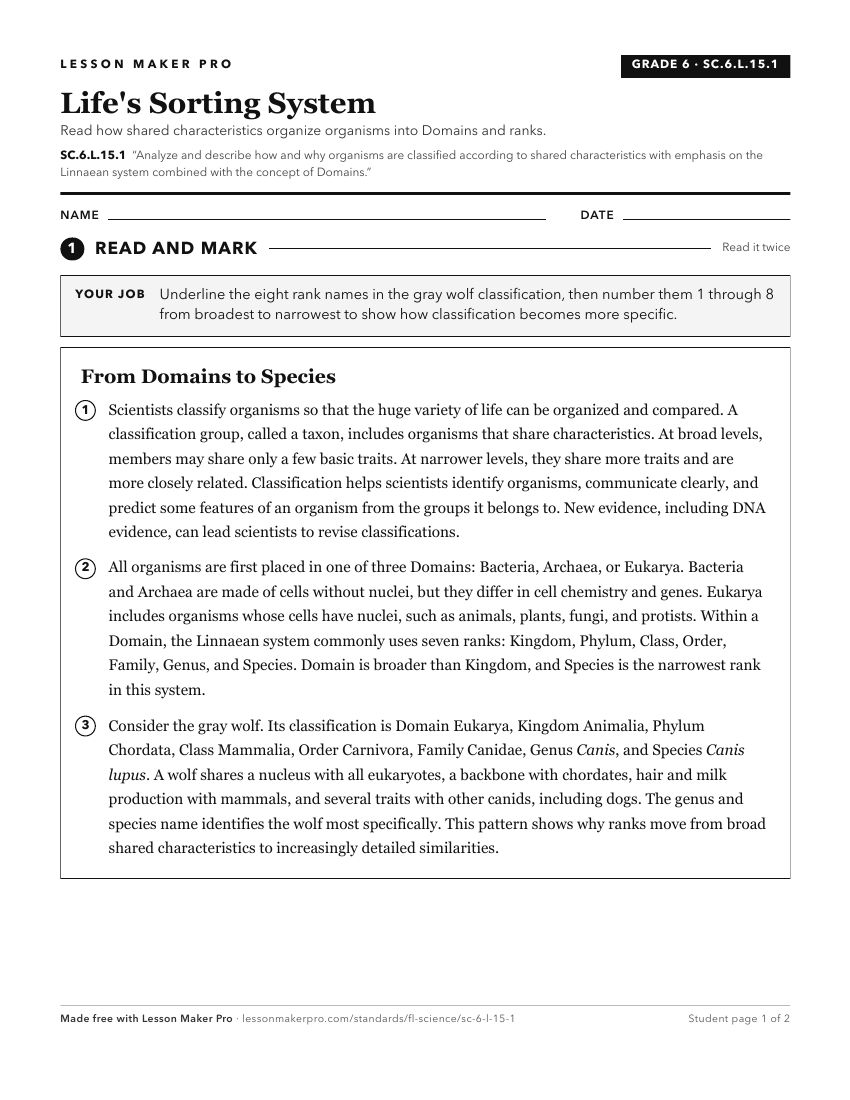
A ready-to-print activity worksheet aligned to SC.6.L.15.1, with an answer key for the teacher on its own page. No account needed.
PDF, US Letter, prints cleanly in black and white.
Download the worksheetKeep exploring
Related Standards
- SC.6.L.14.1
Describe and identify patterns in the hierarchical organization of organisms from atoms to molecules and cells to tissues to organs to organ systems to organism...
- SC.K.L.14.3
Observe plants and animals, describe how they are alike and how they are different in the way they look and in the things they do.
- SC.1.L.14.3
Differentiate between living and nonliving things.
- SC.3.L.15.1
Classify animals into major groups (mammals, birds, reptiles, amphibians, fish, arthropods, vertebrates and invertebrates, those having live births and those wh...
Turn this exact standard into a lesson
Grade, subject, topic, and the complete standard are prefilled. Create one free, no account needed.
Also for this standard:Make a WorksheetMake a QuizMake a Sub Lesson