Florida SC.3.L.15.1
The Standard
Classify animals into major groups (mammals, birds, reptiles, amphibians, fish, arthropods, vertebrates and invertebrates, those having live births and those which lay eggs) according to their physical characteristics and behaviors.
Florida Next Generation Sunshine State Standards for Science
Teacher's field guide
What This Standard Means
What Students Need to Do
- Students sort animals into broad groups using body coverings, backbones, limbs, movement, and reproduction. They explain each choice with traits or behaviors they can observe.
What Mastery Looks Like
- Students correctly place familiar and unfamiliar animals in one or more groups. They use clear evidence, such as feathers, a backbone, jointed legs, or egg laying, to defend each choice.
Common Misconceptions
- Students may assume each animal belongs to only one group, or that every animal that flies is a bird. They may call whales fish, bats birds, or spiders insects because they focus on habitat, movement, or size instead of defining traits.
How to Assess It
- Give students pictures of a bat, turtle, frog, salmon, butterfly, and dog. Ask them to name each animal's groups and write one supporting trait for each choice.
Lesson moves
Ways to Teach It
Give pairs animal photo cards and labeled hoops; students sort the cards, then attach one trait note to justify each placement.
Ask, “Is a bat more like a bird or a mammal?” Students write a claim and cite two visible or behavioral clues.
Play Animal Mystery: reveal one clue at a time, and teams earn more points for identifying the group with fewer clues.
Use a Florida wildlife guide to classify five local animals and record where each lives, how it moves, and how it reproduces.
Free download
Printable SC.3.L.15.1 Worksheet
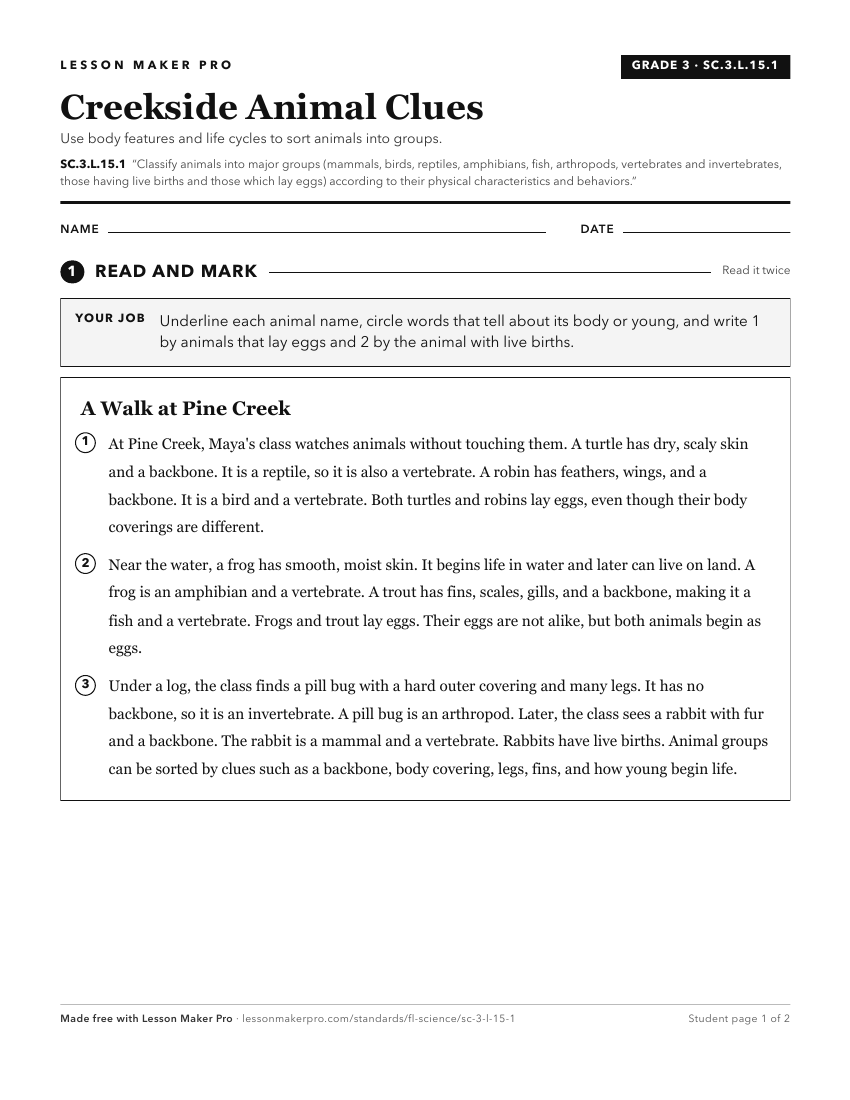
A ready-to-print activity worksheet aligned to SC.3.L.15.1, with an answer key for the teacher on its own page. No account needed.
PDF, US Letter, prints cleanly in black and white.
Download the worksheetKeep exploring
Related Standards
- SC.3.L.15.2
Classify flowering and nonflowering plants into major groups such as those that produce seeds, or those like ferns and mosses that produce spores, according to ...
- SC.6.L.15.1
Analyze and describe how and why organisms are classified according to shared characteristics with emphasis on the Linnaean system combined with the concept of ...
- SC.K.L.14.3
Observe plants and animals, describe how they are alike and how they are different in the way they look and in the things they do.
- SC.1.L.14.3
Differentiate between living and nonliving things.
Turn this exact standard into a lesson
Grade, subject, topic, and the complete standard are prefilled. Create one free, no account needed.
Also for this standard:Make a WorksheetMake a QuizMake a Sub Lesson