Florida SC.3.L.15.2
The Standard
Classify flowering and nonflowering plants into major groups such as those that produce seeds, or those like ferns and mosses that produce spores, according to their physical characteristics.
Florida Next Generation Sunshine State Standards for Science
Teacher's field guide
What This Standard Means
What Students Need to Do
- Students examine leaves, flowers, cones, seeds, and spore structures. They use these features to sort plants into flowering, cone-bearing, fern, and moss groups.
What Mastery Looks Like
- Students correctly classify an unfamiliar plant from a specimen or clear photograph. They name the physical evidence supporting their choice, such as flowers, cones, or spores.
Common Misconceptions
- Students may think every seed plant has flowers or that all nonflowering plants make spores. They may confuse spores with seeds or classify plants only by size and color.
How to Assess It
- Show pictures of a rose, pine tree, fern, and moss. Ask students to group them and write one visible feature that supports each placement.
Lesson moves
Ways to Teach It
Give pairs plant samples or photo cards to sort by flowers, cones, seeds, and spore structures, then label each group.
Ask students to explain why a pine tree and a fern belong in different groups even though neither has flowers.
Play Plant Detective by revealing one feature clue at a time while teams identify the plant group and record their evidence.
Survey the schoolyard for flowering and nonflowering plants, photograph examples, and create a class map labeled with each plant group.
Free download
Printable SC.3.L.15.2 Worksheet
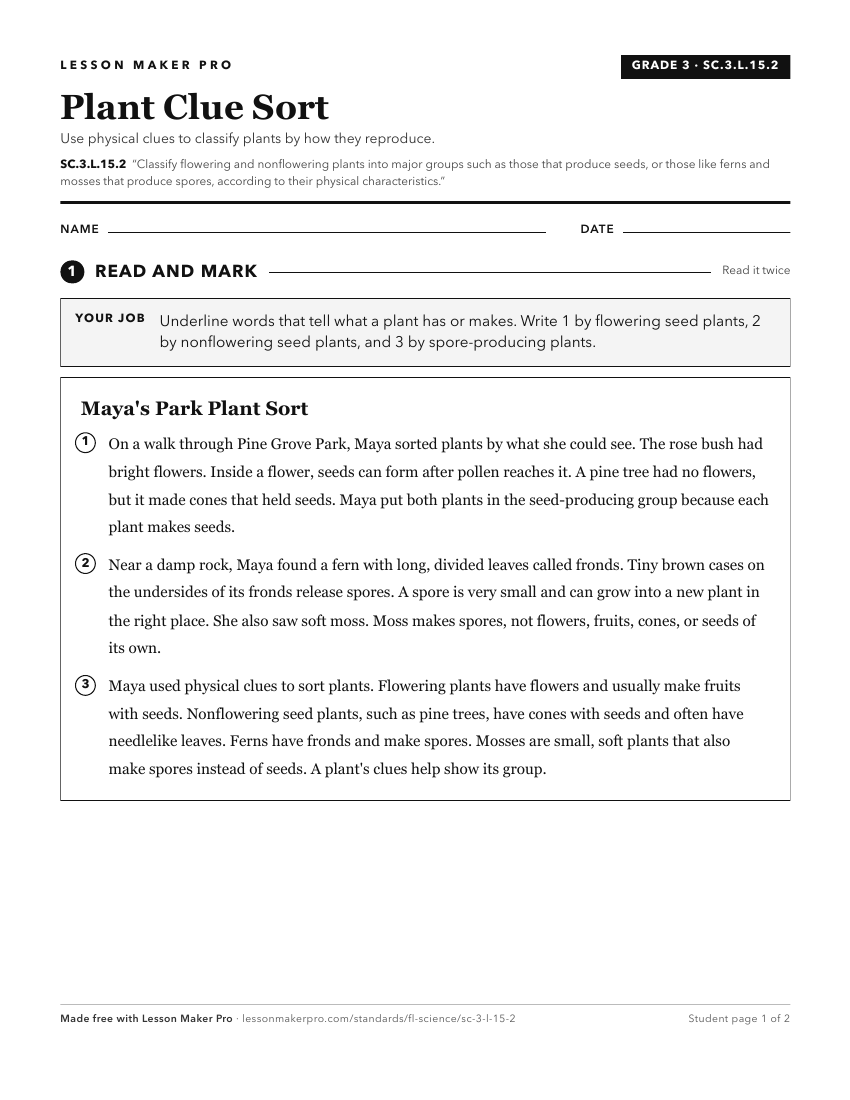
A ready-to-print activity worksheet aligned to SC.3.L.15.2, with an answer key for the teacher on its own page. No account needed.
PDF, US Letter, prints cleanly in black and white.
Download the worksheetKeep exploring
Related Standards
- SC.2.E.6.3
Classify soil types based on color, texture (size of particles), the ability to retain water, and the ability to support the growth of plants.
- SC.1.L.14.2
Identify the major parts of plants, including stem, roots, leaves, and flowers.
- SC.4.L.16.1
Identify processes of sexual reproduction in flowering plants, including pollination, fertilization (seed production), seed dispersal, and germination.
- SC.3.L.15.1
Classify animals into major groups (mammals, birds, reptiles, amphibians, fish, arthropods, vertebrates and invertebrates, those having live births and those wh...
Turn this exact standard into a lesson
Grade, subject, topic, and the complete standard are prefilled. Create one free, no account needed.
Also for this standard:Make a WorksheetMake a QuizMake a Sub Lesson