Florida SC.2.E.6.3
The Standard
Classify soil types based on color, texture (size of particles), the ability to retain water, and the ability to support the growth of plants.
Florida Next Generation Sunshine State Standards for Science
Teacher's field guide
What This Standard Means
What Students Need to Do
- Students observe soil samples and sort them by color, particle size, texture, and how much water they hold. They use those properties to predict how well plants may grow in each soil.
What Mastery Looks Like
- Students can describe and compare unknown soil samples using observations and water test results. They can classify each sample and explain which one would best support plant growth.
Common Misconceptions
- Students may think all dark soil is best for plants or that larger particles hold more water. They may also confuse water retention with drainage and assume the wettest soil supports the most growth.
How to Assess It
- Give students three soil samples and a small cup of water. Ask them to classify each sample, then choose the best for a bean plant and name two supporting properties.
Lesson moves
Ways to Teach It
Place sand, clay, and potting soil in clear cups; students compare color, feel particles, add equal water, and record drainage.
Ask, “Which soil would help a bean plant grow best?” Students write a claim supported by two observed properties.
Give teams Soil Detective cards listing properties; students match each card to sand, clay, or potting soil and explain their choices.
Students inspect soil from the playground and garden, then recommend the better planting site using color, texture, and water retention.
Free download
Printable SC.2.E.6.3 Worksheet
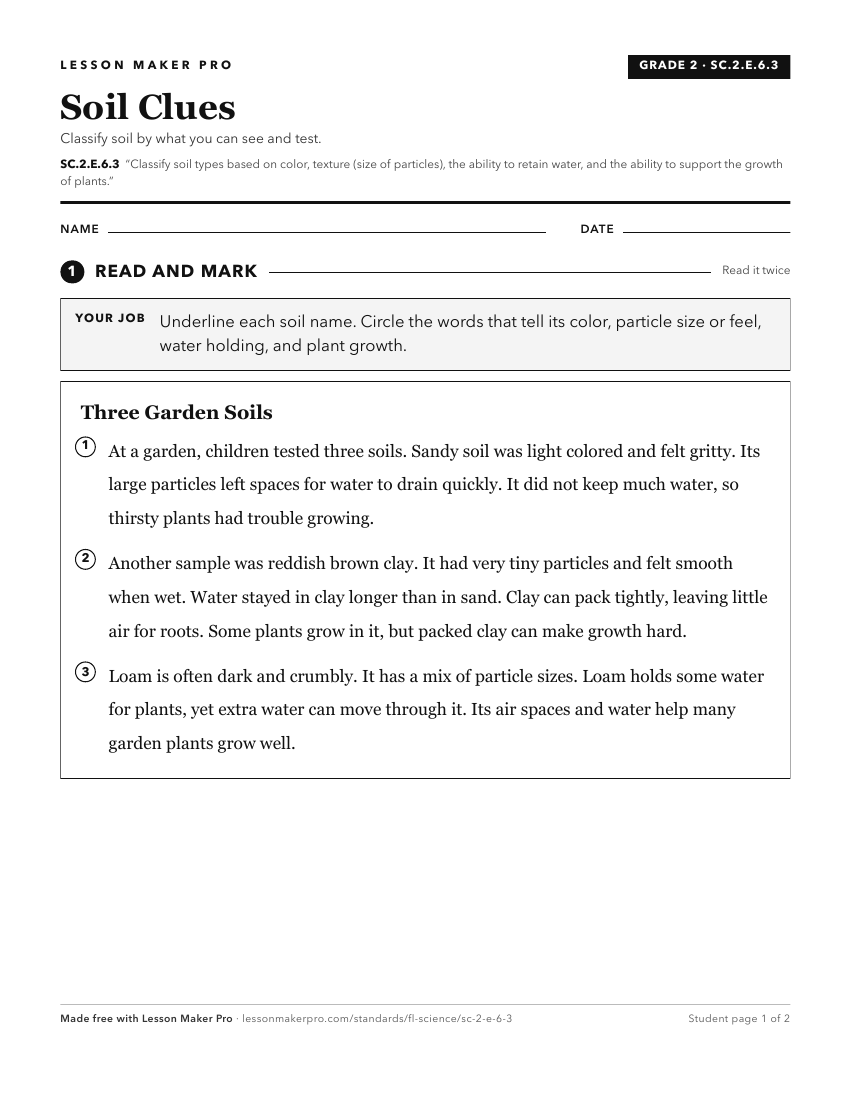
A ready-to-print activity worksheet aligned to SC.2.E.6.3, with an answer key for the teacher on its own page. No account needed.
PDF, US Letter, prints cleanly in black and white.
Download the worksheetKeep exploring
Related Standards
- SC.3.L.15.2
Classify flowering and nonflowering plants into major groups such as those that produce seeds, or those like ferns and mosses that produce spores, according to ...
- SC.8.P.8.4
Classify and compare substances on the basis of characteristic physical properties that can be demonstrated or measured; for example, density, thermal or electr...
- SC.3.P.8.3
Compare materials and objects according to properties such as size, shape, color, texture, and hardness.
- SC.4.E.6.2
Identify the physical properties of common earth-forming minerals, including hardness, color, luster, cleavage, and streak color, and recognize the role of mine...
Turn this exact standard into a lesson
Grade, subject, topic, and the complete standard are prefilled. Create one free, no account needed.
Also for this standard:Make a WorksheetMake a QuizMake a Sub Lesson