Florida SC.4.E.6.2
The Standard
Identify the physical properties of common earth-forming minerals, including hardness, color, luster, cleavage, and streak color, and recognize the role of minerals in the formation of rocks.
Florida Next Generation Sunshine State Standards for Science
Teacher's field guide
What This Standard Means
What Students Need to Do
- Students examine mineral samples and gather evidence with scratch tests, streak plates, reflected light, and break patterns. They explain that rocks are made from one or more minerals.
What Mastery Looks Like
- Students distinguish surface color from streak color and correctly describe hardness, luster, and cleavage. They use several observations to identify an unknown mineral and explain how minerals combine in rocks.
Common Misconceptions
- Students may identify a mineral by color alone or assume its streak always matches its surface. They may confuse hardness with resistance to breaking, or mistake any broken edge for cleavage.
How to Assess It
- Give students a mineral property chart and observations for one unknown sample. Ask them to name the mineral, cite two supporting properties, and explain its connection to rocks.
Lesson moves
Ways to Teach It
At stations, students test quartz, calcite, mica, and talc with fingernails, pennies, streak plates, and flashlights, then record evidence.
Ask students to write: Why can two minerals look alike but leave different evidence during identification tests?
Play Mineral Detective: teams match mystery sample cards to a property chart and earn a point only when they cite two observations.
Inspect granite countertop or tile samples, identify visible mineral grains, and list ways those minerals affect color, shine, or durability.
Free download
Printable SC.4.E.6.2 Worksheet
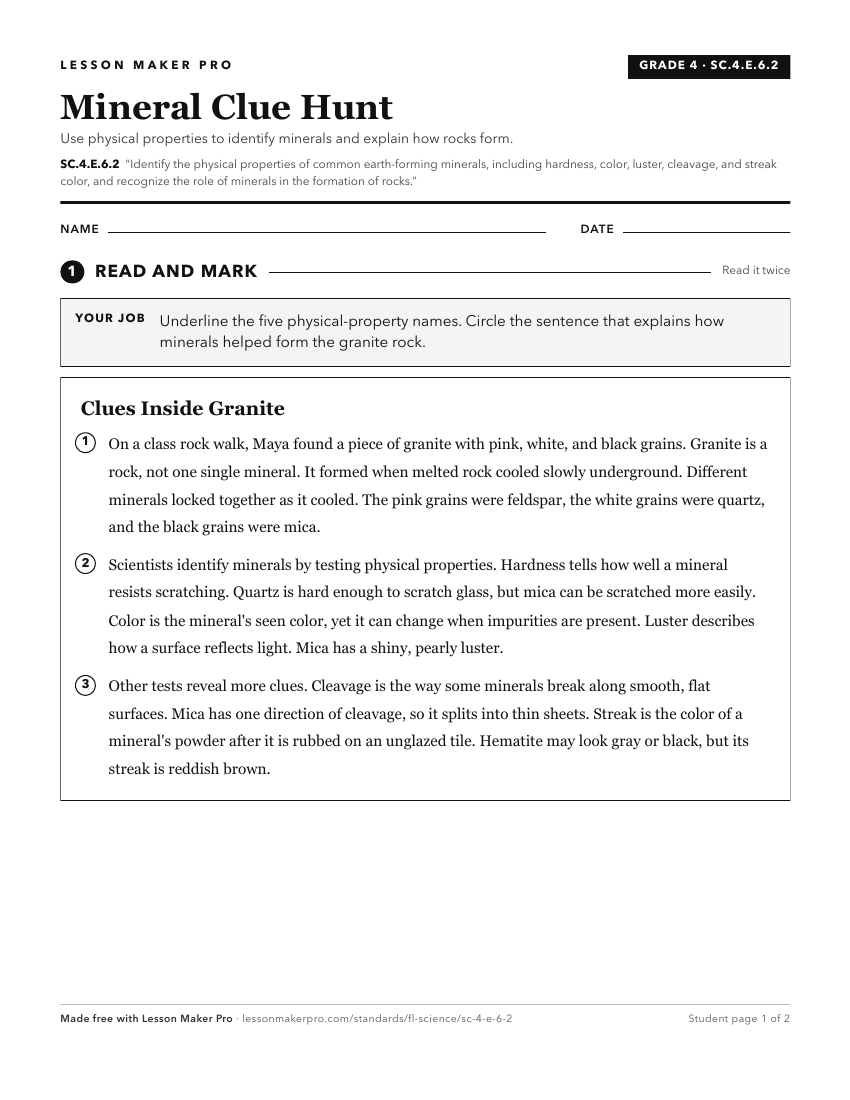
A ready-to-print activity worksheet aligned to SC.4.E.6.2, with an answer key for the teacher on its own page. No account needed.
PDF, US Letter, prints cleanly in black and white.
Download the worksheetKeep exploring
Related Standards
- SC.4.P.8.1
Measure and compare objects and materials based on their physical properties including: mass, shape, volume, color, hardness, texture, odor, taste, attraction t...
- SC.8.P.8.8
Identify basic examples of and compare and classify the properties of compounds, including acids, bases, and salts.
- SC.2.E.6.1
Recognize that Earth is made up of rocks. Rocks come in many sizes and shapes.
- SC.3.P.8.3
Compare materials and objects according to properties such as size, shape, color, texture, and hardness.
Turn this exact standard into a lesson
Grade, subject, topic, and the complete standard are prefilled. Create one free, no account needed.
Also for this standard:Make a WorksheetMake a QuizMake a Sub Lesson