Florida SC.2.E.6.1
The Standard
Recognize that Earth is made up of rocks. Rocks come in many sizes and shapes.
Florida Next Generation Sunshine State Standards for Science
Teacher's field guide
What This Standard Means
What Students Need to Do
- Students connect rocks to the solid ground and landforms around them. They identify rocks even when examples differ greatly in size or shape.
What Mastery Looks Like
- A student can identify a pebble, rounded river rock, and jagged boulder as rocks. The student can explain that size and shape do not determine whether something is a rock.
Common Misconceptions
- Students may think only small, loose stones count as rocks, while cliffs and boulders do not. They may believe every rock is gray, smooth, or about the same size.
How to Assess It
- Display pictures of a pebble, boulder, brick, and leaf. Ask students to circle the natural rocks and explain how both examples can be rocks.
Lesson moves
Ways to Teach It
Give pairs a tray of five rocks, then have them sort by size and shape and explain two different groupings.
Show a pebble and a boulder, then ask, “How can both be rocks when they look so different?”
Play Rock Detective with picture cards of rocks and nonrocks. Students hold up R or N cards and justify each choice.
Walk around the school grounds to find rocks in gravel, landscaping, or exposed soil, then sketch the largest and smallest examples.
Free download
Printable SC.2.E.6.1 Worksheet
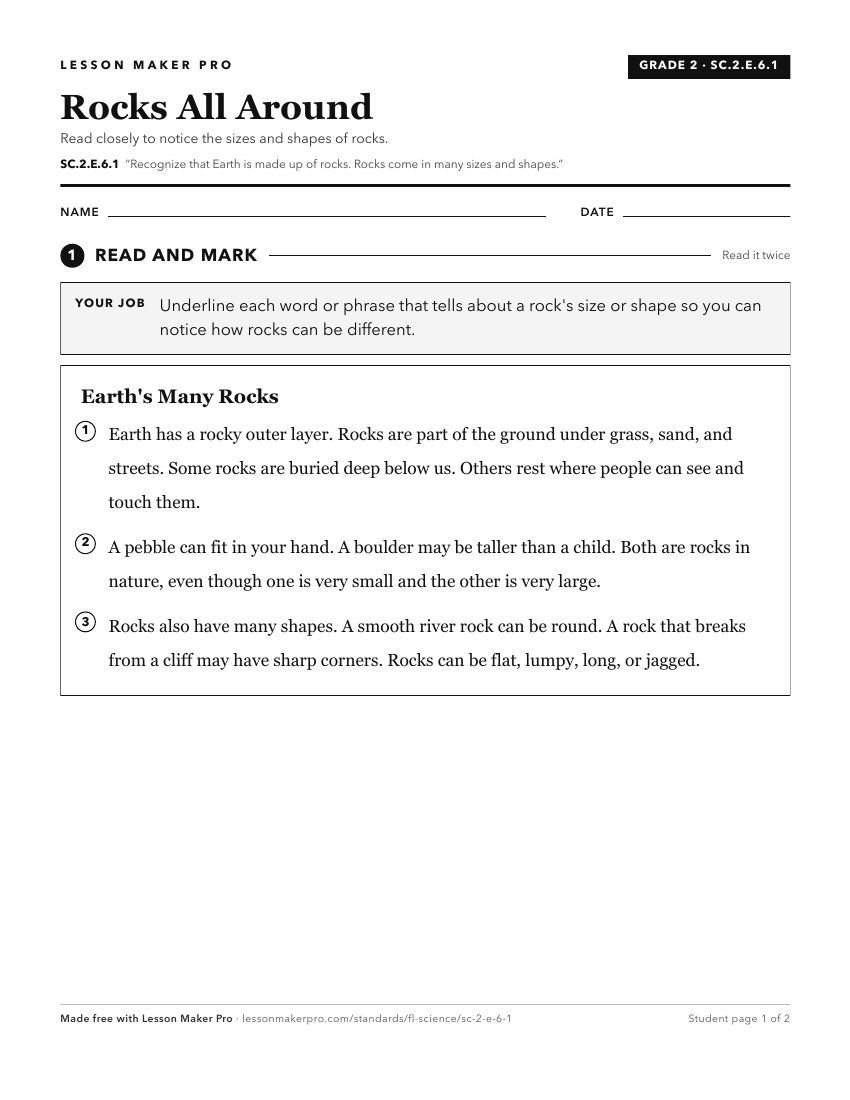
A ready-to-print activity worksheet aligned to SC.2.E.6.1, with an answer key for the teacher on its own page. No account needed.
PDF, US Letter, prints cleanly in black and white.
Download the worksheetKeep exploring
Related Standards
- SC.1.E.6.1
Recognize that water, rocks, soil, and living organisms are found on Earth's surface.
- SC.8.P.8.5
Recognize that there are a finite number of elements and that their atoms combine in a multitude of ways to produce compounds that make up all of the living and...
- SC.4.E.6.2
Identify the physical properties of common earth-forming minerals, including hardness, color, luster, cleavage, and streak color, and recognize the role of mine...
- SC.K.E.5.5
Observe that things can be big and things can be small as seen from Earth.
Turn this exact standard into a lesson
Grade, subject, topic, and the complete standard are prefilled. Create one free, no account needed.
Also for this standard:Make a WorksheetMake a QuizMake a Sub Lesson