Florida SC.8.P.8.5
The Standard
Recognize that there are a finite number of elements and that their atoms combine in a multitude of ways to produce compounds that make up all of the living and nonliving things that we encounter.
Florida Next Generation Sunshine State Standards for Science
Teacher's field guide
What This Standard Means
What Students Need to Do
- Students identify elements as the limited set of atomic building blocks. They explain how atoms join in different types, numbers, and arrangements to form many compounds in living and nonliving matter.
What Mastery Looks Like
- Students use formulas or models to name the elements in a compound and count each type of atom. They distinguish a compound from an element or mixture.
Common Misconceptions
- Students may think compounds are simple mixtures or that atoms lose their identities when bonded. They may also think changing atom ratios produces the same compound.
How to Assess It
- Give students models of H2O, CO2, and O2. Ask them to identify the elements, count the atoms, and explain which models represent compounds.
Lesson moves
Ways to Teach It
Use colored beads and pipe cleaners to build models of water, carbon dioxide, oxygen, and glucose, then compare their atoms.
Ask students to explain how a small set of letter tiles can model elements forming many different compounds.
Play a card-matching game that pairs compound formulas with atom counts, molecular models, and familiar substance names.
Examine labels from water, salt, and sugar products, then use formula cards to identify the elements present.
Free download
Printable SC.8.P.8.5 Worksheet
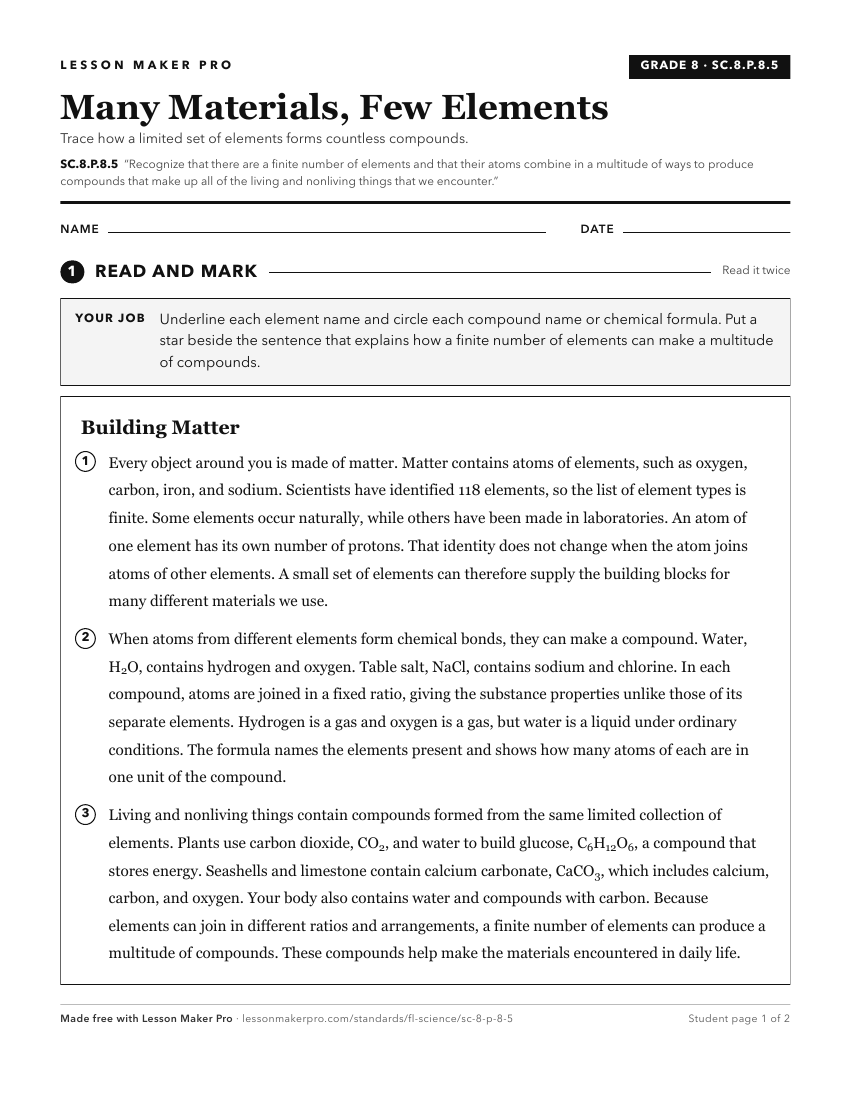
A ready-to-print activity worksheet aligned to SC.8.P.8.5, with an answer key for the teacher on its own page. No account needed.
PDF, US Letter, prints cleanly in black and white.
Download the worksheetKeep exploring
Related Standards
- SC.1.E.6.1
Recognize that water, rocks, soil, and living organisms are found on Earth's surface.
- SC.2.E.6.1
Recognize that Earth is made up of rocks. Rocks come in many sizes and shapes.
- SC.8.P.8.6
Recognize that elements are grouped in the periodic table according to similarities of their properties.
- SC.5.P.8.4
Explore the scientific theory of atoms (also called atomic theory) by recognizing that all matter is composed of parts that are too small to be seen without mag...
Turn this exact standard into a lesson
Grade, subject, topic, and the complete standard are prefilled. Create one free, no account needed.
Also for this standard:Make a WorksheetMake a QuizMake a Sub Lesson