Florida SC.5.P.8.4
The Standard
Explore the scientific theory of atoms (also called atomic theory) by recognizing that all matter is composed of parts that are too small to be seen without magnification.
Florida Next Generation Sunshine State Standards for Science
Teacher's field guide
What This Standard Means
What Students Need to Do
- Students explain that solids, liquids, and gases are built from extremely small particles. They use observations and particle models to explain why those particles may not be visible.
What Mastery Looks Like
- A student can describe a desk, water, and air as collections of tiny particles. They can model dissolved sugar and explain that invisible does not mean gone.
Common Misconceptions
- Students may think only powders contain particles, or that dissolved substances no longer exist. They may also think a classroom microscope can show individual atoms.
How to Assess It
- Ask students to draw sugar water before and after the sugar dissolves. Have them explain what happened to the sugar particles and why they cannot see them.
Lesson moves
Ways to Teach It
Mix salt into warm water, observe the change, then recover the salt by examining a prepared dish where salt water has evaporated.
Ask students to explain in writing, If air is invisible, how can it still be matter made of particles?
Sort picture cards showing objects, microscope images, and particle models, then match each object with its closest view and model.
Examine nutrition labels and discuss how dissolved sugar remains in clear drinks even when no sugar grains are visible.
Free download
Printable SC.5.P.8.4 Worksheet
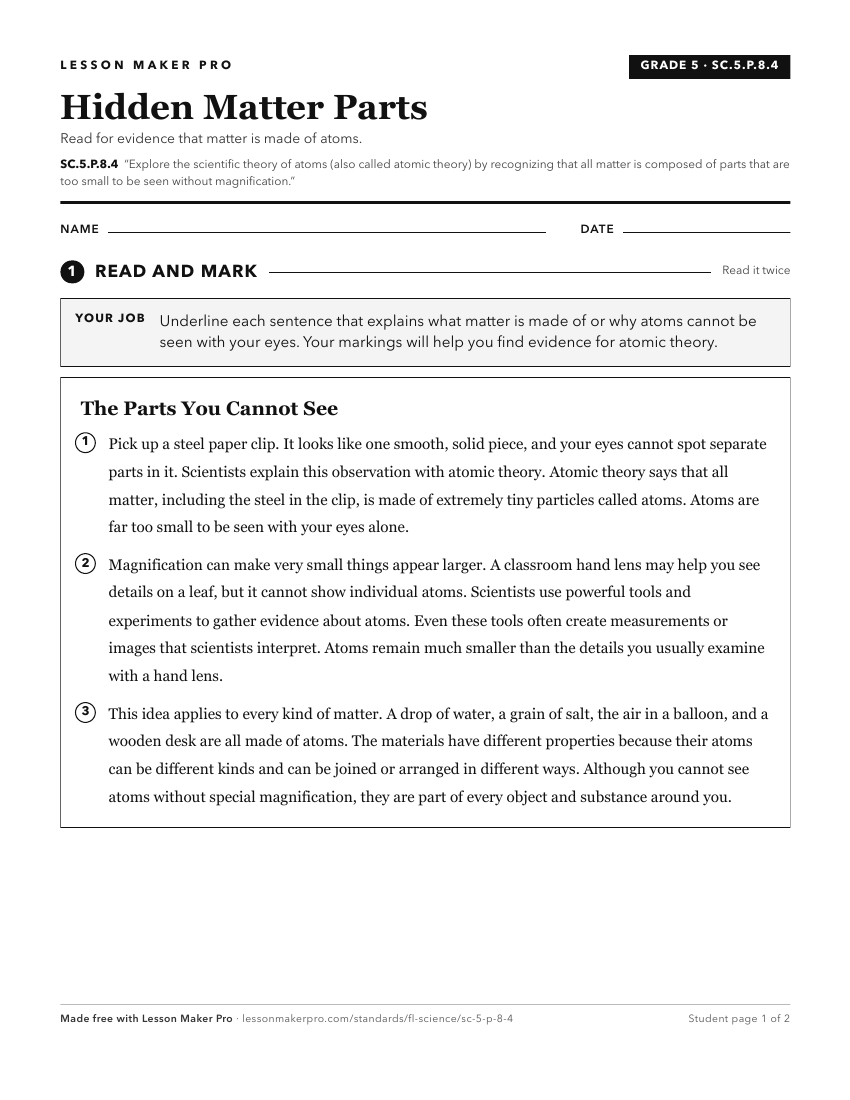
A ready-to-print activity worksheet aligned to SC.5.P.8.4, with an answer key for the teacher on its own page. No account needed.
PDF, US Letter, prints cleanly in black and white.
Download the worksheetKeep exploring
Related Standards
- SC.8.P.8.7
Explore the scientific theory of atoms (also known as atomic theory) by recognizing that atoms are the smallest unit of an element and are composed of sub-atomi...
- SC.8.P.8.1
Explore the scientific theory of atoms (also known as atomic theory) by using models to explain the motion of particles in solids, liquids, and gases.
- SC.8.P.8.5
Recognize that there are a finite number of elements and that their atoms combine in a multitude of ways to produce compounds that make up all of the living and...
- SC.6.L.14.2
Investigate and explain the components of the scientific theory of cells (cell theory): all organisms are composed of cells (single-celled or multi-cellular), a...
Turn this exact standard into a lesson
Grade, subject, topic, and the complete standard are prefilled. Create one free, no account needed.
Also for this standard:Make a WorksheetMake a QuizMake a Sub Lesson