Florida SC.8.P.8.4
The Standard
Classify and compare substances on the basis of characteristic physical properties that can be demonstrated or measured; for example, density, thermal or electrical conductivity, solubility, magnetic properties, melting and boiling points, and know that these properties are independent of the amount of the sample.
Florida Next Generation Sunshine State Standards for Science
Teacher's field guide
What This Standard Means
What Students Need to Do
- Students measure or observe several physical properties, then use the results to classify known and unknown substances. They explain why changing sample size changes mass and volume but not characteristic properties such as density.
What Mastery Looks Like
- Students can calculate density, interpret test results, and identify an unknown substance using more than one property. They can explain why two different-sized samples of the same substance share characteristic properties.
Common Misconceptions
- Students may treat mass, volume, color, or shape as reliable identifiers. They may think a larger sample has greater density or a different melting point. They may also confuse solubility with the amount of material placed in the solvent.
How to Assess It
- Exit ticket: A 10 cm³ sample has a mass of 27 g, and a 20 cm³ sample has a mass of 54 g. Calculate both densities and explain whether the samples could be the same substance.
Lesson moves
Ways to Teach It
Use a balance, graduated cylinder, magnet, simple circuit, and water to test coded solids, then match each solid to a property card.
Ask students to write: Why can density identify a substance more reliably than mass? Use two different-sized aluminum samples as evidence.
Play Property Sort, with teams placing cards under characteristic or noncharacteristic, then earning points for accurate explanations.
Give teams steel, aluminum, and plastic recycling samples, then have them design a sorting process using magnetism, conductivity, and density.
Free download
Printable SC.8.P.8.4 Worksheet
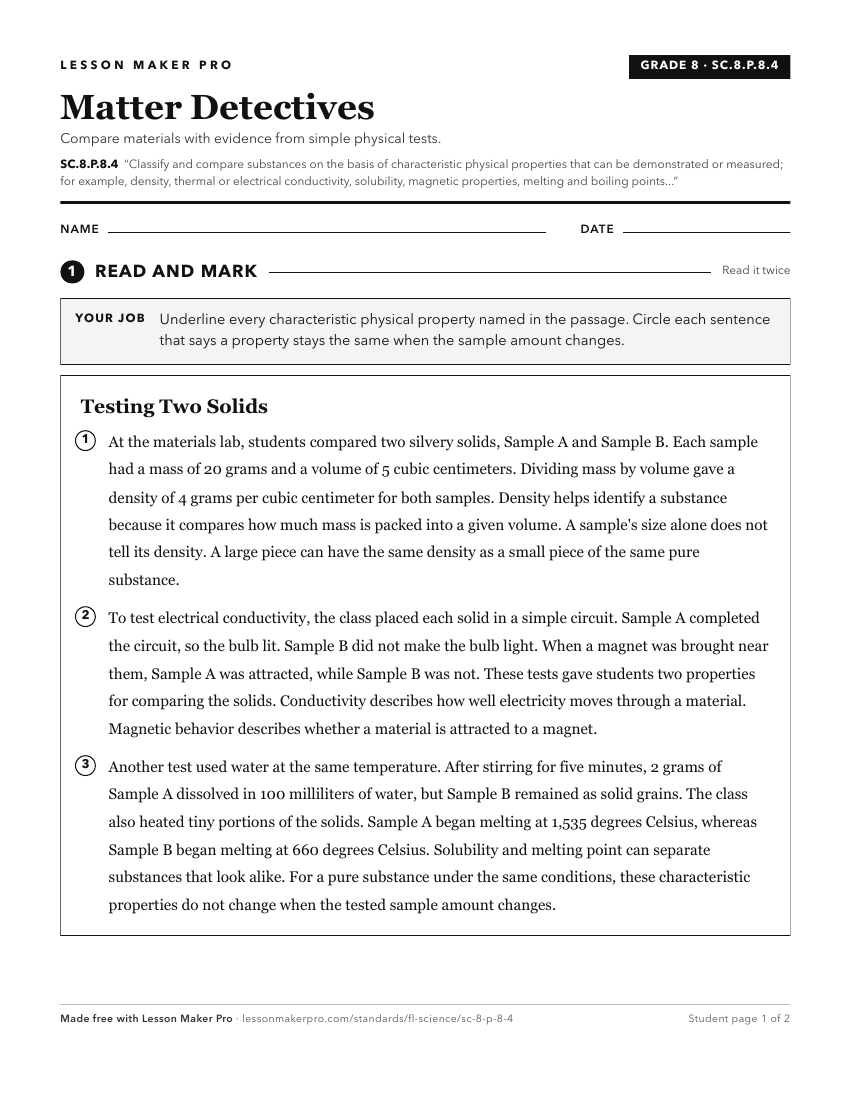
A ready-to-print activity worksheet aligned to SC.8.P.8.4, with an answer key for the teacher on its own page. No account needed.
PDF, US Letter, prints cleanly in black and white.
Download the worksheetKeep exploring
Related Standards
- SC.4.P.8.1
Measure and compare objects and materials based on their physical properties including: mass, shape, volume, color, hardness, texture, odor, taste, attraction t...
- SC.8.P.8.8
Identify basic examples of and compare and classify the properties of compounds, including acids, bases, and salts.
- SC.2.P.8.1
Observe and measure objects in terms of their properties, including size, shape, color, temperature, weight, texture, sinking or floating in water, and attracti...
- SC.5.P.8.3
Demonstrate and explain that mixtures of solids can be separated based on observable properties of their parts such as particle size, shape, color, and magnetic...
Turn this exact standard into a lesson
Grade, subject, topic, and the complete standard are prefilled. Create one free, no account needed.
Also for this standard:Make a WorksheetMake a QuizMake a Sub Lesson