Florida SC.8.E.5.9
The Standard
Explain the impact of objects in space on each other including: the Sun on the Earth including seasons and gravitational attraction the Moon on the Earth, including phases, tides, and eclipses, and the relative position of each body.
Florida Next Generation Sunshine State Standards for Science
Teacher's field guide
What This Standard Means
What Students Need to Do
- Students interpret and draw Sun, Earth, and Moon models from different viewpoints. They use Earth's tilt, sunlight, orbital positions, and gravity to explain seasons, lunar phases, tides, and eclipses.
What Mastery Looks Like
- Given a diagram, students identify the season, Moon phase, tide pattern, or eclipse and justify the answer using relative positions. They connect gravity to orbits and tides, and sunlight angle to seasonal temperature changes.
Common Misconceptions
- Students often think seasons result from changes in Earth's distance from the Sun. They may confuse Moon phases with Earth's shadow or expect an eclipse every month. They may also overlook the Moon's role in tides.
How to Assess It
- Give students one Sun, Earth, and Moon diagram. Ask them to identify one resulting event and explain it using position, sunlight, tilt, or gravity.
Lesson moves
Ways to Teach It
Use a lamp, globe, foam Moon, and two clay tide bulges to model seasons, phases, tides, and eclipses from changing positions.
Ask students to explain why June is winter in Australia while Florida has summer, using Earth's tilt and the angle of sunlight.
Run a card sort matching Sun, Earth, and Moon diagrams to season, phase, tide, and eclipse explanation cards.
Compare a local tide table with Moon phase dates, then have students describe the pattern in high and low tides.
Free download
Printable SC.8.E.5.9 Worksheet
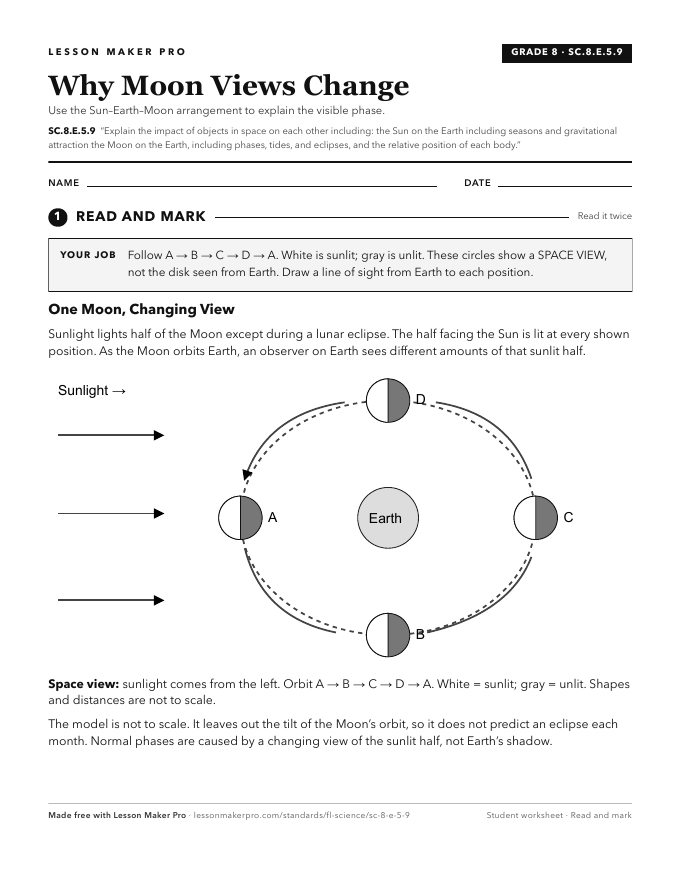
A ready-to-print activity worksheet aligned to SC.8.E.5.9, with an answer key for the teacher on its own page. No account needed.
PDF, US Letter, prints cleanly in black and white.
Download the worksheetKeep exploring
Related Standards
- SC.8.E.5.3
Distinguish the hierarchical relationships between planets and other astronomical bodies relative to solar system, galaxy, and universe, including distance, siz...
- SC.5.E.5.3
Distinguish among the following objects of the Solar System -- Sun, planets, moons, asteroids, comets -- and identify Earth's position in it.
- SC.4.E.5.4
Relate that the rotation of Earth (day and night) and apparent movements of the Sun, Moon, and stars are connected.
- SC.8.E.5.7
Compare and contrast the properties of objects in the Solar System including the Sun, planets, and moons to those of Earth, such as gravitational force, distanc...
Turn this exact standard into a lesson
Grade, subject, topic, and the complete standard are prefilled. Create one free, no account needed.
Also for this standard:Make a WorksheetMake a QuizMake a Sub Lesson