Florida SC.8.E.5.3
The Standard
Distinguish the hierarchical relationships between planets and other astronomical bodies relative to solar system, galaxy, and universe, including distance, size, and composition.
Florida Next Generation Sunshine State Standards for Science
Teacher's field guide
What This Standard Means
What Students Need to Do
- Students place moons, planets, stars, solar systems, and galaxies into the correct nested levels. They compare examples by relative distance, size, and composition, such as rocky, gaseous, icy, or plasma.
What Mastery Looks Like
- Students can build and label an accurate diagram showing which objects belong within larger structures. They can justify size, distance, and composition comparisons using clear evidence.
Common Misconceptions
- Students often confuse a solar system with a galaxy or think the universe is one galaxy. They may use apparent size instead of actual size. Some describe stars as burning rocks or gas giants as having solid surfaces.
How to Assess It
- Exit ticket: Order Moon, Earth, solar system, Milky Way, and universe from smallest scale to largest. Then compare Earth and the Sun by size and composition.
Lesson moves
Ways to Teach It
Use nested hoops and labeled object cards to build a floor model from moons and planets through the solar system, galaxy, and universe.
Correct this claim in writing: The solar system contains the Milky Way. Use the words contains, smaller, and farther.
Play a card sort race: group objects by location and composition, then rank selected pairs by size and typical distance.
Build a scale model with a basketball Sun and peppercorn Earth, then estimate where the nearest star would lie beyond campus.
Free download
Printable SC.8.E.5.3 Worksheet
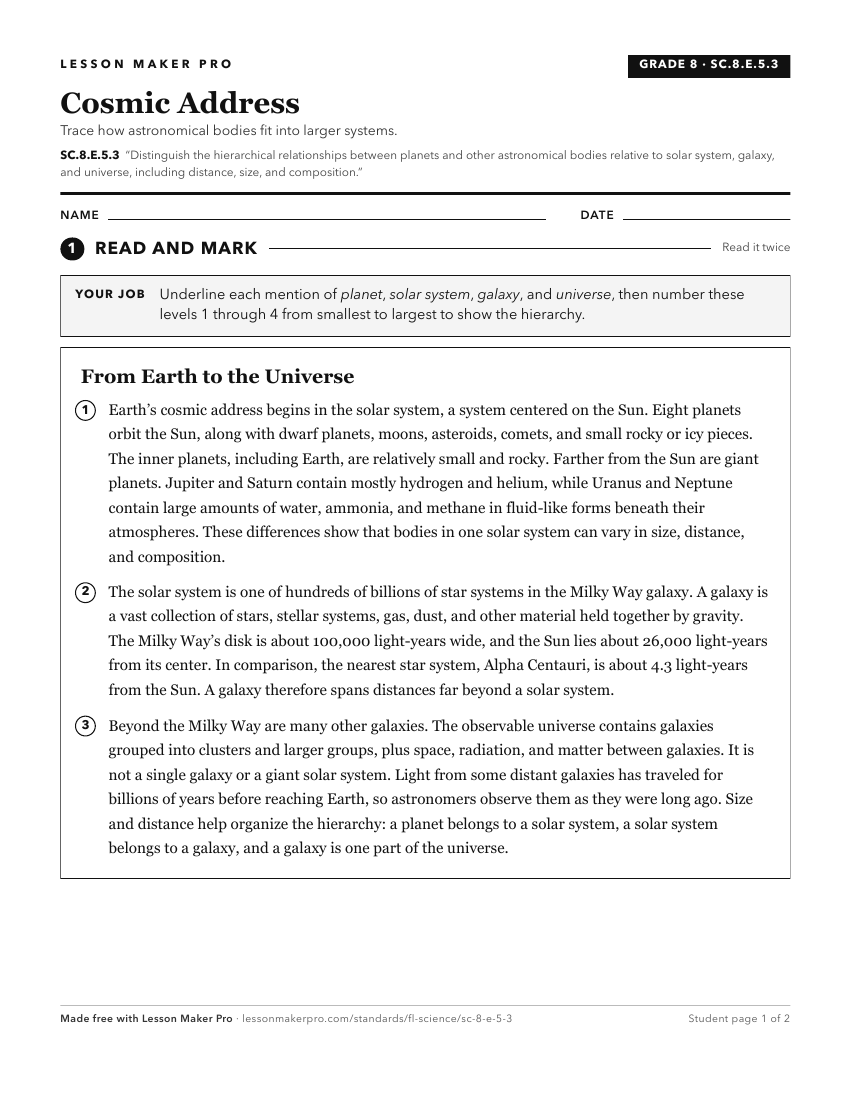
A ready-to-print activity worksheet aligned to SC.8.E.5.3, with an answer key for the teacher on its own page. No account needed.
PDF, US Letter, prints cleanly in black and white.
Download the worksheetKeep exploring
Related Standards
- SC.5.E.5.2
Recognize the major common characteristics of all planets and compare/contrast the properties of inner and outer planets.
- SC.5.E.5.3
Distinguish among the following objects of the Solar System -- Sun, planets, moons, asteroids, comets -- and identify Earth's position in it.
- SC.8.E.5.1
Recognize that there are enormous distances between objects in space and apply our knowledge of light and space travel to understand this distance.
- SC.8.E.5.7
Compare and contrast the properties of objects in the Solar System including the Sun, planets, and moons to those of Earth, such as gravitational force, distanc...
Turn this exact standard into a lesson
Grade, subject, topic, and the complete standard are prefilled. Create one free, no account needed.
Also for this standard:Make a WorksheetMake a QuizMake a Sub Lesson