Florida SC.5.E.5.2
The Standard
Recognize the major common characteristics of all planets and compare/contrast the properties of inner and outer planets.
Florida Next Generation Sunshine State Standards for Science
Teacher's field guide
What This Standard Means
What Students Need to Do
- Students identify traits shared by the eight planets, such as orbiting the Sun, rotating, having gravity, and being nearly spherical. They compare rocky inner planets with larger gas and ice giants using size, composition, temperature, moons, rings, and orbit length.
What Mastery Looks Like
- Students correctly sort planets into inner and outer groups and explain the basis for the sort. They support comparisons with specific facts, such as inner planets having solid surfaces and outer planets having many moons.
Common Misconceptions
- Students may think all planets have solid ground, rings, or similar temperatures. They may also confuse planet order, assume larger planets are closer to the Sun, or call Pluto one of the eight planets.
How to Assess It
- Give students an exit ticket with Earth and Saturn. Ask them to name two shared traits and three differences, including composition and location.
Lesson moves
Ways to Teach It
Give groups planet fact cards, hoops, and labels to sort the planets by location, composition, size, rings, and number of moons.
Ask students to write: Which would be harder to visit, Mercury or Neptune, and what planet facts support your answer?
Play Planet Guess Who using clue cards about surface, size, moons, rings, temperature, and distance from the Sun.
Have teams choose a planet for a robotic mission and list three design needs based on that planet’s conditions.
Free download
Printable SC.5.E.5.2 Worksheet
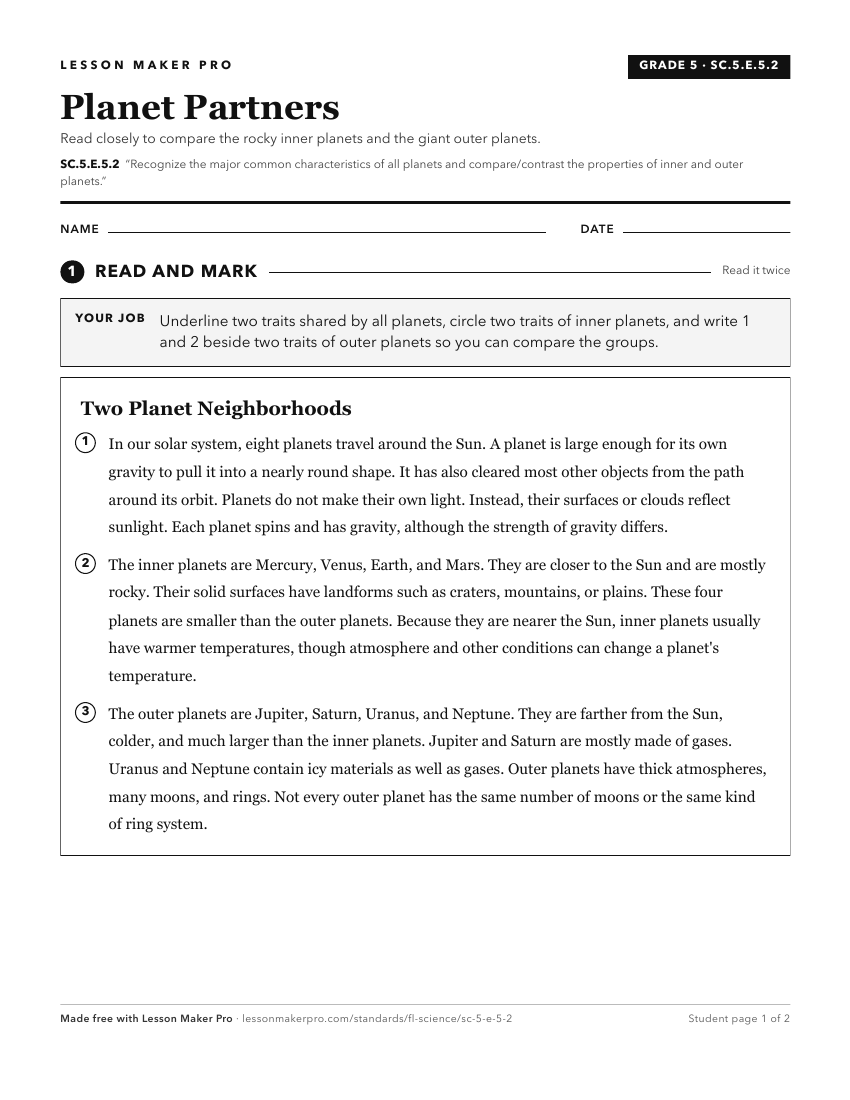
A ready-to-print activity worksheet aligned to SC.5.E.5.2, with an answer key for the teacher on its own page. No account needed.
PDF, US Letter, prints cleanly in black and white.
Download the worksheetKeep exploring
Related Standards
- SC.8.E.5.3
Distinguish the hierarchical relationships between planets and other astronomical bodies relative to solar system, galaxy, and universe, including distance, siz...
- SC.5.E.5.3
Distinguish among the following objects of the Solar System -- Sun, planets, moons, asteroids, comets -- and identify Earth's position in it.
- SC.8.E.5.8
Compare various historical models of the Solar System, including geocentric and heliocentric.
- SC.8.E.5.7
Compare and contrast the properties of objects in the Solar System including the Sun, planets, and moons to those of Earth, such as gravitational force, distanc...
Turn this exact standard into a lesson
Grade, subject, topic, and the complete standard are prefilled. Create one free, no account needed.
Also for this standard:Make a WorksheetMake a QuizMake a Sub Lesson