Florida SC.8.E.5.8
The Standard
Compare various historical models of the Solar System, including geocentric and heliocentric.
Florida Next Generation Sunshine State Standards for Science
Teacher's field guide
What This Standard Means
What Students Need to Do
- Students identify what is placed at the center of each model and describe how the Sun, Earth, and planets move. They compare how each model explains observed patterns, such as daily sky motion and retrograde motion.
What Mastery Looks Like
- Students can label and explain geocentric and heliocentric diagrams without mixing up their centers. They can name evidence that supported changing the accepted model and explain why later models predicted planetary motion better.
Common Misconceptions
- Students may think geocentric means Earth is flat, or that heliocentric means the Sun is the center of the universe. They may also treat apparent motion across the sky as proof that the Sun and planets orbit Earth.
How to Assess It
- Exit ticket: Draw and label both models, then explain one observation that the heliocentric model explains more accurately. Require students to use the words orbit and apparent motion.
Lesson moves
Ways to Teach It
Use a lamp, globe, and foam ball to model planetary motion from Earth-centered and Sun-centered viewpoints.
Ask students to write which model they would accept using only naked-eye observations, then defend their choice with two observations.
Play a card sort matching diagrams, model features, scientists, and observations to geocentric, heliocentric, or later elliptical models.
Use a sky-tracking app to examine Mars's apparent retrograde motion and explain how Earth's orbit produces the observed path.
Free download
Printable SC.8.E.5.8 Worksheet
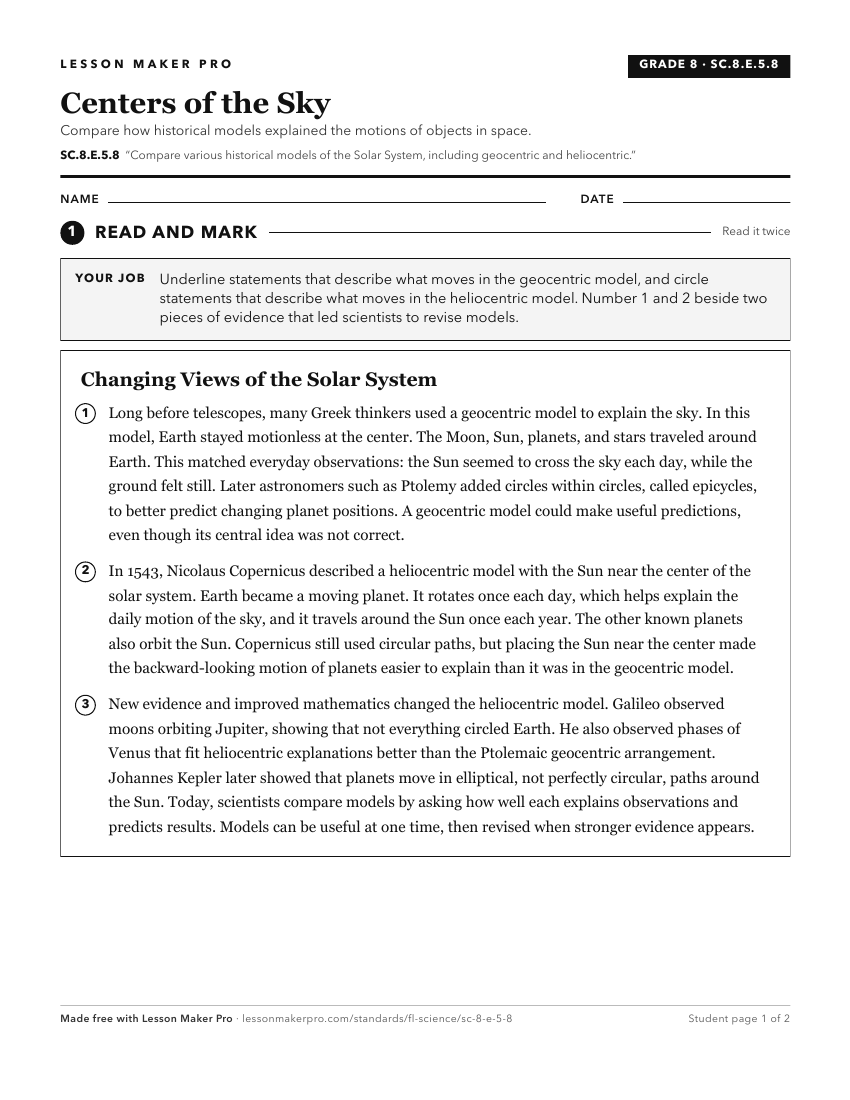
A ready-to-print activity worksheet aligned to SC.8.E.5.8, with an answer key for the teacher on its own page. No account needed.
PDF, US Letter, prints cleanly in black and white.
Download the worksheetKeep exploring
Related Standards
- SC.8.E.5.3
Distinguish the hierarchical relationships between planets and other astronomical bodies relative to solar system, galaxy, and universe, including distance, siz...
- SC.5.E.5.3
Distinguish among the following objects of the Solar System -- Sun, planets, moons, asteroids, comets -- and identify Earth's position in it.
- SC.8.E.5.6
Create models of solar properties including: rotation, structure of the Sun, convection, sunspots, solar flares, and prominences.
- SC.8.E.5.7
Compare and contrast the properties of objects in the Solar System including the Sun, planets, and moons to those of Earth, such as gravitational force, distanc...
Turn this exact standard into a lesson
Grade, subject, topic, and the complete standard are prefilled. Create one free, no account needed.
Also for this standard:Make a WorksheetMake a QuizMake a Sub Lesson