Florida SC.5.E.5.3
The Standard
Distinguish among the following objects of the Solar System -- Sun, planets, moons, asteroids, comets -- and identify Earth's position in it.
Florida Next Generation Sunshine State Standards for Science
Teacher's field guide
What This Standard Means
What Students Need to Do
- Students identify each type of Solar System object by what it is and what it orbits. They locate Earth as the third planet from the Sun and recognize that the Moon orbits Earth.
What Mastery Looks Like
- Given pictures or descriptions, students correctly classify the Sun, planets, moons, asteroids, and comets. They place Earth in the correct position and explain the basic differences among the objects.
Common Misconceptions
- Students may call the Sun a planet or place Earth at the center of the Solar System. They may confuse moons with planets, or assume asteroids and comets are the same kind of object.
How to Assess It
- Exit ticket: Match five object descriptions to Sun, planet, moon, asteroid, or comet, then mark Earth's position on a simple Solar System diagram.
Lesson moves
Ways to Teach It
Use a lamp, foam balls, beads, pebbles, and a clay comet to build and label a tabletop Solar System model.
Write a comparison of an asteroid and a comet, including what each is made of and how it moves.
Play a card sort relay using object pictures, names, features, and orbit clues.
Examine NASA images of Solar System objects and create captions that name each object and explain its classification.
Free download
Printable SC.5.E.5.3 Worksheet
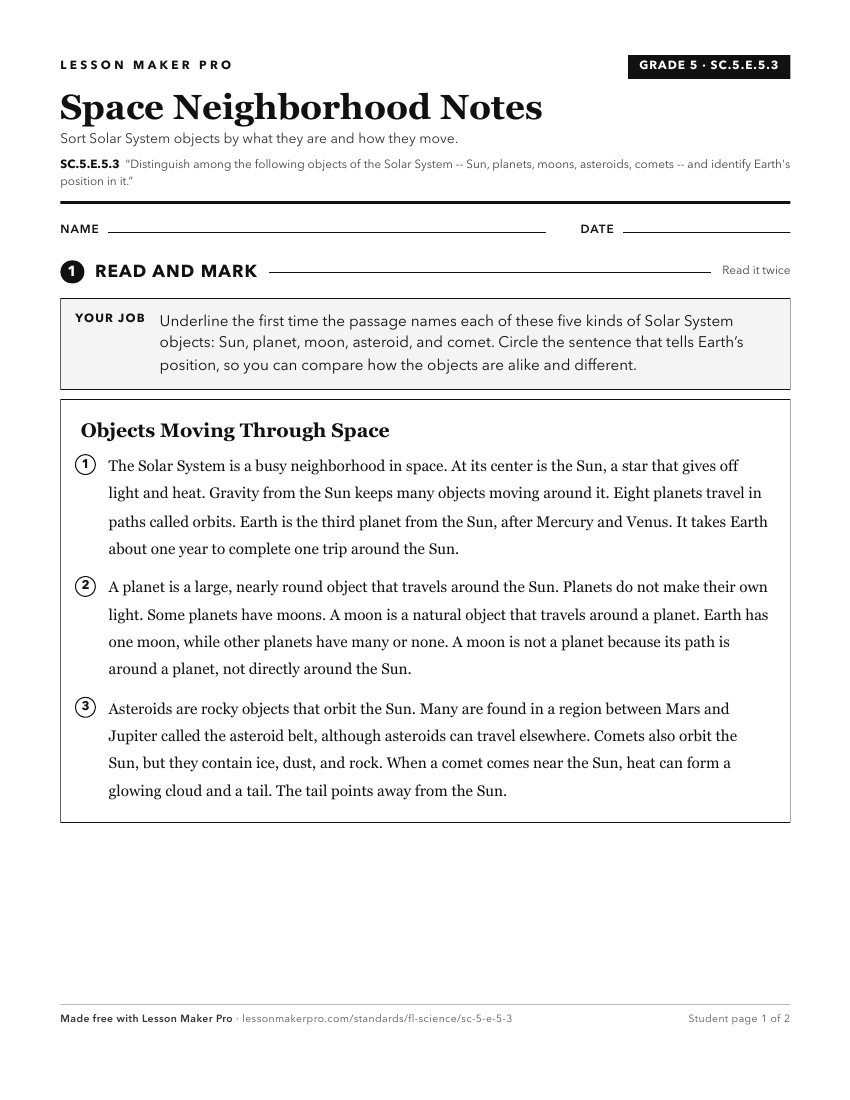
A ready-to-print activity worksheet aligned to SC.5.E.5.3, with an answer key for the teacher on its own page. No account needed.
PDF, US Letter, prints cleanly in black and white.
Download the worksheetKeep exploring
Related Standards
- SC.8.E.5.9
Explain the impact of objects in space on each other including: • the Sun on the Earth including seasons and gravitational attraction • the Moon on the Earth, i...
- SC.8.E.5.3
Distinguish the hierarchical relationships between planets and other astronomical bodies relative to solar system, galaxy, and universe, including distance, siz...
- SC.4.E.5.4
Relate that the rotation of Earth (day and night) and apparent movements of the Sun, Moon, and stars are connected.
- SC.8.E.5.7
Compare and contrast the properties of objects in the Solar System including the Sun, planets, and moons to those of Earth, such as gravitational force, distanc...
Turn this exact standard into a lesson
Grade, subject, topic, and the complete standard are prefilled. Create one free, no account needed.
Also for this standard:Make a WorksheetMake a QuizMake a Sub Lesson