Florida SC.8.E.5.11
The Standard
Identify and compare characteristics of the electromagnetic spectrum such as wavelength, frequency, use, and hazards and recognize its application to an understanding of planetary images and satellite photographs.
Florida Next Generation Sunshine State Standards for Science
Teacher's field guide
What This Standard Means
What Students Need to Do
- Students compare electromagnetic waves by wavelength, frequency, common uses, and possible hazards. They explain how sensors use different wavelengths to reveal features in planetary and satellite images.
What Mastery Looks Like
- Students correctly order the main wave types and describe the inverse relationship between wavelength and frequency. They can choose a useful wave type for observing clouds, heat, vegetation, or planetary surfaces and explain why.
Common Misconceptions
- Students may think higher frequency means longer wavelength or that all electromagnetic waves are equally harmful. They may also assume every satellite image shows visible light and natural color.
How to Assess It
- Give students an infrared satellite image and ask: What does this image detect, and what information can it show that a visible-light image may miss?
Lesson moves
Ways to Teach It
Use diffraction glasses to observe classroom light sources, then sketch and compare the visible spectra produced.
Write a claim explaining which wave type would best help scientists map heat on a planet.
Play a card-matching race pairing wave types with wavelength, frequency, uses, hazards, and satellite images.
Compare visible and infrared weather images from the same hour to identify clouds, temperatures, and storm patterns.
Free download
Printable SC.8.E.5.11 Worksheet
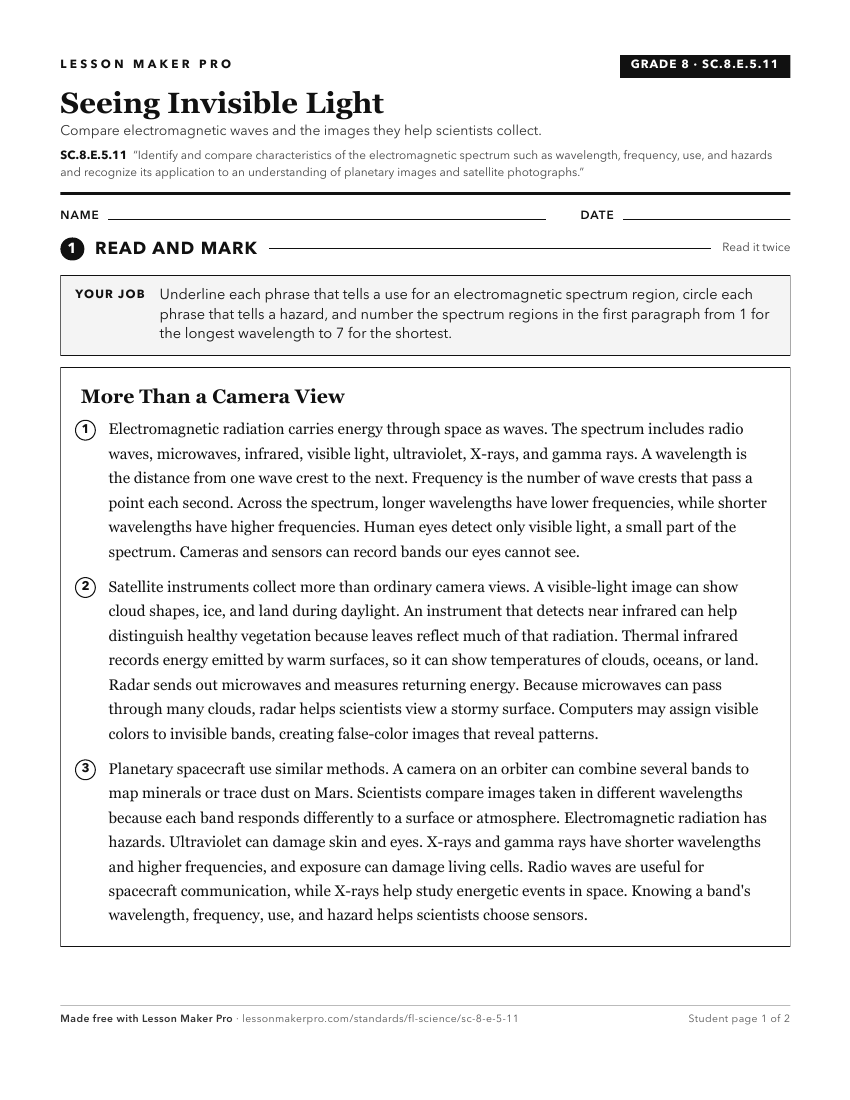
A ready-to-print activity worksheet aligned to SC.8.E.5.11, with an answer key for the teacher on its own page. No account needed.
PDF, US Letter, prints cleanly in black and white.
Download the worksheetKeep exploring
Related Standards
- SC.7.P.10.1
Illustrate that the sun's energy arrives as radiation with a wide range of wavelengths, including infrared, visible, and ultraviolet, and that white light is ma...
- SC.8.E.5.10
Assess how technology is essential to science for such purposes as access to outer space and other remote locations, sample collection, measurement, data collec...
- SC.1.E.5.4
Identify the beneficial and harmful properties of the Sun.
- SC.8.E.5.7
Compare and contrast the properties of objects in the Solar System including the Sun, planets, and moons to those of Earth, such as gravitational force, distanc...
Turn this exact standard into a lesson
Grade, subject, topic, and the complete standard are prefilled. Create one free, no account needed.
Also for this standard:Make a WorksheetMake a QuizMake a Sub Lesson