Florida SC.1.E.5.4
The Standard
Identify the beneficial and harmful properties of the Sun.
Florida Next Generation Sunshine State Standards for Science
Teacher's field guide
What This Standard Means
What Students Need to Do
- Students name ways the Sun helps Earth, such as providing light, warmth, and energy for plant growth. They also identify dangers from too much sunlight, including sunburn, eye damage, and overheating.
What Mastery Looks Like
- Students correctly sort examples as helpful, harmful, or both. They explain each choice and name safe actions such as using shade, hats, sunscreen, and water.
Common Misconceptions
- Students may think sunlight is harmful only on hot days or that looking at the Sun briefly is safe. They may also think plants grow from heat alone rather than sunlight, water, air, and nutrients.
How to Assess It
- Give students four pictures: a growing plant, daylight, a sunburn, and an overheated child. Have them label each helpful or harmful and explain one choice.
Lesson moves
Ways to Teach It
Give pairs picture cards showing plant growth, daylight, sunburn, and overheating, then have them sort the cards into helpful, harmful, or both.
Ask students to complete this prompt: The Sun helps us by ___, but too much sunlight can ___.
Read short Sun scenarios, then have students hold up a green helpful card or red harmful card and explain their choice.
Check the local UV forecast, then have students choose a hat, water, sunscreen, and shade for a safe playground plan.
Free download
Printable SC.1.E.5.4 Worksheet
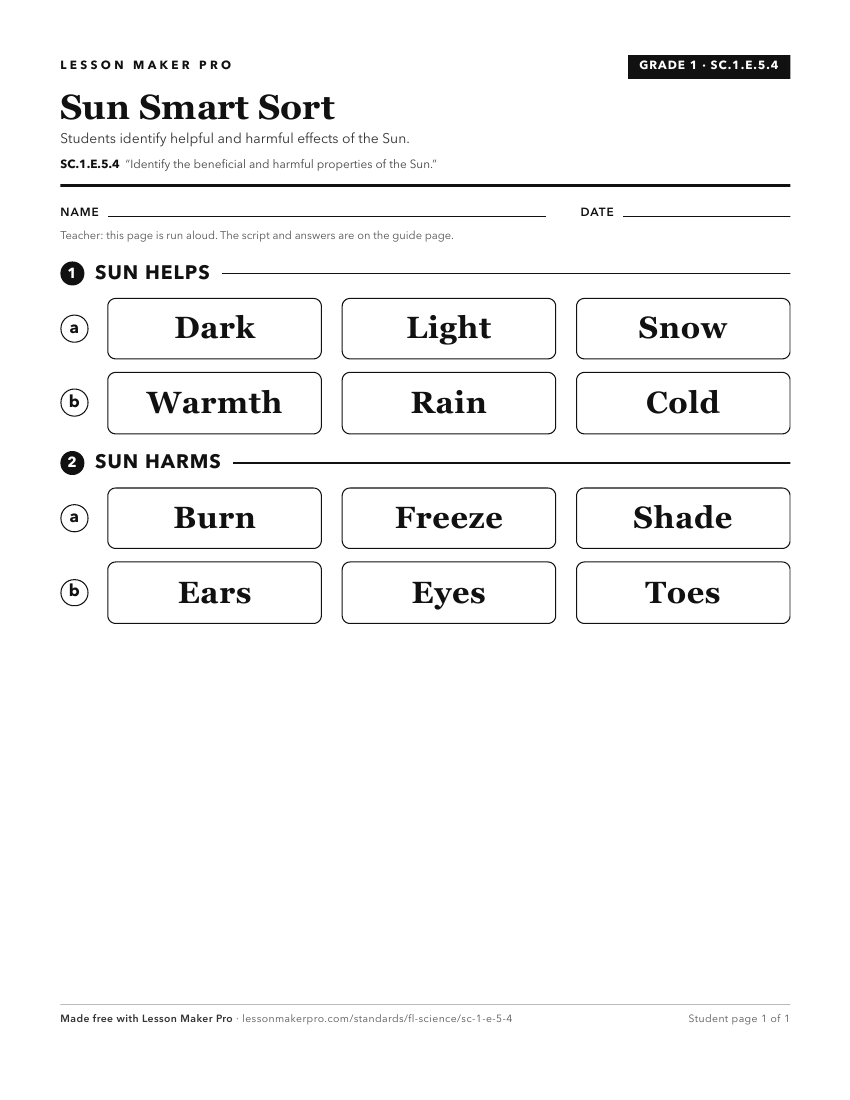
A ready-to-print activity worksheet aligned to SC.1.E.5.4, with an answer key for the teacher on its own page. No account needed.
PDF, US Letter, prints cleanly in black and white.
Download the worksheetKeep exploring
Related Standards
- SC.2.E.7.2
Investigate by observing and measuring, that the Sun's energy directly and indirectly warms the water, land, and air.
- SC.3.E.5.2
Identify the Sun as a star that emits energy; some of it in the form of light.
- SC.8.E.5.6
Create models of solar properties including: rotation, structure of the Sun, convection, sunspots, solar flares, and prominences.
- SC.8.E.5.7
Compare and contrast the properties of objects in the Solar System including the Sun, planets, and moons to those of Earth, such as gravitational force, distanc...
Turn this exact standard into a lesson
Grade, subject, topic, and the complete standard are prefilled. Create one free, no account needed.
Also for this standard:Make a WorksheetMake a QuizMake a Sub Lesson