Florida SC.7.L.17.2
The Standard
Compare and contrast the relationships among organisms such as mutualism, predation, parasitism, competition, and commensalism.
Florida Next Generation Sunshine State Standards for Science
Teacher's field guide
What This Standard Means
What Students Need to Do
- Students identify how an interaction affects each organism. They use those effects to distinguish mutualism, predation, parasitism, competition, and commensalism.
What Mastery Looks Like
- Students correctly label an interaction from a short scenario and mark each organism as helped, harmed, or unaffected. They compare two interactions using clear evidence.
Common Misconceptions
- Students may confuse parasitism with predation because both benefit one organism and harm another. They may think competition always involves fighting. They may also label any peaceful interaction as mutualism, even when only one organism benefits.
How to Assess It
- Exit ticket: A tick feeds on a dog, while a remora eats scraps beside a shark without affecting it. Label both relationships, mark each organism +, -, or 0, and state one difference.
Lesson moves
Ways to Teach It
Give pairs organism cards and +, -, and 0 tokens, then have them build and label five different interaction examples.
Ask students to explain whether a bee visiting a flower benefits both organisms, using one observation as evidence.
Play a scenario sorting relay where teams place interaction cards under relationship labels and correct one another's choices.
Use schoolyard photos to identify competition for light, water, food, or space among nearby plants and animals.
Free download
Printable SC.7.L.17.2 Worksheet
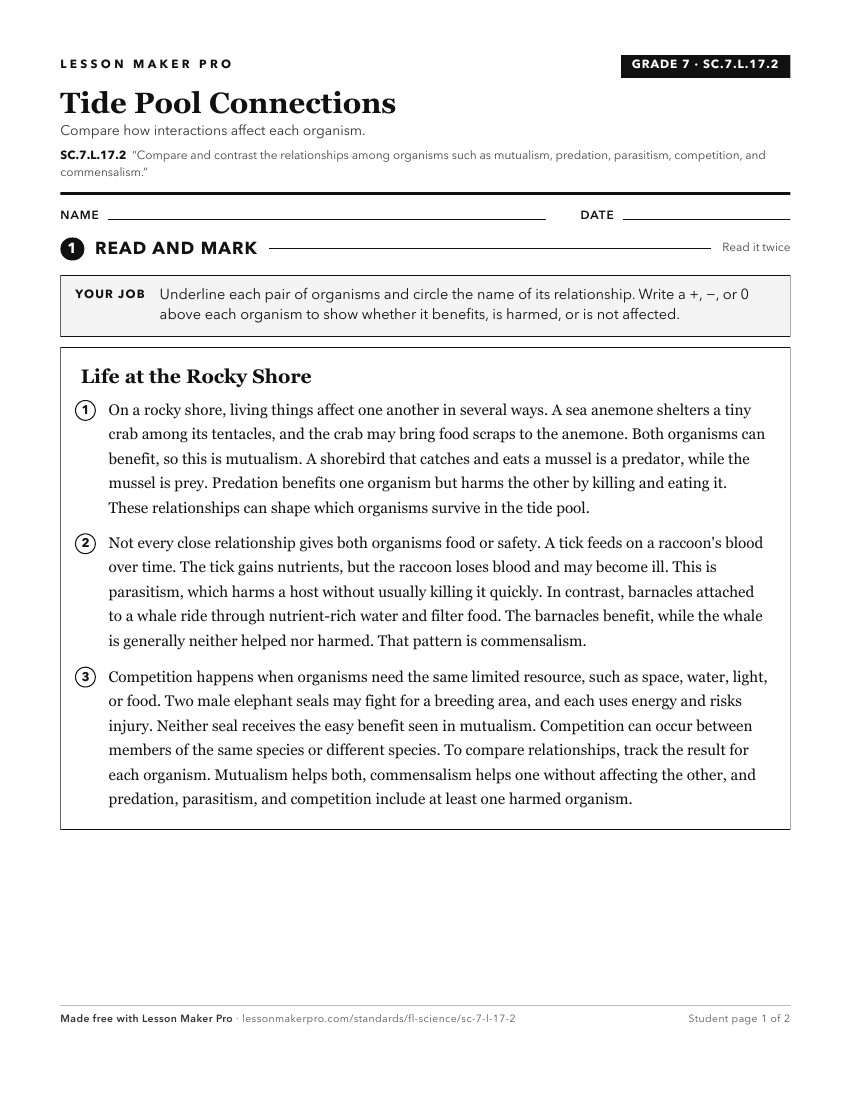
A ready-to-print activity worksheet aligned to SC.7.L.17.2, with an answer key for the teacher on its own page. No account needed.
PDF, US Letter, prints cleanly in black and white.
Download the worksheetKeep exploring
Related Standards
- SC.2.L.17.1
Compare and contrast the basic needs that all living things, including humans, have for survival.
- SC.6.L.14.6
Compare and contrast types of infectious agents that may infect the human body, including viruses, bacteria, fungi, and parasites.
- SC.5.L.17.1
Compare and contrast adaptations displayed by animals and plants that enable them to survive in different environments such as life cycles variations, animal be...
- SC.7.L.17.1
Explain and illustrate the roles of and relationships among producers, consumers, and decomposers in the process of energy transfer in a food web.
Turn this exact standard into a lesson
Grade, subject, topic, and the complete standard are prefilled. Create one free, no account needed.
Also for this standard:Make a WorksheetMake a QuizMake a Sub Lesson