Florida SC.7.L.17.1
The Standard
Explain and illustrate the roles of and relationships among producers, consumers, and decomposers in the process of energy transfer in a food web.
Florida Next Generation Sunshine State Standards for Science
Teacher's field guide
What This Standard Means
What Students Need to Do
- Students sort organisms by how they get energy. They build and read connected feeding paths, using arrows to show where energy moves. They explain how one population change can affect several others.
What Mastery Looks Like
- A student can classify unfamiliar organisms and trace energy through several paths in a food web. They explain that plants capture light energy, animals eat other organisms, and decomposers use dead matter while returning nutrients to the environment.
Common Misconceptions
- Students often point arrows toward what is eaten instead of toward the organism receiving energy. They may think plants get food from soil, decomposers only consume dead animals, or energy is recycled like matter.
How to Assess It
- Exit ticket: In a marsh with cordgrass, grasshoppers, frogs, herons, and fungi, draw energy-flow arrows and explain what may happen if frogs decline.
Lesson moves
Ways to Teach It
Give groups organism cards and yarn to build a pond food web, then trace energy from sunlight through three feeding paths.
Ask, “What changes if fungi disappear from a forest?” Students write a claim and support it with two food-web links.
Play Food Web Relay: teams place arrow cards between organism pictures, earning a point only when they explain each arrow’s direction.
Use a Florida wetland food web to predict how fewer mosquitofish would affect insects, larger fish, wading birds, and decomposers.
Free download
Printable SC.7.L.17.1 Worksheet
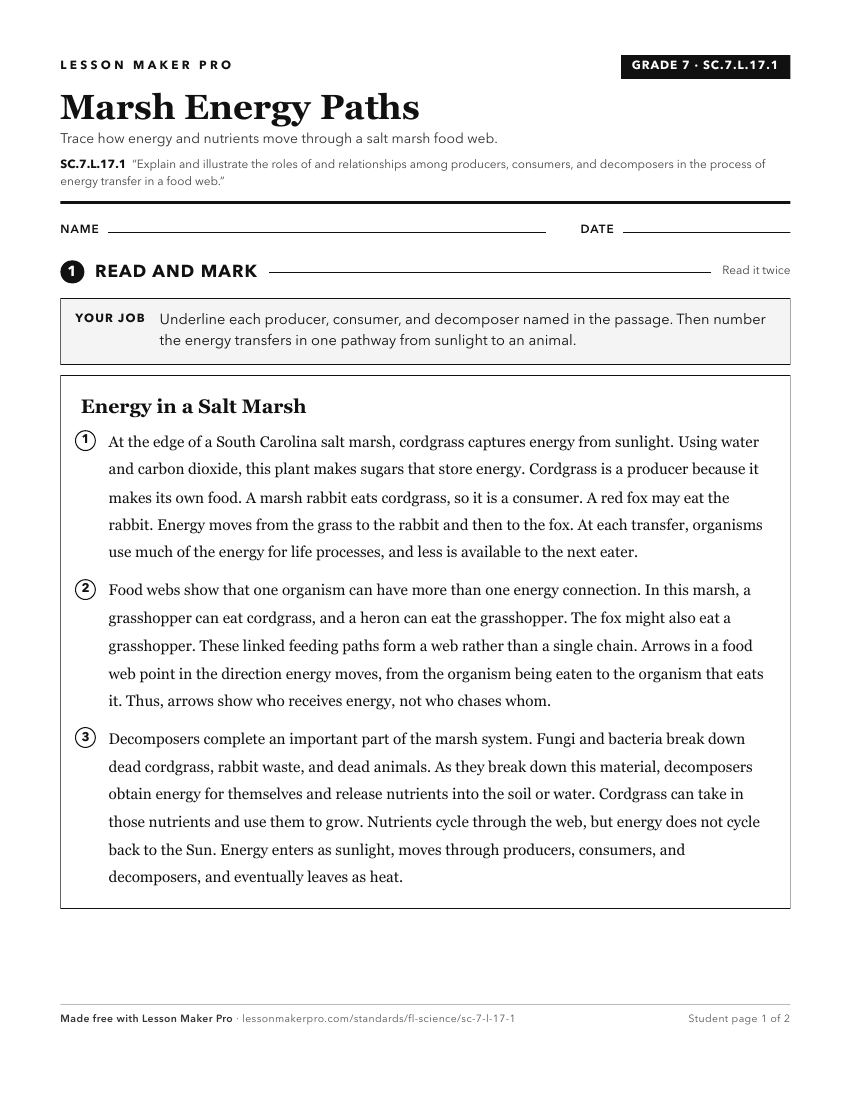
A ready-to-print activity worksheet aligned to SC.7.L.17.1, with an answer key for the teacher on its own page. No account needed.
PDF, US Letter, prints cleanly in black and white.
Download the worksheetKeep exploring
Related Standards
- SC.8.L.18.1
Describe and investigate the process of photosynthesis, such as the roles of light, carbon dioxide, water and chlorophyll; production of food; release of oxygen...
- SC.4.L.17.2
Explain that animals, including humans, cannot make their own food and that when animals eat plants or other animals, the energy stored in the food source is pa...
- SC.4.L.17.3
Trace the flow of energy from the Sun as it is transferred along the food chain through the producers to the consumers.
- SC.7.L.17.2
Compare and contrast the relationships among organisms such as mutualism, predation, parasitism, competition, and commensalism.
Turn this exact standard into a lesson
Grade, subject, topic, and the complete standard are prefilled. Create one free, no account needed.
Also for this standard:Make a WorksheetMake a QuizMake a Sub Lesson