Florida SC.6.L.14.6
The Standard
Compare and contrast types of infectious agents that may infect the human body, including viruses, bacteria, fungi, and parasites.
Florida Next Generation Sunshine State Standards for Science
Teacher's field guide
What This Standard Means
What Students Need to Do
- Students identify viruses, bacteria, fungi, and parasites from descriptions of their traits. They compare how each infects the body, reproduces, and differs in structure.
What Mastery Looks Like
- Students correctly sort examples into the four groups and explain their choices with evidence. They can name one similarity and one difference between any two groups.
Common Misconceptions
- Students may think viruses and bacteria are the same or that antibiotics treat every infection. They may also think all bacteria are harmful, fungi are plants, or parasites are only worms.
How to Assess It
- Give an exit ticket with four short infection profiles. Ask students to label each agent and cite one clue that supports each answer.
Lesson moves
Ways to Teach It
Build models of a virus, bacterium, fungus, and parasite using clay, beads, yarn, and labeled index cards.
Write a response to this prompt: Why can the same medicine not treat every type of infection?
Play an agent sorting relay using cards with traits, examples, body sites, and methods of reproduction.
Compare labels from antibiotic, antifungal, and antiparasitic medicines, then identify which infectious agent each product targets.
Free download
Printable SC.6.L.14.6 Worksheet
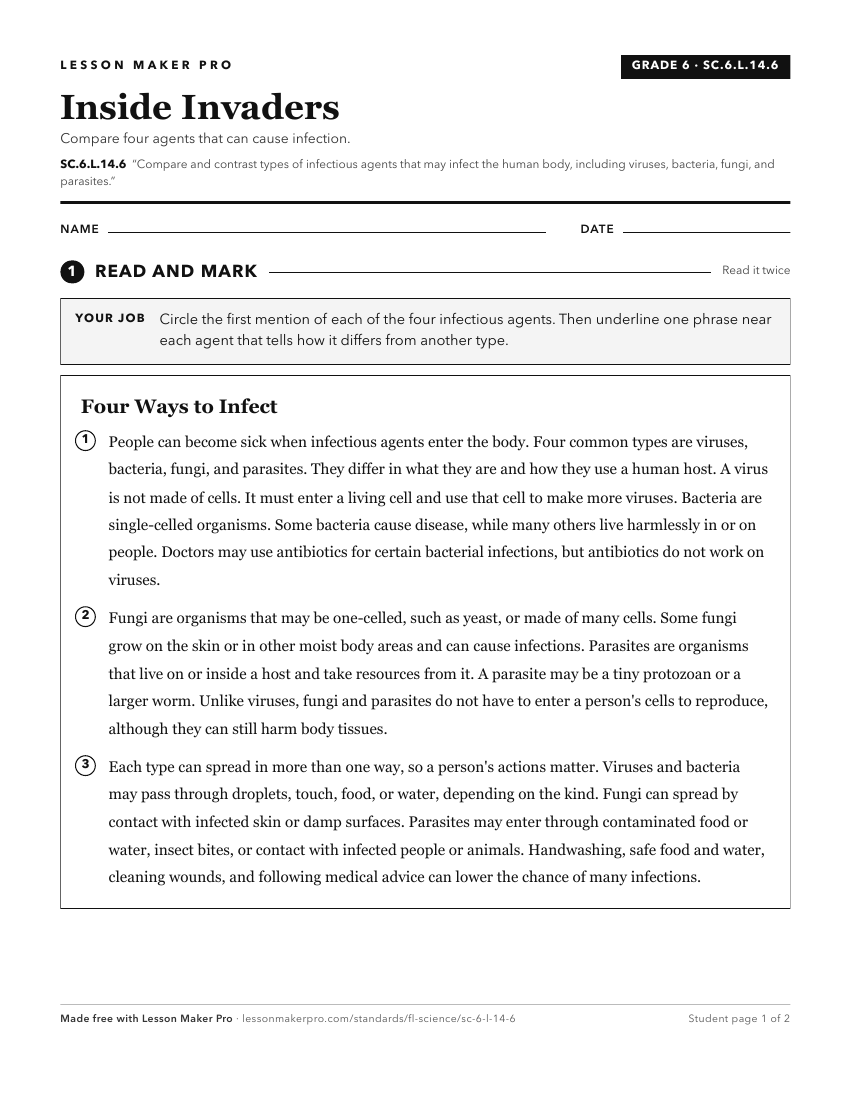
A ready-to-print activity worksheet aligned to SC.6.L.14.6, with an answer key for the teacher on its own page. No account needed.
PDF, US Letter, prints cleanly in black and white.
Download the worksheetKeep exploring
Related Standards
- SC.6.L.14.5
Identify and investigate the general functions of the major systems of the human body (digestive, respiratory, circulatory, reproductive, excretory, immune, ner...
- SC.2.L.17.1
Compare and contrast the basic needs that all living things, including humans, have for survival.
- SC.8.P.8.8
Identify basic examples of and compare and classify the properties of compounds, including acids, bases, and salts.
- SC.7.L.17.2
Compare and contrast the relationships among organisms such as mutualism, predation, parasitism, competition, and commensalism.
Turn this exact standard into a lesson
Grade, subject, topic, and the complete standard are prefilled. Create one free, no account needed.
Also for this standard:Make a WorksheetMake a QuizMake a Sub Lesson