Florida SC.6.L.14.4
The Standard
Compare and contrast the structure and function of major organelles of plant and animal cells, including cell wall, cell membrane, nucleus, cytoplasm, chloroplasts, mitochondria, and vacuoles.
Florida Next Generation Sunshine State Standards for Science
Teacher's field guide
What This Standard Means
What Students Need to Do
- Students identify organelles in diagrams and models of plant and animal cells. They explain each organelle's job and use shared and unique parts to distinguish the cell types.
What Mastery Looks Like
- Given two unlabeled cell diagrams, a student identifies each cell type and labels every shown organelle. The student describes clues such as a rigid outer wall, thin membrane, and large central vacuole. They match each part to jobs such as support, storage, movement control, photosynthesis, energy release, DNA storage, and cell reactions.
Common Misconceptions
- Students often think plant cells have a wall instead of a membrane, or that only animal cells have mitochondria. They may claim animal cells have no vacuoles or that every plant cell has chloroplasts. They also confuse chloroplasts with mitochondria and treat cytoplasm as empty space.
How to Assess It
- Give students one plant cell and one animal cell diagram. Ask them to label four numbered parts, state each function, and give one clue that identifies each cell type.
Lesson moves
Ways to Teach It
Build plant and animal cells with zipper bags, hair gel, beads, and a cardboard wall, then add name and function labels.
Write a claim explaining how a plant cell diagram differs from an animal cell diagram, using three organelles as evidence.
Match organelle name cards to picture, function, and plant, animal, or both cards in timed teams.
Compare microscope photos of spinach leaf and muscle cells, then explain why chloroplast and mitochondrion numbers fit each tissue's job.
Free download
Printable SC.6.L.14.4 Worksheet
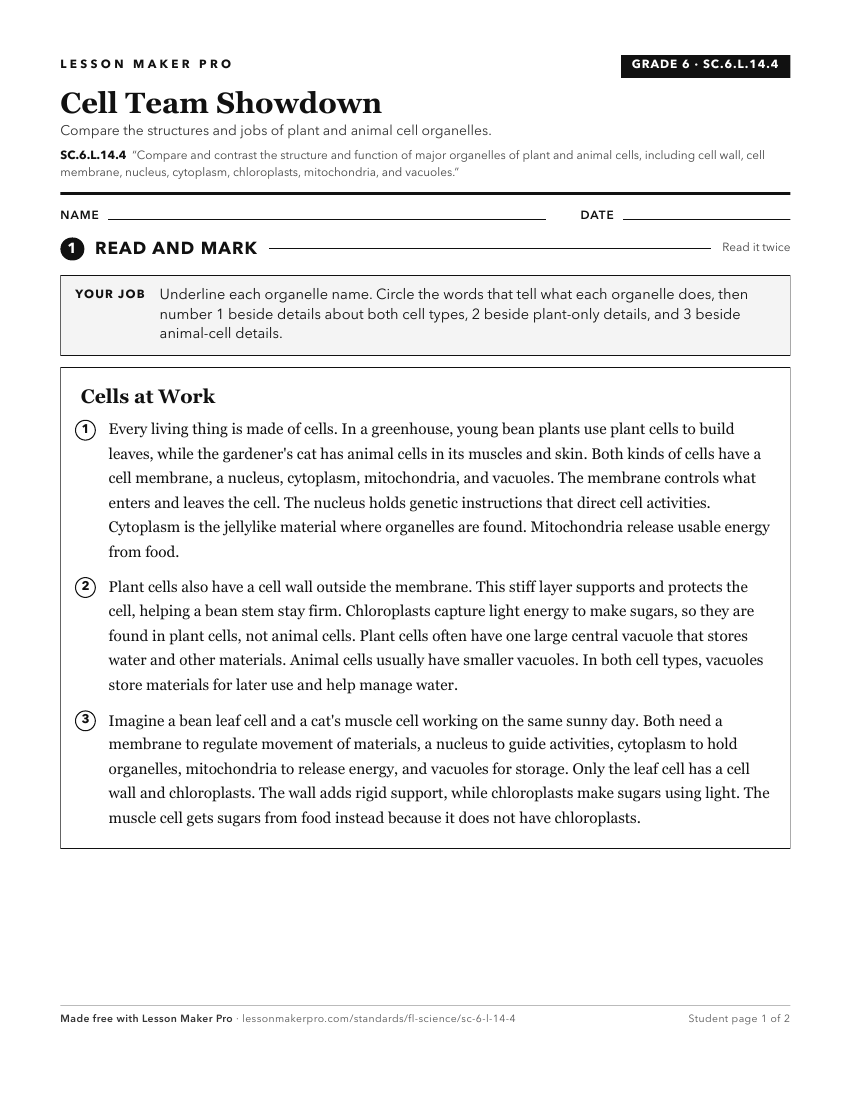
A ready-to-print activity worksheet aligned to SC.6.L.14.4, with an answer key for the teacher on its own page. No account needed.
PDF, US Letter, prints cleanly in black and white.
Download the worksheetKeep exploring
Related Standards
- SC.3.L.14.1
Describe structures in plants and their roles in food production, support, water and nutrient transport, and reproduction.
- SC.1.L.14.2
Identify the major parts of plants, including stem, roots, leaves, and flowers.
- SC.5.L.14.2
Compare and contrast the function of organs and other physical structures of plants and animals, including humans, for example: some animals have skeletons for ...
- SC.6.L.14.3
Recognize and explore how cells of all organisms undergo similar processes to maintain homeostasis, including extracting energy from food, getting rid of waste,...
Turn this exact standard into a lesson
Grade, subject, topic, and the complete standard are prefilled. Create one free, no account needed.
Also for this standard:Make a WorksheetMake a QuizMake a Sub Lesson