Florida SC.3.L.14.1
The Standard
Describe structures in plants and their roles in food production, support, water and nutrient transport, and reproduction.
Florida Next Generation Sunshine State Standards for Science
Teacher's field guide
What This Standard Means
What Students Need to Do
- Students identify roots, stems, leaves, flowers, fruits, and seeds. They explain how leaves make sugar, roots absorb water and minerals, stems support and carry materials, and flowers, fruits, and seeds help reproduction.
What Mastery Looks Like
- A student can label the main structures on a plant diagram and match each one to its job. The student can trace water from roots to leaves and explain how flowers lead to fruits and seeds.
Common Misconceptions
- Students often say plants get food from soil instead of making sugar in their leaves using light. They may think stems only hold plants upright, or that flowers and fruits are decorative rather than involved in reproduction.
How to Assess It
- Show a flowering plant with numbered roots, stem, leaves, and flower. Ask students to name each part, state its job, and draw the path water takes to a leaf.
Lesson moves
Ways to Teach It
Place celery stalks in colored water, then cut cross sections the next day to observe the path water takes through the stem.
Ask students to write how roots, stems, leaves, and flowers work together to help a plant survive and make new plants.
Run a card sort matching each plant structure to its job, then ask teams to defend one match.
Sort carrots, celery, spinach, broccoli, and tomatoes by plant structure, then explain the job each structure has on the plant.
Free download
Printable SC.3.L.14.1 Worksheet
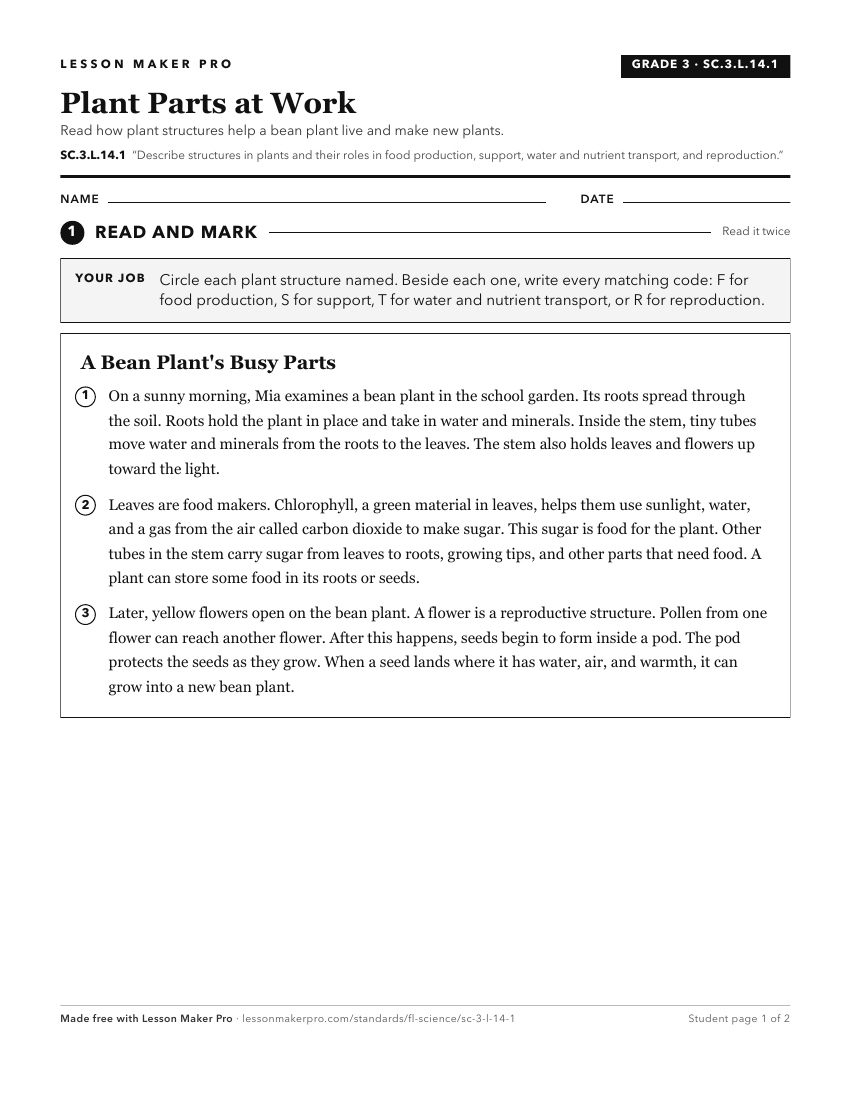
A ready-to-print activity worksheet aligned to SC.3.L.14.1, with an answer key for the teacher on its own page. No account needed.
PDF, US Letter, prints cleanly in black and white.
Download the worksheetKeep exploring
Related Standards
- SC.6.L.14.4
Compare and contrast the structure and function of major organelles of plant and animal cells, including cell wall, cell membrane, nucleus, cytoplasm, chloropla...
- SC.8.L.18.1
Describe and investigate the process of photosynthesis, such as the roles of light, carbon dioxide, water and chlorophyll; production of food; release of oxygen...
- SC.1.L.14.2
Identify the major parts of plants, including stem, roots, leaves, and flowers.
- SC.5.L.14.2
Compare and contrast the function of organs and other physical structures of plants and animals, including humans, for example: some animals have skeletons for ...
Turn this exact standard into a lesson
Grade, subject, topic, and the complete standard are prefilled. Create one free, no account needed.
Also for this standard:Make a WorksheetMake a QuizMake a Sub Lesson