Florida SC.6.E.7.9
The Standard
Describe how the composition and structure of the atmosphere protects life and insulates the planet.
Florida Next Generation Sunshine State Standards for Science
Teacher's field guide
What This Standard Means
What Students Need to Do
- Students identify the main gases in the atmosphere and describe how gases are arranged in layers. They explain how ozone filters ultraviolet radiation and how atmospheric gases slow heat loss. They also connect thicker lower layers with greater air pressure and most weather.
What Mastery Looks Like
- Students can label major atmospheric layers and place ozone, weather, and most gases in the correct locations. They can explain, using cause and effect, how the atmosphere limits harmful radiation and keeps temperatures suitable for life.
Common Misconceptions
- Students may think ozone traps most heat or that greenhouse gases block all sunlight. They may also think atmospheric gases are evenly spread through every layer or that the atmosphere creates heat instead of slowing heat loss.
How to Assess It
- Exit ticket: Draw a simple atmosphere around Earth, label where ozone and most weather occur, then explain one protective effect and one insulating effect.
Lesson moves
Ways to Teach It
Stack labeled layer cards above an Earth picture, then place ozone, clouds, meteoroids, and gas tokens where they belong.
Write a response to this prompt: How would life change if Earth had no atmosphere for one day?
Play a card sort matching atmospheric gases and layers with effects such as filtering ultraviolet radiation, trapping heat, and producing weather.
Compare cloudy and clear nighttime temperature forecasts, then explain how water vapor and clouds can slow heat loss.
Free download
Printable SC.6.E.7.9 Worksheet
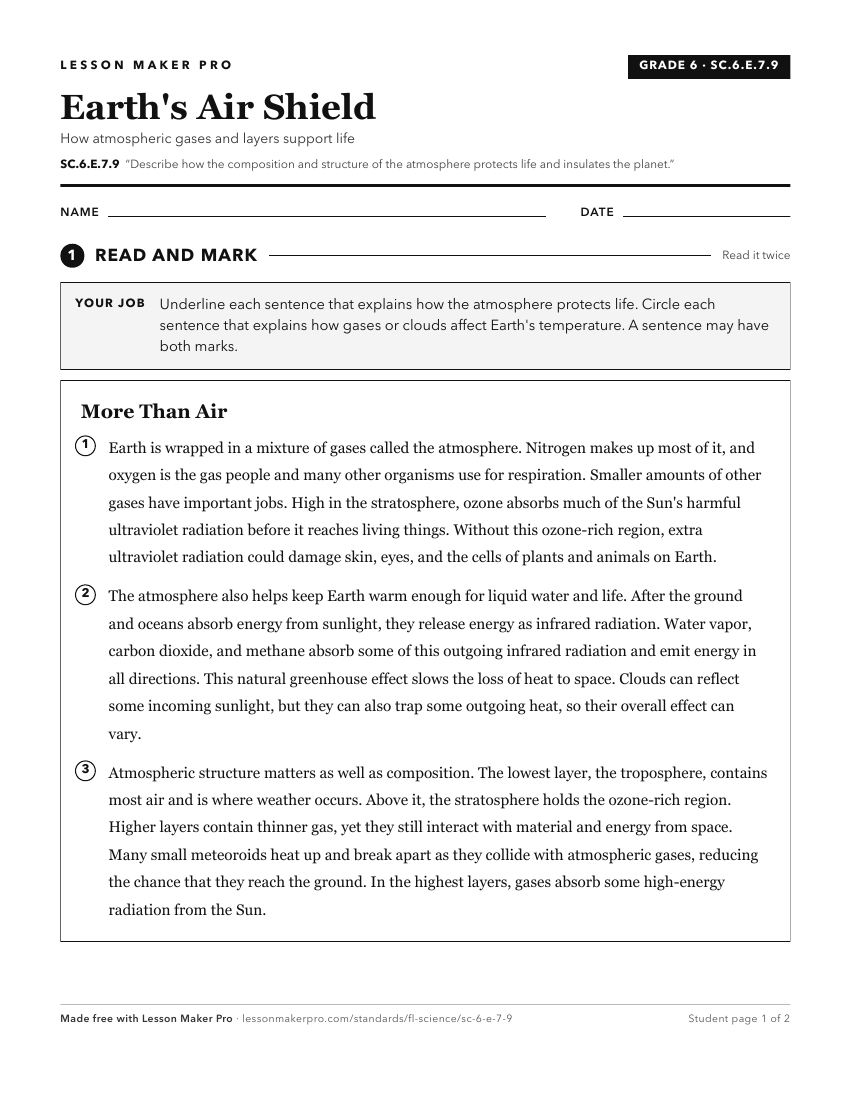
A ready-to-print activity worksheet aligned to SC.6.E.7.9, with an answer key for the teacher on its own page. No account needed.
PDF, US Letter, prints cleanly in black and white.
Download the worksheetKeep exploring
Related Standards
- SC.6.E.7.5
Explain how energy provided by the sun influences global patterns of atmospheric movement and the temperature differences between air, water, and land.
- SC.6.E.7.2
Investigate and apply how the cycling of water between the atmosphere and hydrosphere has an effect on weather patterns and climate.
- SC.6.E.7.8
Describe ways human beings protect themselves from hazardous weather and sun exposure.
- SC.6.E.7.4
Differentiate and show interactions among the geosphere, hydrosphere, cryosphere, atmosphere, and biosphere.
Turn this exact standard into a lesson
Grade, subject, topic, and the complete standard are prefilled. Create one free, no account needed.
Also for this standard:Make a WorksheetMake a QuizMake a Sub Lesson