Florida SC.6.E.7.6
The Standard
Differentiate between weather and climate.
Florida Next Generation Sunshine State Standards for Science
Teacher's field guide
What This Standard Means
What Students Need to Do
- Students identify atmospheric conditions measured over hours or days and compare them with patterns recorded over many years. They classify examples by timescale and typical conditions.
What Mastery Looks Like
- Students correctly label forecasts and daily observations as weather. They identify long-term averages and repeated seasonal patterns as climate, then explain their choices.
Common Misconceptions
- Students may think a cold day disproves a warm regional climate. They may also confuse seasonal changes with daily conditions or treat weather and climate as interchangeable terms.
How to Assess It
- Give students four statements about temperature and rainfall. Ask them to label each as weather or climate and justify one answer using timescale.
Lesson moves
Ways to Teach It
Have pairs sort forecast cards, daily observation cards, and 30-year average cards into weather and climate groups.
Ask students to explain why one snowy day does not define the climate of a city.
Play a team game where students hold up weather or climate cards after hearing short examples.
Compare a weekend packing decision with choosing crops for a region, then identify which uses weather and which uses climate.
Free download
Printable SC.6.E.7.6 Worksheet
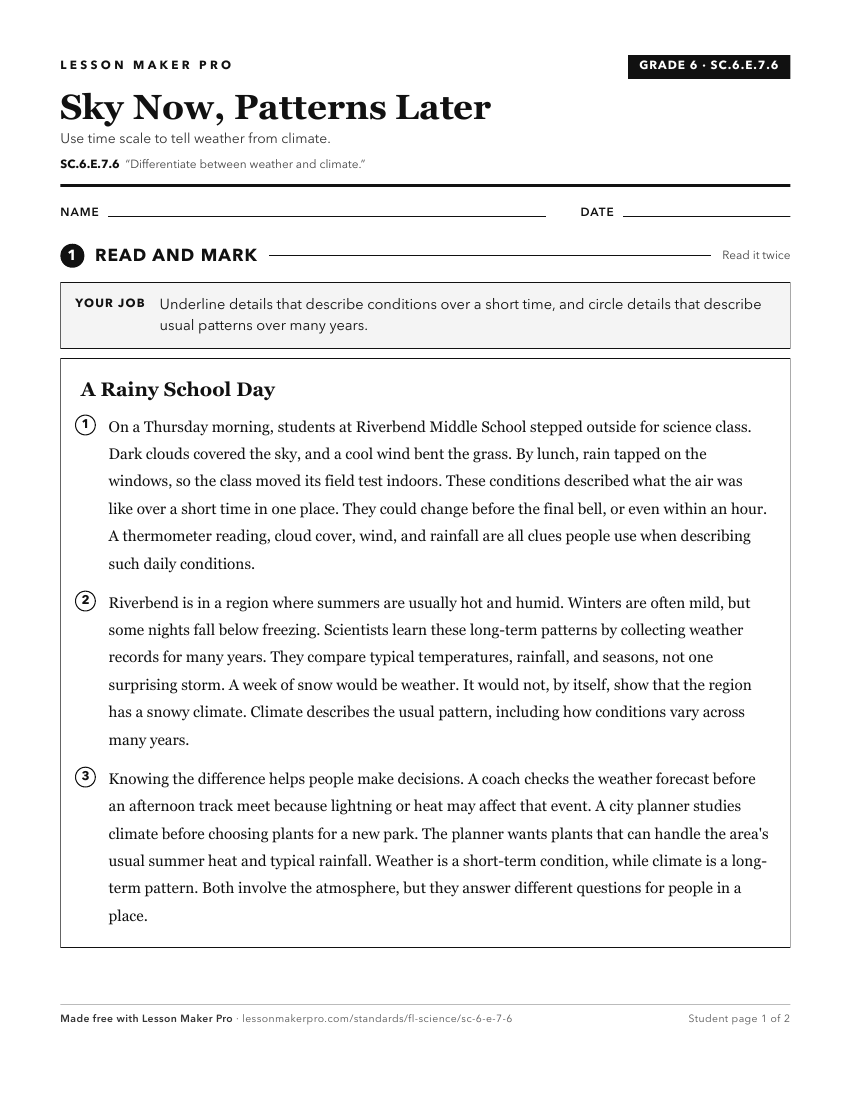
A ready-to-print activity worksheet aligned to SC.6.E.7.6, with an answer key for the teacher on its own page. No account needed.
PDF, US Letter, prints cleanly in black and white.
Download the worksheetKeep exploring
Related Standards
- SC.5.E.7.4
Distinguish among the various forms of precipitation (rain, snow, sleet, and hail), making connections to the weather in a particular place and time.
- SC.2.E.7.1
Compare and describe changing patterns in nature that repeat themselves, such as weather conditions including temperature and precipitation, day to day and seas...
- SC.5.E.7.5
Recognize that some of the weather-related differences, such as temperature and humidity, are found among different environments, such as swamps, deserts, and m...
- SC.5.E.7.3
Recognize how air temperature, barometric pressure, humidity, wind speed and direction, and precipitation determine the weather in a particular place and time.
Turn this exact standard into a lesson
Grade, subject, topic, and the complete standard are prefilled. Create one free, no account needed.
Also for this standard:Make a WorksheetMake a QuizMake a Sub Lesson