Florida SC.5.E.7.4
The Standard
Distinguish among the various forms of precipitation (rain, snow, sleet, and hail), making connections to the weather in a particular place and time.
Florida Next Generation Sunshine State Standards for Science
Teacher's field guide
What This Standard Means
What Students Need to Do
- Students identify rain, snow, sleet, and hail by their physical form and how each develops. They use temperature, cloud, and storm clues to predict what will fall in a given location.
What Mastery Looks Like
- Students correctly label each type from a photo, weather report, or simple temperature profile. They explain why hail can fall on a warm day and why sleet differs from snow.
Common Misconceptions
- Students often confuse sleet with hail or think all frozen precipitation is snow. They may assume hail only occurs in winter. Some predict precipitation using ground temperature alone instead of conditions in the clouds and air layers.
How to Assess It
- Give students four forecast cards: warm air, freezing air, a warm layer above cold ground, and a strong thunderstorm. Ask them to name the likely precipitation and cite one clue for each answer.
Lesson moves
Ways to Teach It
Sort photo cards of rain, snow, sleet, and hail, then match each card to temperature and storm clues.
Write a response to: Why can hail fall during a warm summer thunderstorm?
Play precipitation bingo by reading weather clues while students cover rain, snow, sleet, or hail.
Compare local weather reports from summer and winter, then record which precipitation types are possible during each season.
Free download
Printable SC.5.E.7.4 Worksheet
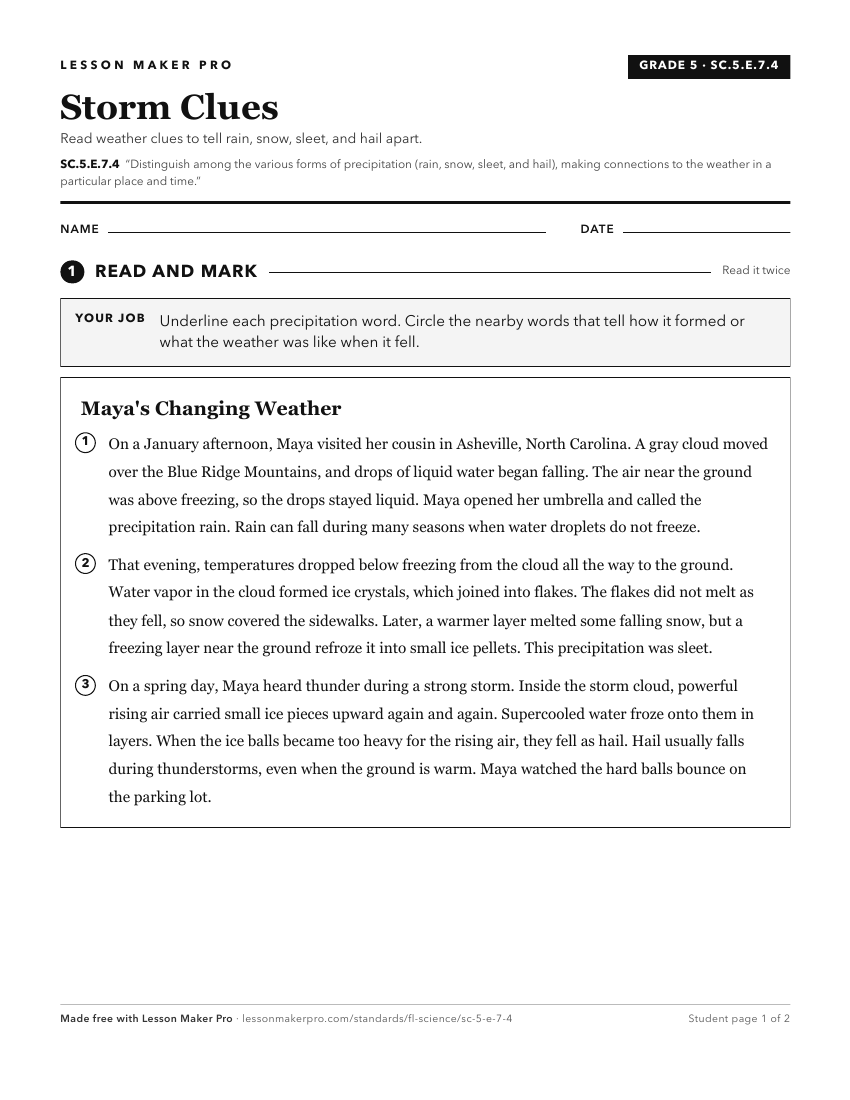
A ready-to-print activity worksheet aligned to SC.5.E.7.4, with an answer key for the teacher on its own page. No account needed.
PDF, US Letter, prints cleanly in black and white.
Download the worksheetKeep exploring
Related Standards
- SC.6.E.7.3
Describe how global patterns such as the jet stream and ocean currents influence local weather in measurable terms such as temperature, air pressure, wind direc...
- SC.2.E.7.1
Compare and describe changing patterns in nature that repeat themselves, such as weather conditions including temperature and precipitation, day to day and seas...
- SC.6.E.7.6
Differentiate between weather and climate.
- SC.5.E.7.3
Recognize how air temperature, barometric pressure, humidity, wind speed and direction, and precipitation determine the weather in a particular place and time.
Turn this exact standard into a lesson
Grade, subject, topic, and the complete standard are prefilled. Create one free, no account needed.
Also for this standard:Make a WorksheetMake a QuizMake a Sub Lesson