Florida SC.5.P.8.2
The Standard
Investigate and identify materials that will dissolve in water and those that will not and identify the conditions that will speed up or slow down the dissolving process.
Florida Next Generation Sunshine State Standards for Science
Teacher's field guide
What This Standard Means
What Students Need to Do
- Students test common solids in water and use observations to decide whether each forms a solution. They compare stirring, water temperature, and particle size to see how each changes dissolving time.
What Mastery Looks Like
- A student can correctly classify materials such as salt, sugar, and sand based on test results. They can plan a fair comparison by changing one condition and measuring dissolving time.
Common Misconceptions
- Students may think a dissolved solid has vanished or melted. They may assume stirring increases how much can dissolve rather than how fast it dissolves. Some think every solid will dissolve in hot water.
How to Assess It
- Give this exit ticket: “Sugar mixes evenly into warm water, while sand settles. Which material dissolved, and name two changes that would slow dissolving?”
Lesson moves
Ways to Teach It
Test salt, sugar, sand, and pepper in clear cups of water, then record whether each remains visible or forms a solution.
Ask students to explain why a sugar cube and loose sugar dissolve at different rates in the same water.
Play a condition card game where students sort stirring, temperature, and particle size changes into faster or slower dissolving groups.
Compare stirring sugar into hot and cold drinks, then connect the results to making lemonade, tea, or cocoa.
Free download
Printable SC.5.P.8.2 Worksheet
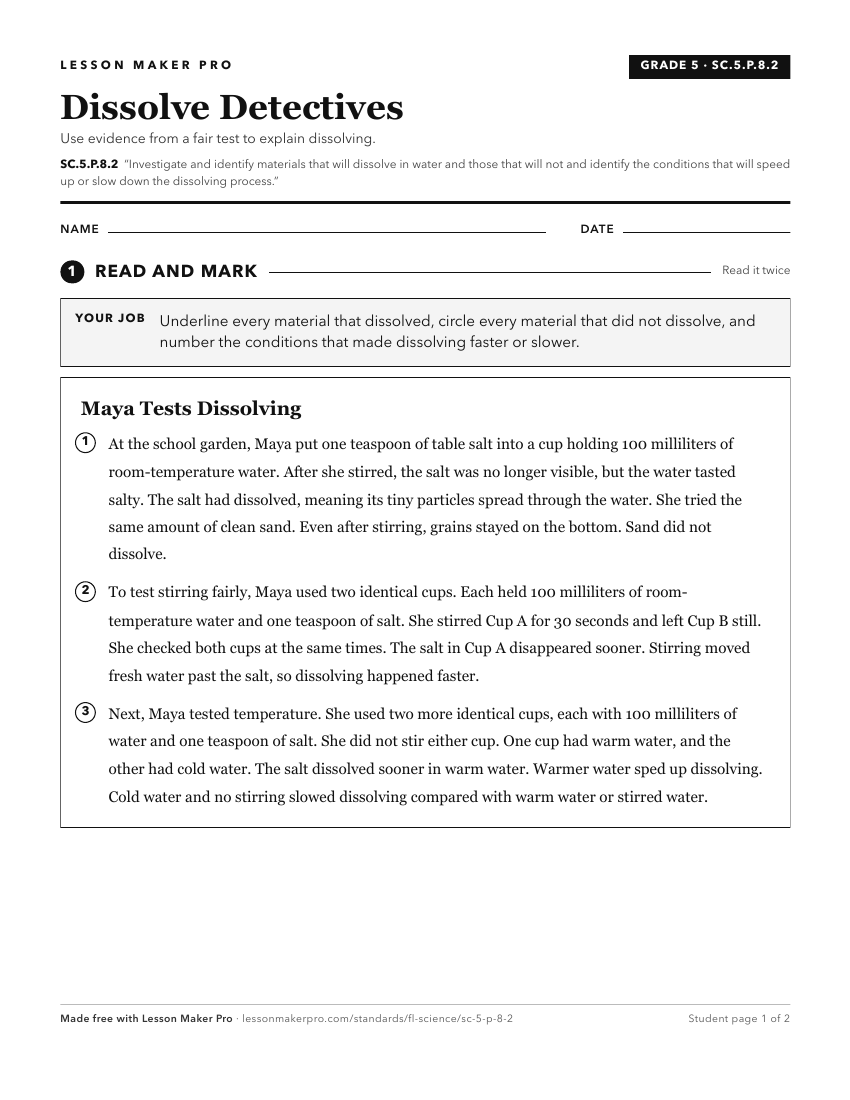
A ready-to-print activity worksheet aligned to SC.5.P.8.2, with an answer key for the teacher on its own page. No account needed.
PDF, US Letter, prints cleanly in black and white.
Download the worksheetKeep exploring
Related Standards
- SC.2.P.9.1
Investigate that materials can be altered to change some of their properties, but not all materials respond the same way to any one alteration.
- SC.2.E.7.3
Investigate, observe and describe how water left in an open container disappears (evaporates), but water in a closed container does not disappear (evaporate).
- SC.8.P.8.4
Classify and compare substances on the basis of characteristic physical properties that can be demonstrated or measured; for example, density, thermal or electr...
- SC.4.P.9.1
Identify some familiar changes in materials that result in other materials with different characteristics, such as decaying animal or plant matter, burning, rus...
Turn this exact standard into a lesson
Grade, subject, topic, and the complete standard are prefilled. Create one free, no account needed.
Also for this standard:Make a WorksheetMake a QuizMake a Sub Lesson