Florida SC.5.E.7.2
The Standard
Recognize that the ocean is an integral part of the water cycle and is connected to all of Earth's water reservoirs via evaporation and precipitation processes.
Florida Next Generation Sunshine State Standards for Science
Teacher's field guide
What This Standard Means
What Students Need to Do
- Students trace how water moves from the ocean to the atmosphere, land, rivers, groundwater, ice, and back again. They explain the roles of evaporation and precipitation in these movements.
What Mastery Looks Like
- Students can draw and label a water cycle that includes the ocean and at least three other water reservoirs. They can explain how water travels between each reservoir.
Common Misconceptions
- Students may think the water cycle begins at one fixed point or that ocean water stays in the ocean. They may confuse evaporation with condensation or think precipitation falls only on land.
How to Assess It
- Give students a diagram with an ocean, cloud, river, glacier, and groundwater. Ask them to add arrows and label where evaporation and precipitation move water.
Lesson moves
Ways to Teach It
Build a sealed water cycle bag with colored water, tape it to a sunny window, and record evaporation, condensation, and dripping.
Write an explanation for how one drop of ocean water could eventually become groundwater beneath a school.
Play a reservoir relay where students pass a water-drop card between labeled stations using evaporation and precipitation event cards.
Use a local rain forecast and map to predict whether falling water will reach rivers, groundwater, or the ocean.
Free download
Printable SC.5.E.7.2 Worksheet
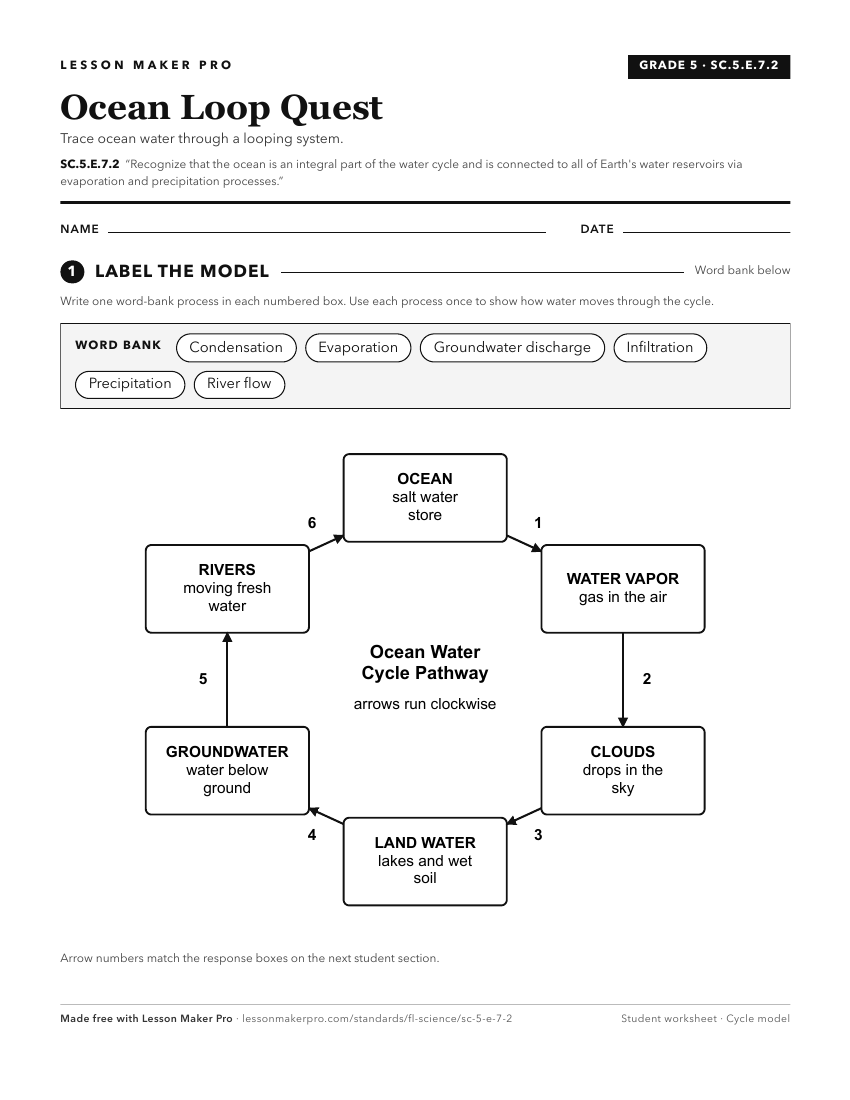
A ready-to-print activity worksheet aligned to SC.5.E.7.2, with an answer key for the teacher on its own page. No account needed.
PDF, US Letter, prints cleanly in black and white.
Download the worksheetKeep exploring
Related Standards
- SC.6.E.7.2
Investigate and apply how the cycling of water between the atmosphere and hydrosphere has an effect on weather patterns and climate.
- SC.6.E.7.4
Differentiate and show interactions among the geosphere, hydrosphere, cryosphere, atmosphere, and biosphere.
- SC.1.E.6.1
Recognize that water, rocks, soil, and living organisms are found on Earth's surface.
- SC.5.E.7.1
Create a model to explain the parts of the water cycle. Water can be a gas, a liquid, or a solid and can go back and forth from one state to another.
Turn this exact standard into a lesson
Grade, subject, topic, and the complete standard are prefilled. Create one free, no account needed.
Also for this standard:Make a WorksheetMake a QuizMake a Sub Lesson