Florida SC.5.E.5.1
The Standard
Recognize that a galaxy consists of gas, dust, and many stars, including any objects orbiting the stars. Identify our home galaxy as the Milky Way.
Florida Next Generation Sunshine State Standards for Science
Teacher's field guide
What This Standard Means
What Students Need to Do
- Students describe a galaxy as a huge collection of stars, planetary systems, gas, and dust. They name the Milky Way as the galaxy containing Earth and our solar system.
What Mastery Looks Like
- Students can label Earth, the solar system, and the Milky Way in the correct nested order. They can distinguish one star system from a galaxy containing many star systems.
Common Misconceptions
- Students may confuse a galaxy with a solar system or think the Milky Way is only a cloudy streak in the night sky. They may also think every object in a galaxy orbits one central star.
How to Assess It
- Give students an exit ticket: “Draw and label where Earth fits within the solar system and the Milky Way, then list four galaxy components.”
Lesson moves
Ways to Teach It
Use star, planet, gas, and dust cards to build a tabletop model showing many star systems inside one galaxy.
Ask students to write three sentences explaining why the solar system and the Milky Way are not the same thing.
Play a sorting relay where teams place object cards under galaxy, solar system, star, or planet.
Examine a Milky Way photograph and discuss why city lights make its band difficult to see from many communities.
Free download
Printable SC.5.E.5.1 Worksheet
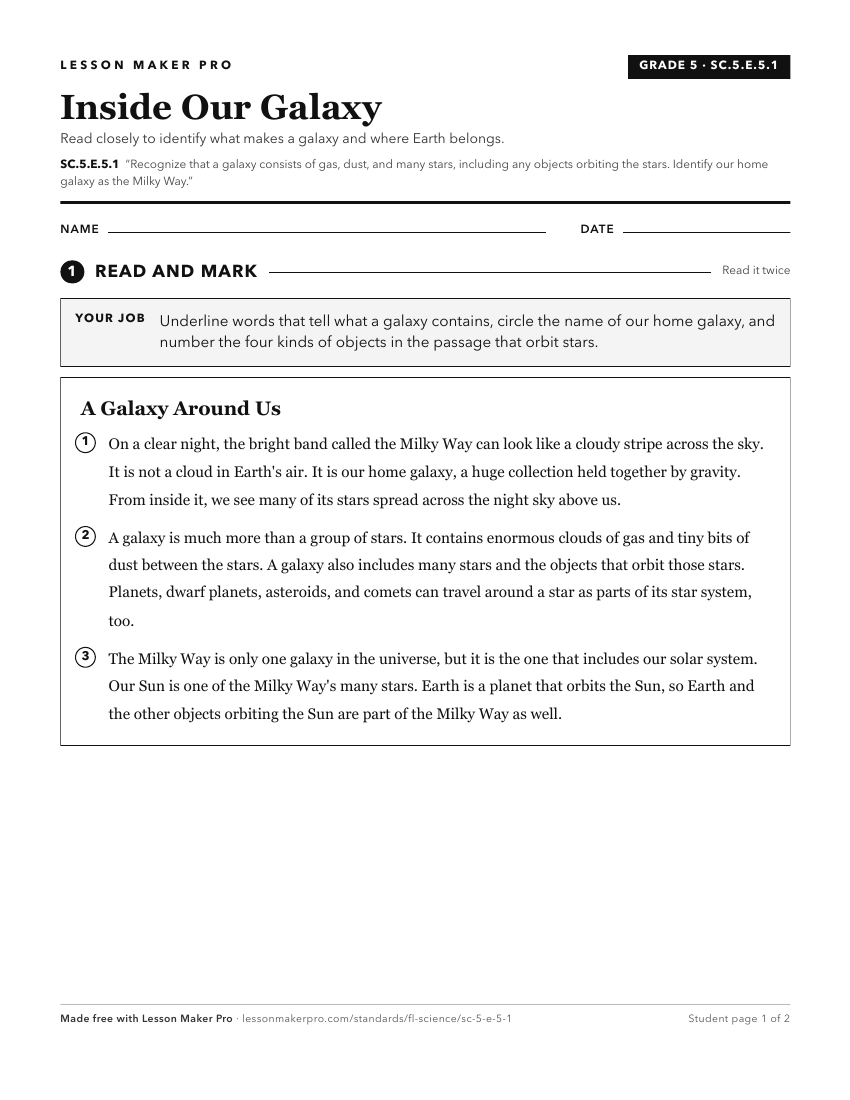
A ready-to-print activity worksheet aligned to SC.5.E.5.1, with an answer key for the teacher on its own page. No account needed.
PDF, US Letter, prints cleanly in black and white.
Download the worksheetKeep exploring
Related Standards
- SC.8.E.5.3
Distinguish the hierarchical relationships between planets and other astronomical bodies relative to solar system, galaxy, and universe, including distance, siz...
- SC.8.E.5.1
Recognize that there are enormous distances between objects in space and apply our knowledge of light and space travel to understand this distance.
- SC.3.E.5.1
Explain that stars can be different; some are smaller, some are larger, and some appear brighter than others; all except the Sun are so far away that they look ...
- SC.8.E.5.2
Recognize that the universe contains many billions of galaxies and that each galaxy contains many billions of stars.
Turn this exact standard into a lesson
Grade, subject, topic, and the complete standard are prefilled. Create one free, no account needed.
Also for this standard:Make a WorksheetMake a QuizMake a Sub Lesson