Florida SC.3.E.5.1
The Standard
Explain that stars can be different; some are smaller, some are larger, and some appear brighter than others; all except the Sun are so far away that they look like points of light.
Florida Next Generation Sunshine State Standards for Science
Teacher's field guide
What This Standard Means
What Students Need to Do
- Students compare stars by relative size and how bright they appear from Earth. They explain why the Sun looks large while other stars look like tiny points.
What Mastery Looks Like
- A student can sort star examples by size and apparent brightness without treating those traits as the same. They can use distance to explain the different appearances of the Sun and other stars.
Common Misconceptions
- Students may think all stars are the same size. They may assume a brighter-looking star must be larger. Some think the Sun is not a star or that distant stars are actually tiny.
How to Assess It
- Exit ticket: A star is larger than the Sun but looks like a tiny dot from Earth. Explain why, then name two ways stars can differ.
Lesson moves
Ways to Teach It
Use clay balls of different sizes and battery tea lights at two distances to model star size, apparent brightness, and distance.
Prompt students: Why does the Sun look larger than stars that may actually be larger?
Play a card sort using star profiles, grouping each by relative size and apparent brightness, then justify one placement.
Compare a daytime Sun photograph with a night-sky image, then write what distance explains about each appearance.
Free download
Printable SC.3.E.5.1 Worksheet
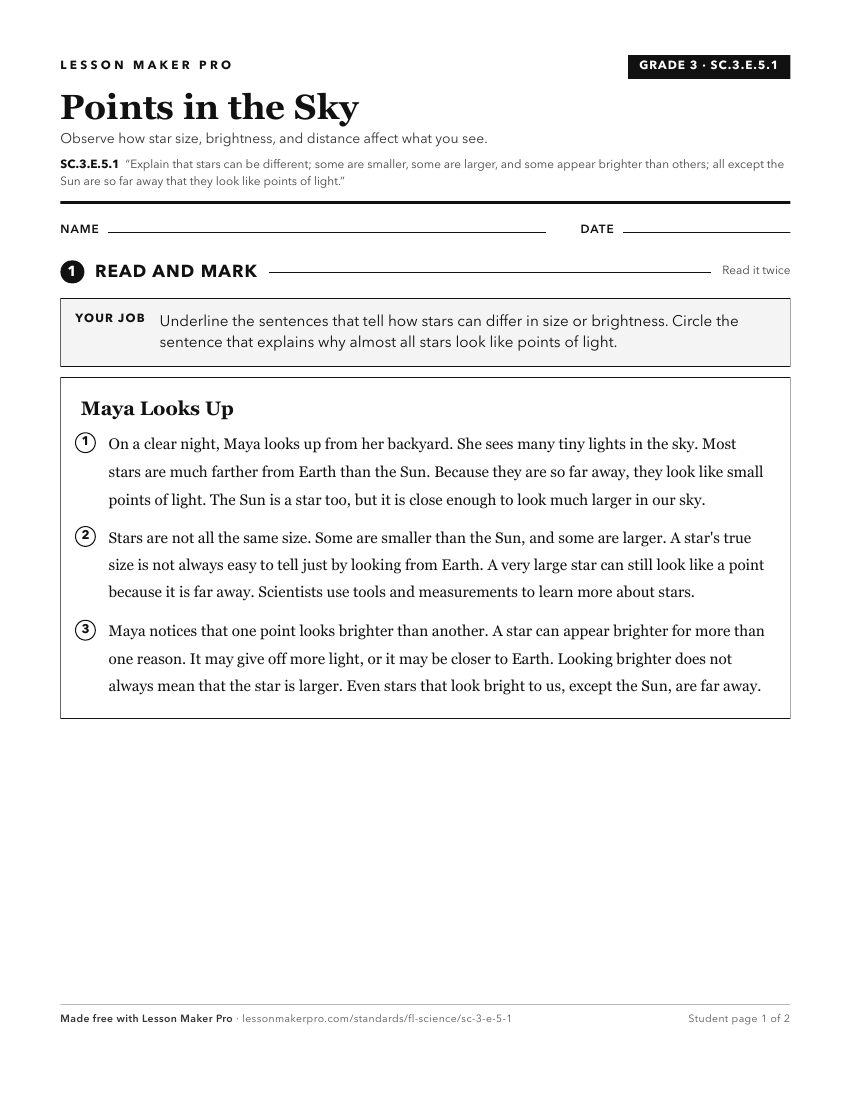
A ready-to-print activity worksheet aligned to SC.3.E.5.1, with an answer key for the teacher on its own page. No account needed.
PDF, US Letter, prints cleanly in black and white.
Download the worksheetKeep exploring
Related Standards
- SC.4.E.5.1
Observe that the patterns of stars in the sky stay the same although they appear to shift across the sky nightly, and different stars can be seen in different s...
- SC.3.E.5.3
Recognize that the Sun appears large and bright because it is the closest star to Earth.
- SC.1.E.5.1
Observe and discuss that there are more stars in the sky than anyone can easily count and that they are not scattered evenly in the sky.
- SC.8.E.5.5
Describe and classify specific physical properties of stars: apparent magnitude (brightness), temperature (color), size, and luminosity (absolute brightness).
Turn this exact standard into a lesson
Grade, subject, topic, and the complete standard are prefilled. Create one free, no account needed.
Also for this standard:Make a WorksheetMake a QuizMake a Sub Lesson