Florida SC.8.E.5.5
The Standard
Describe and classify specific physical properties of stars: apparent magnitude (brightness), temperature (color), size, and luminosity (absolute brightness).
Florida Next Generation Sunshine State Standards for Science
Teacher's field guide
What This Standard Means
What Students Need to Do
- Students compare stars using observed brightness, color, size, and total light output. They explain how distance affects how bright a star looks from Earth.
What Mastery Looks Like
- Students can use a data table to identify which star appears brighter, is hotter, is larger, or produces more light. They correctly separate apparent brightness from luminosity.
Common Misconceptions
- Students may think the brightest-looking star produces the most light, without considering distance. They may think red stars are hotter than blue stars or that larger stars are always hotter. They may also miss that lower apparent magnitude numbers mean brighter objects.
How to Assess It
- Give this exit ticket: Star A is red, has radius 100, apparent magnitude 1, and luminosity 500. Star B is blue, has radius 5, apparent magnitude 3, and luminosity 1,000. Identify which appears brighter, is hotter, is larger, and is more luminous.
Lesson moves
Ways to Teach It
Give groups star data cards and have them sort the cards four times, once by brightness, temperature, size, and luminosity.
Ask students to explain why a nearby flashlight can look brighter than a powerful stadium light far away.
Play four-corner classification using star descriptions, with corners labeled brighter-looking, hotter, larger, and more luminous.
Use an online star catalog to compare Sirius, Betelgeuse, and the Sun by color, size, apparent brightness, and luminosity.
Free download
Printable SC.8.E.5.5 Worksheet
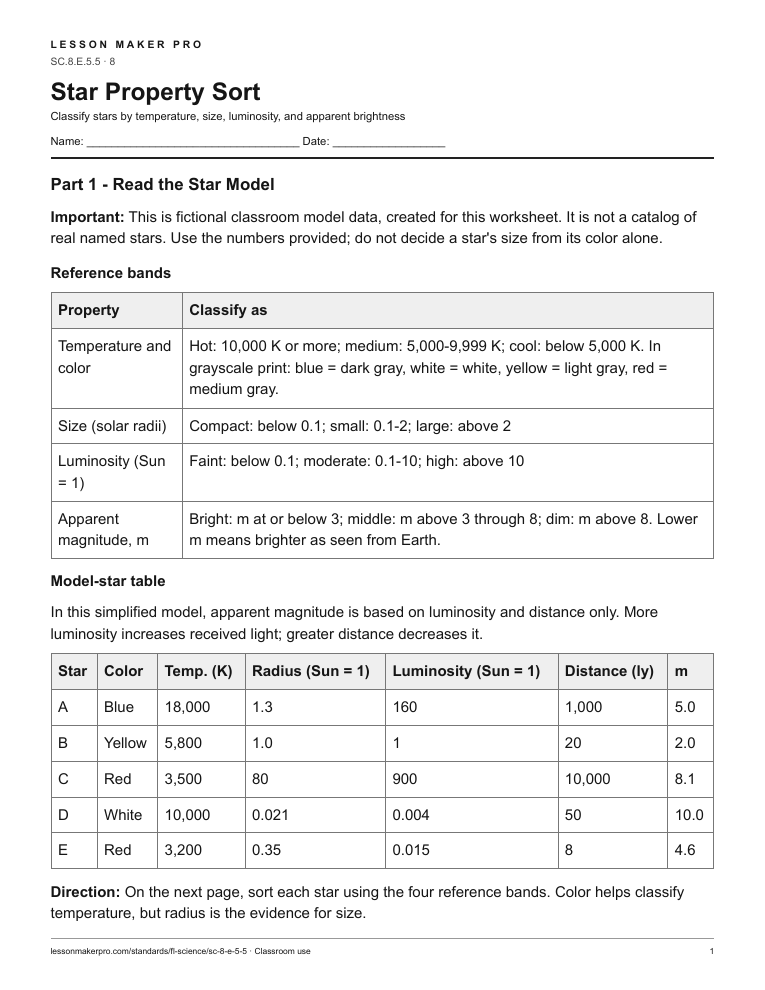
A ready-to-print activity worksheet aligned to SC.8.E.5.5, with an answer key for the teacher on its own page. No account needed.
PDF, US Letter, prints cleanly in black and white.
Download the worksheetKeep exploring
Related Standards
- SC.5.P.8.1
Compare and contrast the basic properties of solids, liquids, and gases, such as mass, volume, color, texture, and temperature.
- SC.3.E.5.1
Explain that stars can be different; some are smaller, some are larger, and some appear brighter than others; all except the Sun are so far away that they look ...
- SC.8.E.5.7
Compare and contrast the properties of objects in the Solar System including the Sun, planets, and moons to those of Earth, such as gravitational force, distanc...
- SC.8.P.8.4
Classify and compare substances on the basis of characteristic physical properties that can be demonstrated or measured; for example, density, thermal or electr...
Turn this exact standard into a lesson
Grade, subject, topic, and the complete standard are prefilled. Create one free, no account needed.
Also for this standard:Make a WorksheetMake a QuizMake a Sub Lesson