Florida SC.1.E.5.1
The Standard
Observe and discuss that there are more stars in the sky than anyone can easily count and that they are not scattered evenly in the sky.
Florida Next Generation Sunshine State Standards for Science
Teacher's field guide
What This Standard Means
What Students Need to Do
- Students observe photographs or simple sky maps and describe the number and placement of stars. They identify crowded areas, sparse areas, and gaps.
What Mastery Looks Like
- A student can compare equal sections of a star image and tell which section has more stars. They use visible patterns to explain why counting every star would be difficult.
Common Misconceptions
- Students may think stars are evenly spaced or that each part of the sky has the same number. They may also think a photograph shows every star that exists.
How to Assess It
- Show a star field divided into four equal sections. Ask students to circle the most crowded section, mark the sparsest section, and explain their choices.
Lesson moves
Ways to Teach It
Give pairs a printed star field, cut it into equal sections, and have them sort the sections from sparsest to most crowded.
Ask students to finish this prompt: I noticed stars are crowded near ___, but there are fewer near ___.
Play Star Spotter by flashing sky images while students point to crowded areas, sparse areas, and gaps.
Display a real observatory photograph and compare its star patterns with what students can see from their neighborhood at night.
Free download
Printable SC.1.E.5.1 Worksheet
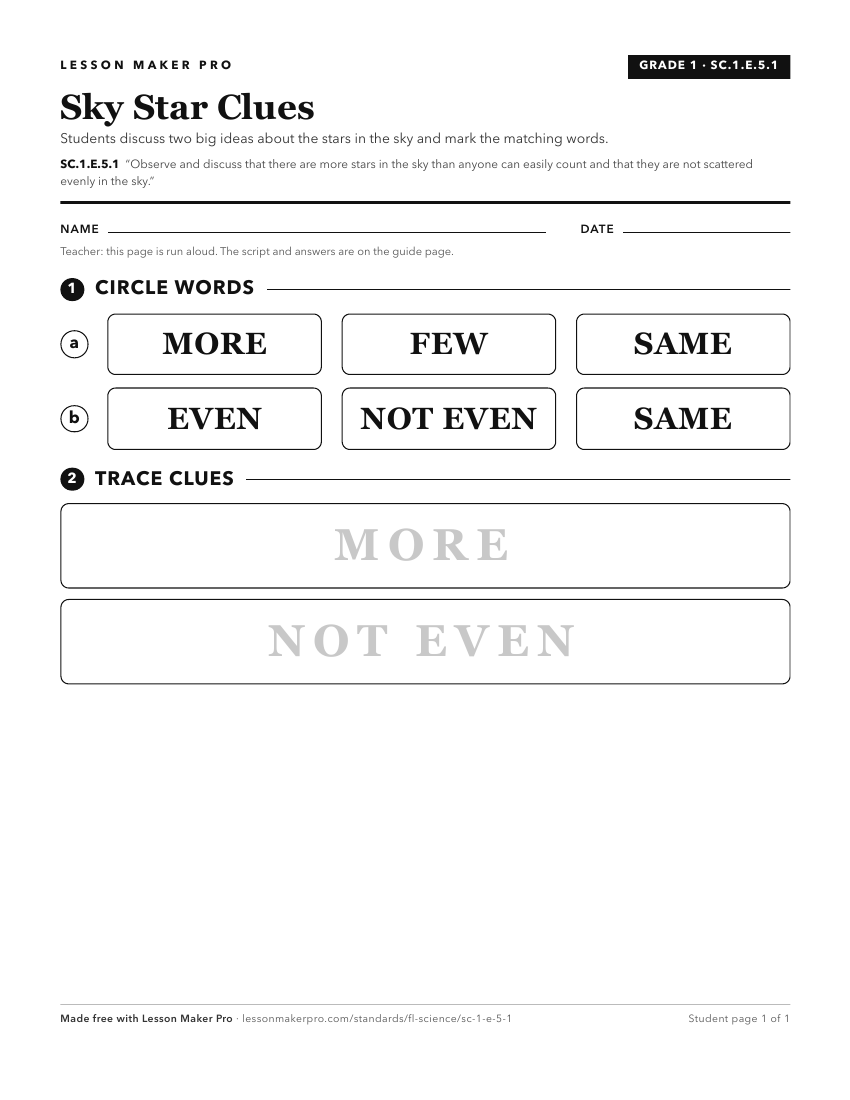
A ready-to-print activity worksheet aligned to SC.1.E.5.1, with an answer key for the teacher on its own page. No account needed.
PDF, US Letter, prints cleanly in black and white.
Download the worksheetKeep exploring
Related Standards
- SC.4.E.5.1
Observe that the patterns of stars in the sky stay the same although they appear to shift across the sky nightly, and different stars can be seen in different s...
- SC.3.E.5.1
Explain that stars can be different; some are smaller, some are larger, and some appear brighter than others; all except the Sun are so far away that they look ...
- SC.8.E.5.2
Recognize that the universe contains many billions of galaxies and that each galaxy contains many billions of stars.
- SC.3.E.5.5
Investigate that the number of stars that can be seen through telescopes is dramatically greater than those seen by the unaided eye.
Turn this exact standard into a lesson
Grade, subject, topic, and the complete standard are prefilled. Create one free, no account needed.
Also for this standard:Make a WorksheetMake a QuizMake a Sub Lesson