Florida SC.4.P.11.2
The Standard
Identify common materials that conduct heat well or poorly.
Florida Next Generation Sunshine State Standards for Science
Teacher's field guide
What This Standard Means
What Students Need to Do
- Students compare how quickly heat moves through everyday materials such as metal, wood, plastic, glass, and fabric. They use observations to sort materials by heat transfer rate.
What Mastery Looks Like
- Students correctly classify common metals as good heat conductors and materials such as wood, plastic, and fabric as poor conductors. They support each choice with test results or observations.
Common Misconceptions
- Students may think materials that feel cold are always colder, rather than transferring heat from the hand more quickly. They may also think poor conductors block all heat instead of slowing its movement.
How to Assess It
- Exit ticket: Sort aluminum foil, a wooden craft stick, a plastic spoon, and a steel paper clip into two heat transfer groups. Explain one choice.
Lesson moves
Ways to Teach It
Place metal, wood, and plastic spoons in warm water, then compare how quickly equal dots of butter soften on each handle.
Ask students to explain why cooking pots are often metal but their handles may be wood or plastic.
Play a material sort relay using cards labeled aluminum, copper, wood, rubber, glass, fabric, plastic, and steel.
Inspect a lunch box, oven mitt, or travel mug and identify materials chosen to slow or speed heat transfer.
Free download
Printable SC.4.P.11.2 Worksheet
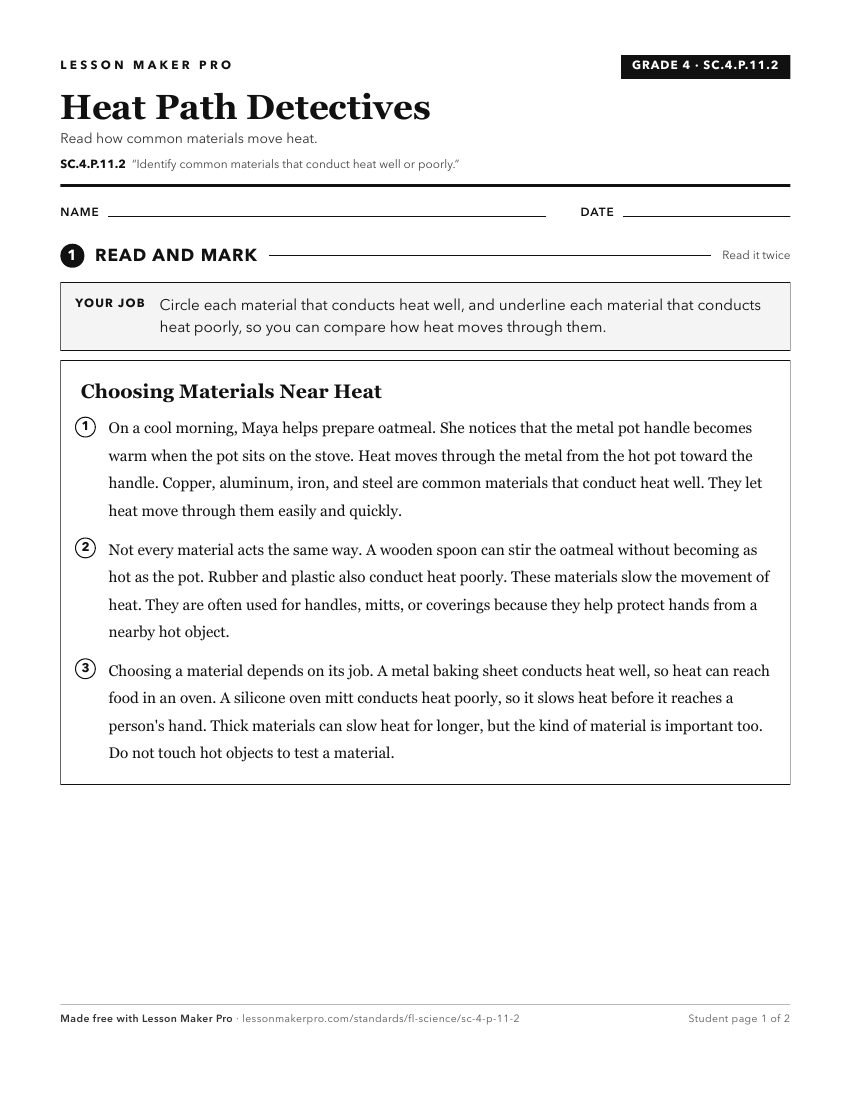
A ready-to-print activity worksheet aligned to SC.4.P.11.2, with an answer key for the teacher on its own page. No account needed.
PDF, US Letter, prints cleanly in black and white.
Download the worksheetKeep exploring
Related Standards
- SC.3.P.8.1
Measure and compare temperatures of various samples of solids and liquids.
- SC.5.P.11.2
Identify and classify materials that conduct electricity and materials that do not.
- SC.4.P.11.1
Recognize that heat flows from a hot object to a cold object and that heat flow may cause materials to change temperature.
- SC.7.P.11.4
Observe and describe that heat flows in predictable ways, moving from warmer objects to cooler ones until they reach the same temperature.
Turn this exact standard into a lesson
Grade, subject, topic, and the complete standard are prefilled. Create one free, no account needed.
Also for this standard:Make a WorksheetMake a QuizMake a Sub Lesson