Florida SC.5.P.11.2
The Standard
Identify and classify materials that conduct electricity and materials that do not.
Florida Next Generation Sunshine State Standards for Science
Teacher's field guide
What This Standard Means
What Students Need to Do
- Students use a simple circuit to test common materials. They sort each material as a conductor or insulator based on whether the bulb lights.
What Mastery Looks Like
- A student can test an unknown material in a complete circuit and record the result. The student classifies it correctly and uses test evidence to explain the choice.
Common Misconceptions
- Students may think every shiny object conducts or every metal object is magnetic. They may also blame the test material when a loose wire or dead battery keeps the bulb off.
How to Assess It
- Give students a battery, bulb, wires, coin, rubber band, and craft stick. Ask them to test, classify, and cite one observation for each material.
Lesson moves
Ways to Teach It
Build a tester with a cell, bulb, and wires, then test foil, a paper clip, wood, rubber, and plastic.
Ask students to explain why an electrical wire has a metal center and a plastic covering.
Play a prediction game using material cards, then award points when circuit tests confirm each conductor or insulator choice.
Examine an unplugged cord sample or cross section photo and label the conducting core and insulating cover.
Free download
Printable SC.5.P.11.2 Worksheet
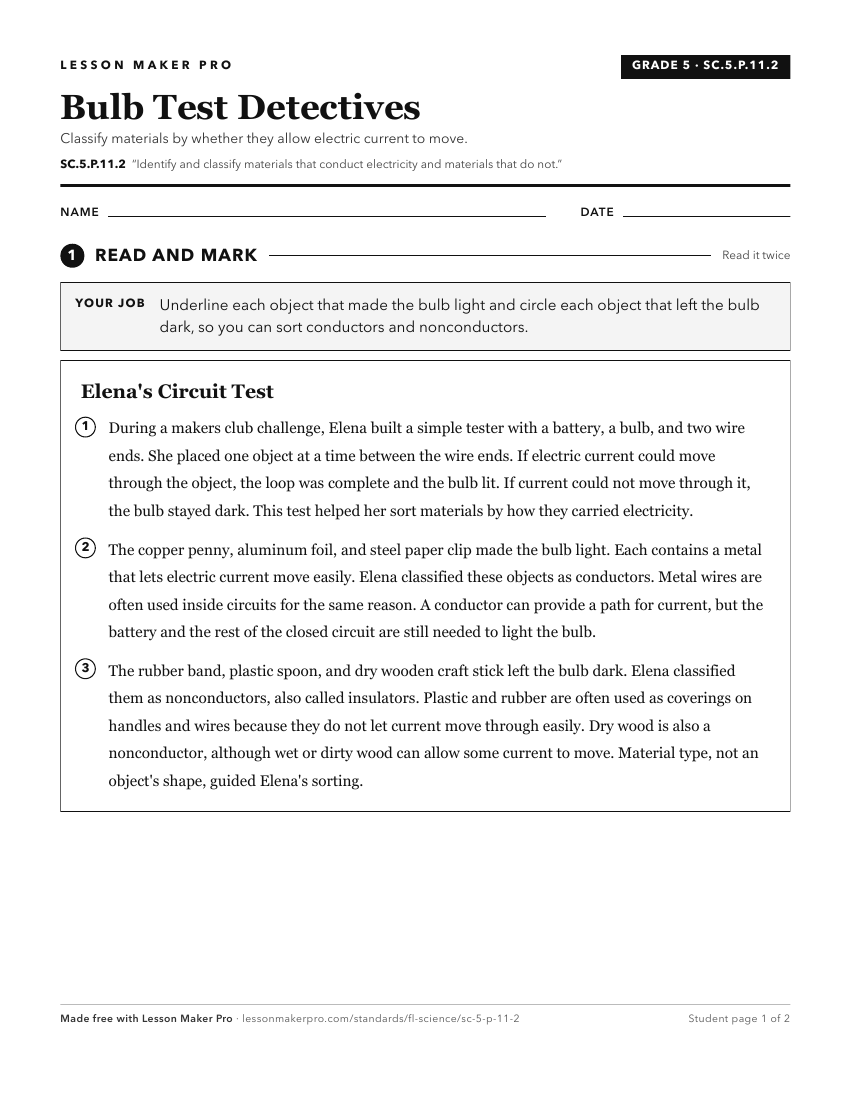
A ready-to-print activity worksheet aligned to SC.5.P.11.2, with an answer key for the teacher on its own page. No account needed.
PDF, US Letter, prints cleanly in black and white.
Download the worksheetKeep exploring
Related Standards
- SC.2.P.8.2
Identify objects and materials as solid, liquid, or gas.
- SC.4.P.11.2
Identify common materials that conduct heat well or poorly.
- SC.8.P.8.4
Classify and compare substances on the basis of characteristic physical properties that can be demonstrated or measured; for example, density, thermal or electr...
- SC.5.P.10.3
Investigate and explain that an electrically-charged object can attract an uncharged object and can either attract or repel another charged object without any c...
Turn this exact standard into a lesson
Grade, subject, topic, and the complete standard are prefilled. Create one free, no account needed.
Also for this standard:Make a WorksheetMake a QuizMake a Sub Lesson