Florida SC.3.P.8.1
The Standard
Measure and compare temperatures of various samples of solids and liquids.
Florida Next Generation Sunshine State Standards for Science
Teacher's field guide
What This Standard Means
What Students Need to Do
- Students use a thermometer to measure solid and liquid samples. They record each reading with the correct unit, then identify which sample is warmer, cooler, or the same temperature.
What Mastery Looks Like
- Students place the thermometer correctly, wait for the reading to settle, and read the scale accurately. They compare recorded temperatures using numbers as evidence.
Common Misconceptions
- Students may think larger samples always have higher temperatures or that solids do not have temperature. They may trust touch instead of a thermometer, misread scale intervals, or confuse Fahrenheit and Celsius.
How to Assess It
- Give each student a cup of room-temperature water and a chilled metal spoon. Ask them to measure both, record the temperatures with units, and write one comparison sentence.
Lesson moves
Ways to Teach It
Set up warm water, cold water, a wood block, and a chilled metal spoon for students to measure, record, and order by temperature.
Ask students to write why touching two objects is less reliable than measuring them with a thermometer.
Play a matching game where students pair thermometer diagrams with temperature cards, then arrange the matches from coolest to warmest.
Measure a lunchbox drink and classroom water, then decide which one needs cooling before lunch based on the recorded temperatures.
Free download
Printable SC.3.P.8.1 Worksheet
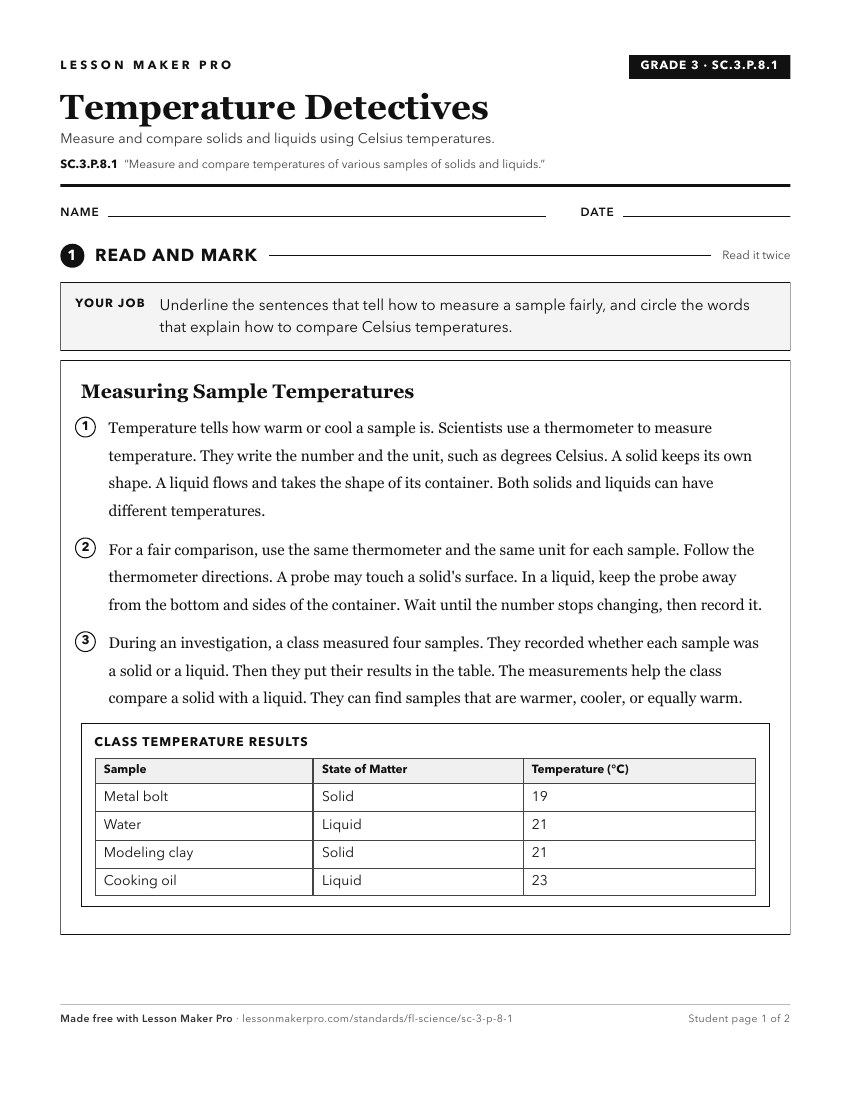
A ready-to-print activity worksheet aligned to SC.3.P.8.1, with an answer key for the teacher on its own page. No account needed.
PDF, US Letter, prints cleanly in black and white.
Download the worksheetKeep exploring
Related Standards
- SC.3.P.8.2
Measure and compare the mass and volume of solids and liquids.
- SC.2.P.8.5
Measure and compare temperatures taken every day at the same time.
- SC.2.P.8.6
Measure and compare the volume of liquids using containers of various shapes and sizes.
- SC.8.P.8.4
Classify and compare substances on the basis of characteristic physical properties that can be demonstrated or measured; for example, density, thermal or electr...
Turn this exact standard into a lesson
Grade, subject, topic, and the complete standard are prefilled. Create one free, no account needed.
Also for this standard:Make a WorksheetMake a QuizMake a Sub Lesson