Florida SC.3.P.8.2
The Standard
Measure and compare the mass and volume of solids and liquids.
Florida Next Generation Sunshine State Standards for Science
Teacher's field guide
What This Standard Means
What Students Need to Do
- Students use balances, graduated cylinders, measuring cups, or unit cubes to measure samples. They record the correct units and compare measurements using numbers.
What Mastery Looks Like
- A student selects the right tool and measures mass in grams and volume in milliliters or cubic units. They compare samples using measurements, not appearance alone.
Common Misconceptions
- Students may assume a larger object always has more mass. They may confuse mass with volume, forget units, or read a liquid level from the wrong mark.
How to Assess It
- Give each student a small block, water, a balance, and a graduated cylinder. Ask them to measure and record one mass and one volume, then compare their results.
Lesson moves
Ways to Teach It
Have pairs measure classroom objects with a balance and unit cubes, then order the objects by mass and volume.
Ask students to explain why a large sponge can have less mass than a small rock.
Play Measurement Match by pairing sample cards with the correct tool, unit, and reasonable measurement.
Compare the mass and volume of drink containers used at lunch, such as juice boxes, water bottles, and milk cartons.
Free download
Printable SC.3.P.8.2 Worksheet
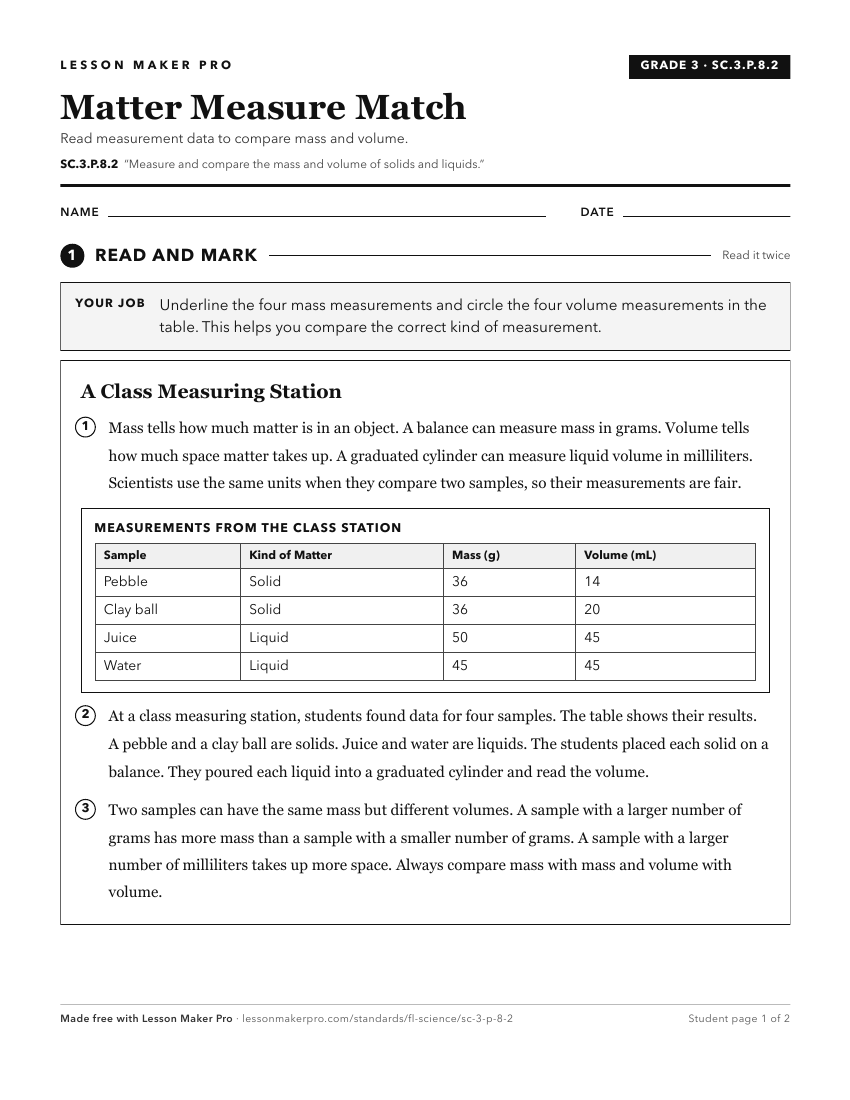
A ready-to-print activity worksheet aligned to SC.3.P.8.2, with an answer key for the teacher on its own page. No account needed.
PDF, US Letter, prints cleanly in black and white.
Download the worksheetKeep exploring
Related Standards
- SC.8.P.8.3
Explore and describe the densities of various materials through measurement of their masses and volumes.
- SC.3.P.8.1
Measure and compare temperatures of various samples of solids and liquids.
- SC.5.P.8.1
Compare and contrast the basic properties of solids, liquids, and gases, such as mass, volume, color, texture, and temperature.
- SC.2.P.8.6
Measure and compare the volume of liquids using containers of various shapes and sizes.
Turn this exact standard into a lesson
Grade, subject, topic, and the complete standard are prefilled. Create one free, no account needed.
Also for this standard:Make a WorksheetMake a QuizMake a Sub Lesson