Florida SC.8.P.8.3
The Standard
Explore and describe the densities of various materials through measurement of their masses and volumes.
Florida Next Generation Sunshine State Standards for Science
Teacher's field guide
What This Standard Means
What Students Need to Do
- Students measure mass with a balance and volume with a graduated cylinder or dimensions. They calculate density by dividing mass by volume and compare materials using correct units.
What Mastery Looks Like
- Given an unknown solid or liquid, students collect reliable measurements and calculate its density. They can explain why sample size changes mass and volume but not density.
Common Misconceptions
- Students may confuse mass with volume or divide volume by mass. They may think a larger sample is always denser. Some misread graduated cylinders or forget to subtract displaced water when finding irregular volume.
How to Assess It
- Exit ticket: A block has a mass of 54 g and a volume of 20 cm³. Calculate its density, show your setup, and include units.
Lesson moves
Ways to Teach It
Set out aluminum, wood, plastic, and clay samples for students to measure, calculate density, and rank from least to greatest.
Ask students to write: Why do two aluminum pieces with different masses have the same density?
Run a density card match with separate mass, volume, density, and material cards that teams combine into correct sets.
Have students identify an unknown metal part by measuring its density and matching the result to a reference table.
Free download
Printable SC.8.P.8.3 Worksheet
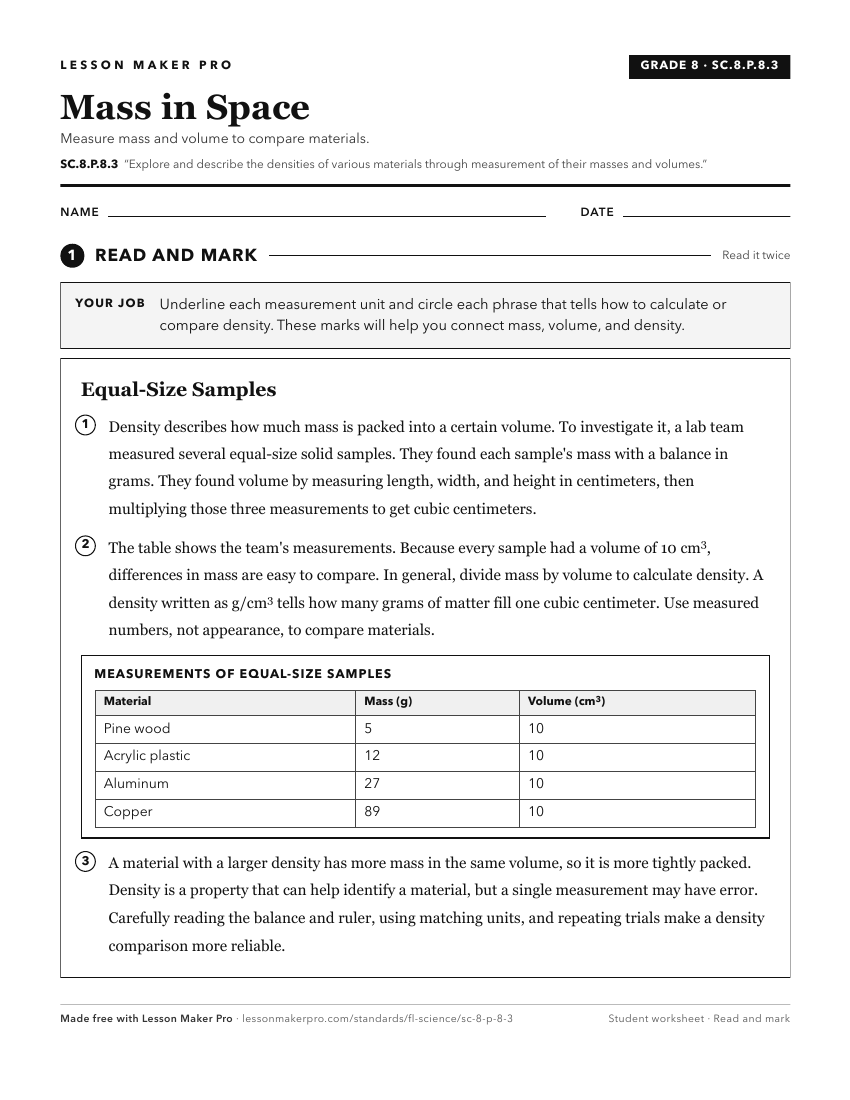
A ready-to-print activity worksheet aligned to SC.8.P.8.3, with an answer key for the teacher on its own page. No account needed.
PDF, US Letter, prints cleanly in black and white.
Download the worksheetKeep exploring
Related Standards
- SC.4.P.8.1
Measure and compare objects and materials based on their physical properties including: mass, shape, volume, color, hardness, texture, odor, taste, attraction t...
- SC.3.P.8.2
Measure and compare the mass and volume of solids and liquids.
- SC.5.P.8.1
Compare and contrast the basic properties of solids, liquids, and gases, such as mass, volume, color, texture, and temperature.
- SC.2.P.8.6
Measure and compare the volume of liquids using containers of various shapes and sizes.
Turn this exact standard into a lesson
Grade, subject, topic, and the complete standard are prefilled. Create one free, no account needed.
Also for this standard:Make a WorksheetMake a QuizMake a Sub Lesson