Florida SC.4.N.3.1
The Standard
Explain that models can be three dimensional, two dimensional, an explanation in your mind, or a computer model.
Florida Next Generation Sunshine State Standards for Science
Teacher's field guide
What This Standard Means
What Students Need to Do
- Students recognize that scientists represent objects, systems, and ideas in several forms. They explain how physical objects, drawings, mental pictures, and computer simulations can each serve as models.
What Mastery Looks Like
- Students correctly identify the form of a model from an example. They describe what the model shows and give one way it helps someone understand the real thing.
Common Misconceptions
- Students may think every model must be a small physical copy. They may not recognize diagrams or mental pictures as models. They may also assume models include every detail and are always correct.
How to Assess It
- Give students four examples: a globe, a food web diagram, an imagined water cycle, and a weather simulation. Ask them to identify each form and explain how one helps scientists.
Lesson moves
Ways to Teach It
Build a clay volcano, sketch it from above, then compare what each model shows and leaves out.
Write about how a mental picture of the solar system differs from a classroom model of it.
Sort example cards into physical, drawn, mental, and computer model groups, then defend one choice to a partner.
Examine a digital weather forecast map and list two ways it models conditions people cannot see directly.
Free download
Printable SC.4.N.3.1 Worksheet
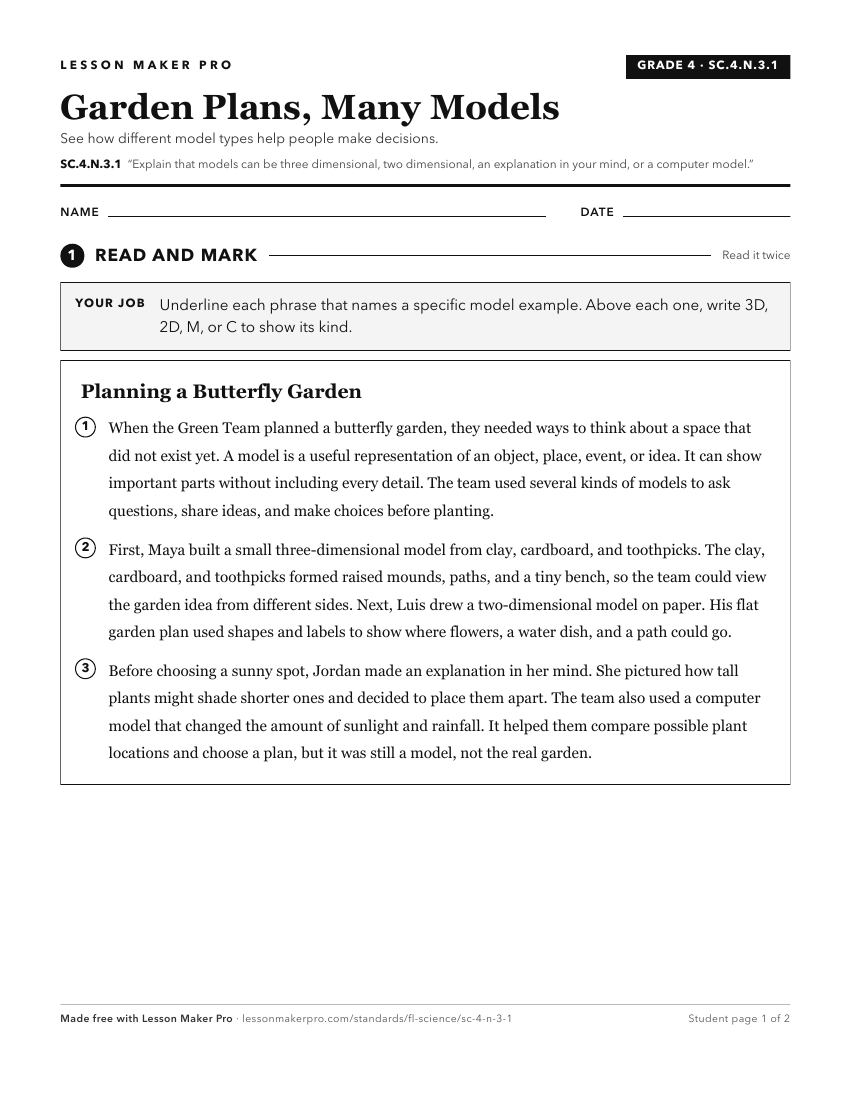
A ready-to-print activity worksheet aligned to SC.4.N.3.1, with an answer key for the teacher on its own page. No account needed.
PDF, US Letter, prints cleanly in black and white.
Download the worksheetKeep exploring
Related Standards
- SC.3.N.3.3
Recognize that all models are approximations of natural phenomena; as such, they do not perfectly account for all observations.
- SC.3.N.3.2
Recognize that scientists use models to help understand and explain how things work.
- SC.5.E.7.1
Create a model to explain the parts of the water cycle. Water can be a gas, a liquid, or a solid and can go back and forth from one state to another.
- SC.7.N.3.2
Identify the benefits and limitations of the use of scientific models.
Turn this exact standard into a lesson
Grade, subject, topic, and the complete standard are prefilled. Create one free, no account needed.
Also for this standard:Make a WorksheetMake a QuizMake a Sub Lesson