Florida SC.4.E.6.1
The Standard
Identify the three categories of rocks: igneous, (formed from molten rock); sedimentary (pieces of other rocks and fossilized organisms); and metamorphic (formed from heat and pressure).
Florida Next Generation Sunshine State Standards for Science
Teacher's field guide
What This Standard Means
What Students Need to Do
- Students sort rocks into igneous, sedimentary, and metamorphic groups. They use clues about how each rock formed to explain each choice.
What Mastery Looks Like
- A student names all three rock groups and matches each one to its formation process. Given a rock description, the student identifies the group and cites supporting clues.
Common Misconceptions
- Students may think metamorphic rock melts during formation, but melting would produce igneous rock. They may think igneous rocks form only from lava, or overlook fossils in sedimentary rocks.
How to Assess It
- Exit ticket: Classify three rocks described as cooled molten rock, pressed layers with shells, and rock changed by heat and pressure. Explain one choice.
Lesson moves
Ways to Teach It
Give pairs hand lenses and rock samples or photo cards to sort, then have them label the formation clue used for each group.
Ask students to write how one rock could change into another rock type without naming the rock cycle.
Play a three-corner game where students move to igneous, sedimentary, or metamorphic signs after hearing a formation clue.
Examine photos of granite countertops, slate roofs, and limestone buildings, then connect each material to its rock group and formation.
Free download
Printable SC.4.E.6.1 Worksheet
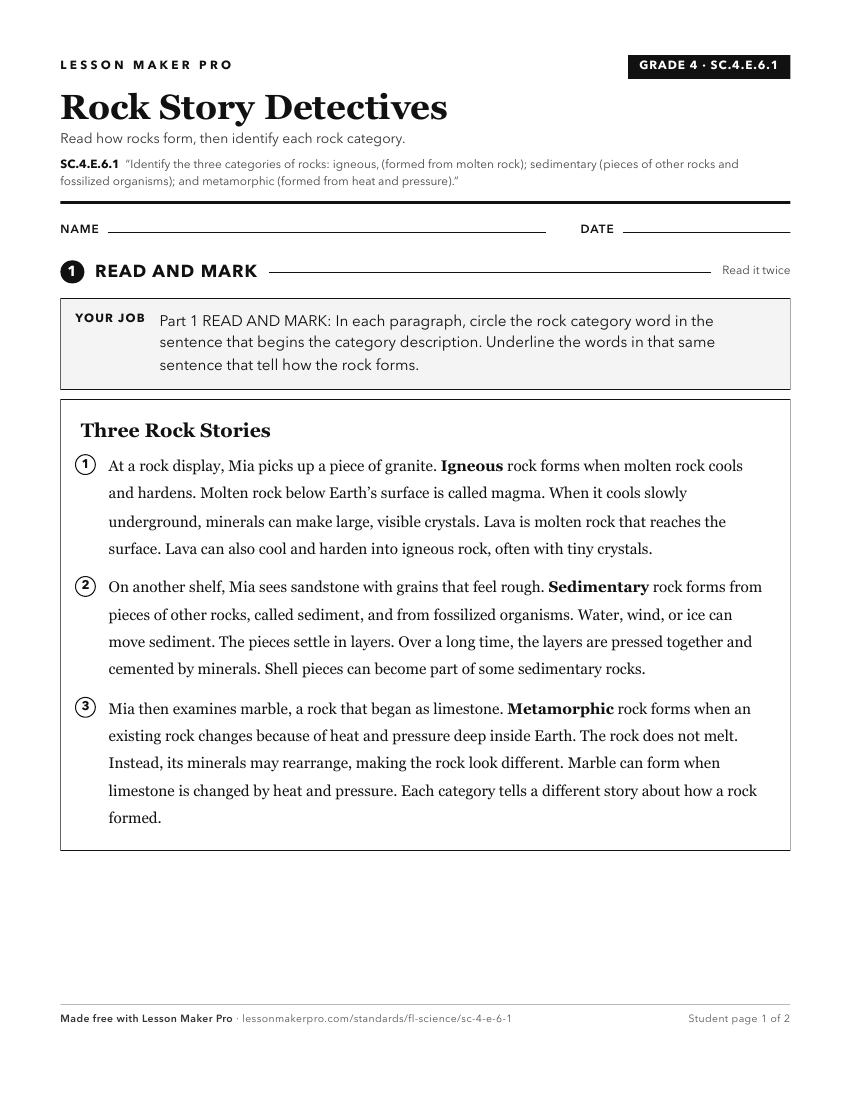
A ready-to-print activity worksheet aligned to SC.4.E.6.1, with an answer key for the teacher on its own page. No account needed.
PDF, US Letter, prints cleanly in black and white.
Download the worksheetKeep exploring
Related Standards
- SC.2.E.6.2
Describe how small pieces of rock and dead plant and animal parts can be the basis of soil and explain the process by which soil is formed.
- SC.2.E.6.1
Recognize that Earth is made up of rocks. Rocks come in many sizes and shapes.
- SC.4.E.6.2
Identify the physical properties of common earth-forming minerals, including hardness, color, luster, cleavage, and streak color, and recognize the role of mine...
- SC.7.E.6.2
Identify the patterns within the rock cycle and relate them to surface events (weathering and erosion) and sub-surface events (plate tectonics and mountain buil...
Turn this exact standard into a lesson
Grade, subject, topic, and the complete standard are prefilled. Create one free, no account needed.
Also for this standard:Make a WorksheetMake a QuizMake a Sub Lesson