Florida SC.7.E.6.2
The Standard
Identify the patterns within the rock cycle and relate them to surface events (weathering and erosion) and sub-surface events (plate tectonics and mountain building).
Florida Next Generation Sunshine State Standards for Science
Teacher's field guide
What This Standard Means
What Students Need to Do
- Students trace how igneous, sedimentary, and metamorphic rocks can change from one type to another. They connect weathering, erosion, burial, heat, pressure, melting, uplift, and cooling to each change.
What Mastery Looks Like
- Students can complete a rock cycle diagram and label each arrow with the process causing the change. They can explain how surface and underground events create more than one possible pathway through the cycle.
Common Misconceptions
- Students often treat the rock cycle as one fixed sequence. They may confuse weathering, which breaks rock apart, with erosion, which moves sediment. Some think rocks must melt before becoming metamorphic.
How to Assess It
- Give students a blank rock cycle diagram with three rock types and four arrows. Ask them to label each arrow and explain one surface process and one underground process.
Lesson moves
Ways to Teach It
Give groups rock and process cards, then have them build and revise several valid rock cycle pathways on chart paper.
Ask students to explain how a mountain rock could become beach sand, then later become sedimentary rock.
Play Rock Cycle Relay, where teams match event cards such as uplift, melting, or erosion to the correct rock change.
Use photos of a local beach, riverbank, road cut, or sinkhole to identify visible evidence of weathering, erosion, deposition, and uplift.
Free download
Printable SC.7.E.6.2 Worksheet
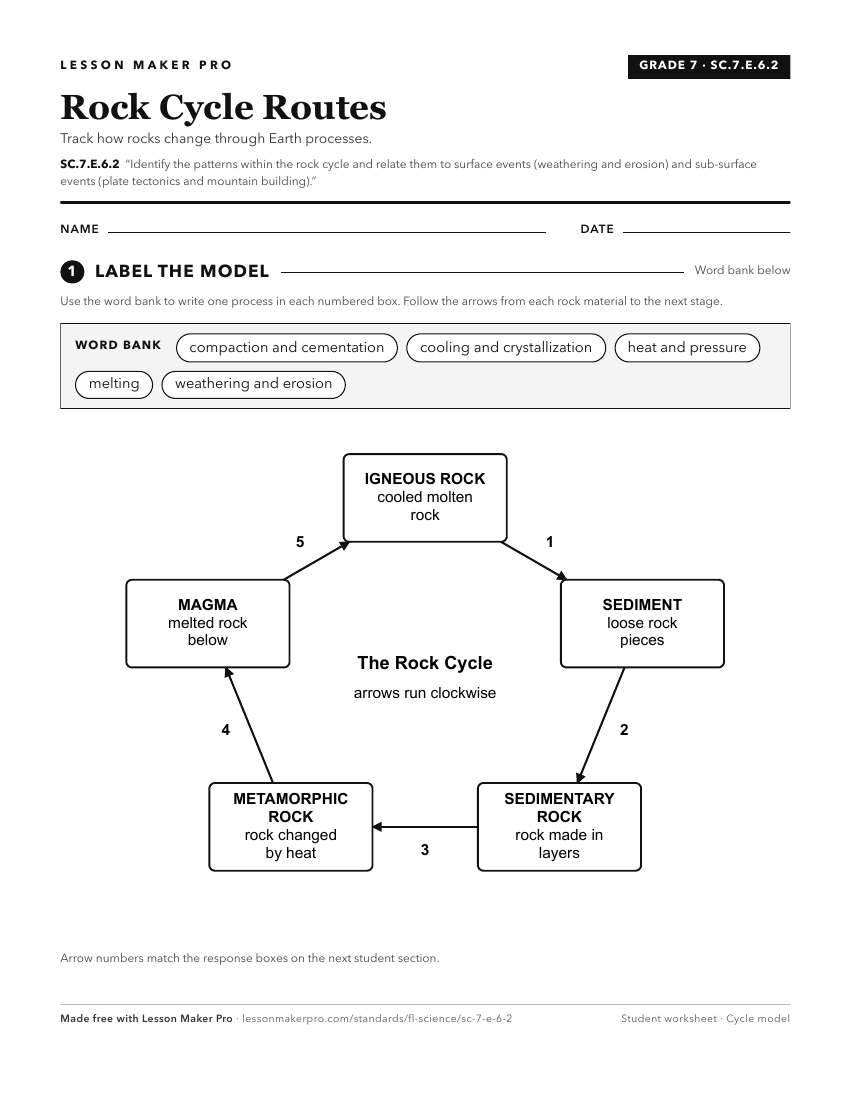
A ready-to-print activity worksheet aligned to SC.7.E.6.2, with an answer key for the teacher on its own page. No account needed.
PDF, US Letter, prints cleanly in black and white.
Download the worksheetKeep exploring
Related Standards
- SC.7.E.6.5
Explore the scientific theory of plate tectonics by describing how the movement of Earth's crustal plates causes both slow and rapid changes in Earth's surface,...
- SC.6.E.6.1
Describe and give examples of ways in which Earth's surface is built up and torn down by physical and chemical weathering, erosion, and deposition.
- SC.2.E.7.1
Compare and describe changing patterns in nature that repeat themselves, such as weather conditions including temperature and precipitation, day to day and seas...
- SC.7.E.6.7
Recognize that heat flow and movement of material within Earth causes earthquakes and volcanic eruptions, and creates mountains and ocean basins.
Turn this exact standard into a lesson
Grade, subject, topic, and the complete standard are prefilled. Create one free, no account needed.
Also for this standard:Make a WorksheetMake a QuizMake a Sub Lesson