Florida SC.7.E.6.5
The Standard
Explore the scientific theory of plate tectonics by describing how the movement of Earth's crustal plates causes both slow and rapid changes in Earth's surface, including volcanic eruptions, earthquakes, and mountain building.
Florida Next Generation Sunshine State Standards for Science
Teacher's field guide
What This Standard Means
What Students Need to Do
- Students use maps and models to explain how moving crustal plates change Earth's surface. They connect slow mountain building and rapid earthquakes or eruptions to movement at plate boundaries.
What Mastery Looks Like
- Given a plate map, students can identify where earthquakes, volcanoes, or mountains are likely to occur. They can explain how plate direction and boundary movement produce each change.
Common Misconceptions
- Students may think plates are only continents or that they move across a fully liquid layer. They may also think earthquakes and volcanoes occur randomly. Some confuse slow plate movement with the rapid events it can trigger.
How to Assess It
- Give students a diagram of two plates moving toward each other. Ask them to draw arrows and explain one slow change and one rapid change that could result.
Lesson moves
Ways to Teach It
Move graham cracker pieces across frosting to model plates colliding, separating, and sliding past each other, then record the surface changes.
Write a response to this prompt: How can plates move slowly but still cause a sudden earthquake?
Sort earthquake, volcano, and mountain cards onto convergent, divergent, or transform boundary mats, then justify each placement.
Use a current USGS earthquake map and a plate boundary map to identify patterns and explain two event locations.
Free download
Printable SC.7.E.6.5 Worksheet
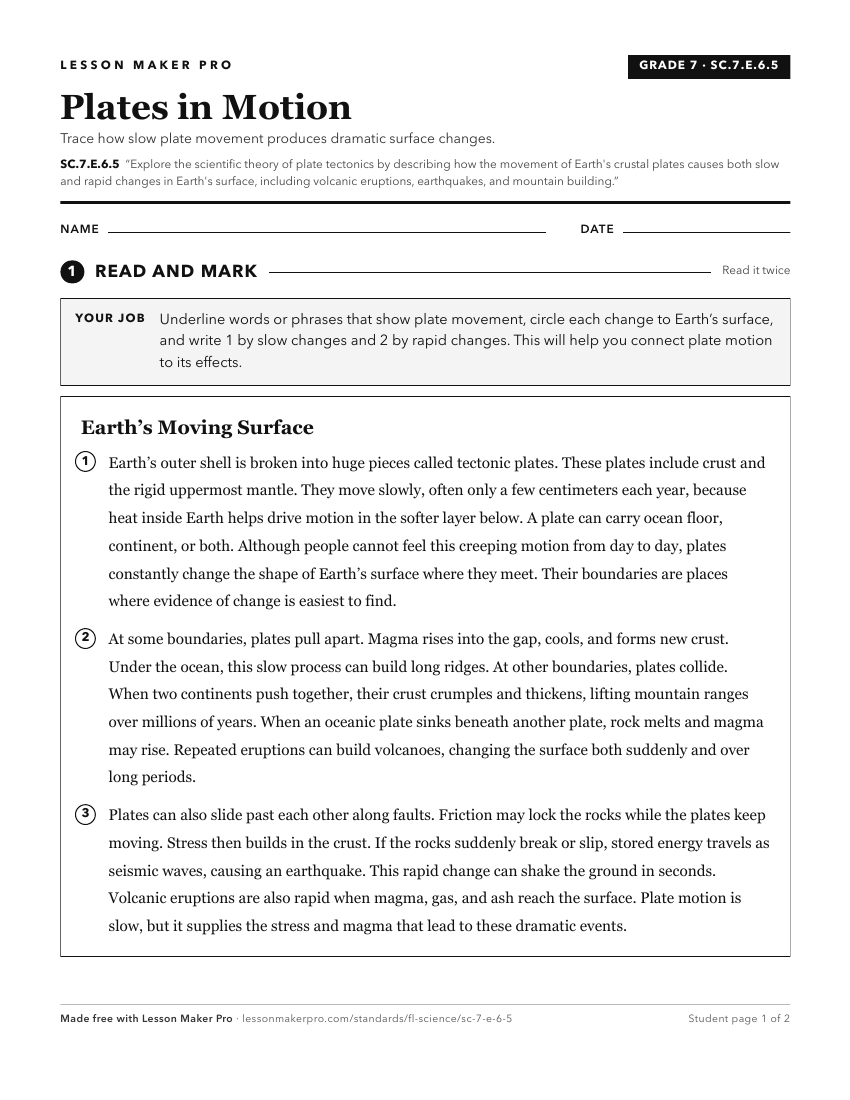
A ready-to-print activity worksheet aligned to SC.7.E.6.5, with an answer key for the teacher on its own page. No account needed.
PDF, US Letter, prints cleanly in black and white.
Download the worksheetKeep exploring
Related Standards
- SC.7.E.6.4
Explain and give examples of how physical evidence supports scientific theories that Earth has evolved over geologic time due to natural processes.
- SC.6.E.6.1
Describe and give examples of ways in which Earth's surface is built up and torn down by physical and chemical weathering, erosion, and deposition.
- SC.7.E.6.7
Recognize that heat flow and movement of material within Earth causes earthquakes and volcanic eruptions, and creates mountains and ocean basins.
- SC.7.E.6.2
Identify the patterns within the rock cycle and relate them to surface events (weathering and erosion) and sub-surface events (plate tectonics and mountain buil...
Turn this exact standard into a lesson
Grade, subject, topic, and the complete standard are prefilled. Create one free, no account needed.
Also for this standard:Make a WorksheetMake a QuizMake a Sub Lesson