Florida SC.2.E.6.2
The Standard
Describe how small pieces of rock and dead plant and animal parts can be the basis of soil and explain the process by which soil is formed.
Florida Next Generation Sunshine State Standards for Science
Teacher's field guide
What This Standard Means
What Students Need to Do
- Students explain that weathered rock fragments and broken-down living remains become soil ingredients. They put soil formation events in order and recognize that the process takes time.
What Mastery Looks Like
- A student can describe rock breaking into smaller fragments and once-living material decaying. The student explains that these materials mix over time to form soil.
Common Misconceptions
- Students may think soil is only crushed rock or that dead leaves stay whole underground. They may also think soil forms as soon as materials are mixed.
How to Assess It
- Exit ticket: Draw three panels showing a rock and fallen leaf becoming part of soil. Label what changes in each panel.
Lesson moves
Ways to Teach It
Use hand lenses to examine sand, soil, rock fragments, and decayed leaves, then list the materials found in soil.
Write a response to: How could a rock and a fallen leaf both become part of soil?
Sequence picture cards showing rock weathering, leaves decaying, fragments mixing, and soil forming over time.
Compare soil beneath leaf litter with soil beside a bare playground area, recording color, texture, and visible materials.
Free download
Printable SC.2.E.6.2 Worksheet
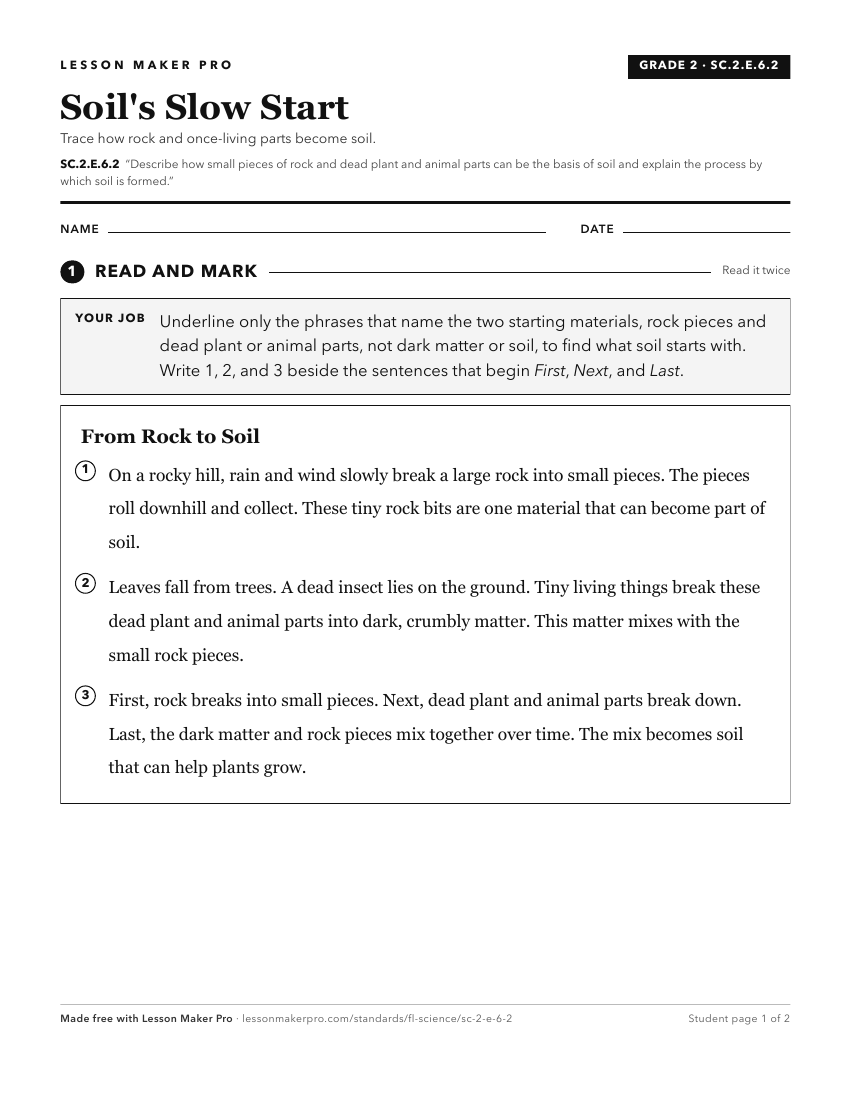
A ready-to-print activity worksheet aligned to SC.2.E.6.2, with an answer key for the teacher on its own page. No account needed.
PDF, US Letter, prints cleanly in black and white.
Download the worksheetKeep exploring
Related Standards
- SC.7.E.6.4
Explain and give examples of how physical evidence supports scientific theories that Earth has evolved over geologic time due to natural processes.
- SC.6.E.6.1
Describe and give examples of ways in which Earth's surface is built up and torn down by physical and chemical weathering, erosion, and deposition.
- SC.2.E.6.1
Recognize that Earth is made up of rocks. Rocks come in many sizes and shapes.
- SC.4.E.6.1
Identify the three categories of rocks: igneous, (formed from molten rock); sedimentary (pieces of other rocks and fossilized organisms); and metamorphic (forme...
Turn this exact standard into a lesson
Grade, subject, topic, and the complete standard are prefilled. Create one free, no account needed.
Also for this standard:Make a WorksheetMake a QuizMake a Sub Lesson