Florida SC.3.N.3.1
The Standard
Recognize that words in science can have different or more specific meanings than their use in everyday language; for example, energy, cell, heat/cold, and evidence.
Florida Next Generation Sunshine State Standards for Science
Teacher's field guide
What This Standard Means
What Students Need to Do
- Students identify when a familiar word has a special meaning in science. They use the sentence or situation to explain the intended meaning.
What Mastery Looks Like
- Students can explain what words such as energy, cell, heat, cold, and evidence mean in a science context. They can give separate science and everyday examples for the same word.
Common Misconceptions
- Students may think energy only means feeling active, or cell only means a phone or jail room. They may treat cold as a substance and call any opinion or guess evidence.
How to Assess It
- Exit ticket: Compare “The Sun’s energy warmed the sidewalk” with “I have lots of energy after lunch.” Explain what energy means in each sentence.
Lesson moves
Ways to Teach It
Have students sort picture cards showing plant cells, phones, active children, batteries, thermometers, and clues into science and everyday meaning groups.
Ask students to write two sentences using cell, one with its science meaning and one with an everyday meaning.
Play Context Clue Match by pairing word cards for energy, cell, heat, cold, and evidence with short science and everyday sentences.
Examine a weather report and discuss how heat, cold, and evidence are used when meteorologists explain a forecast.
Free download
Printable SC.3.N.3.1 Worksheet
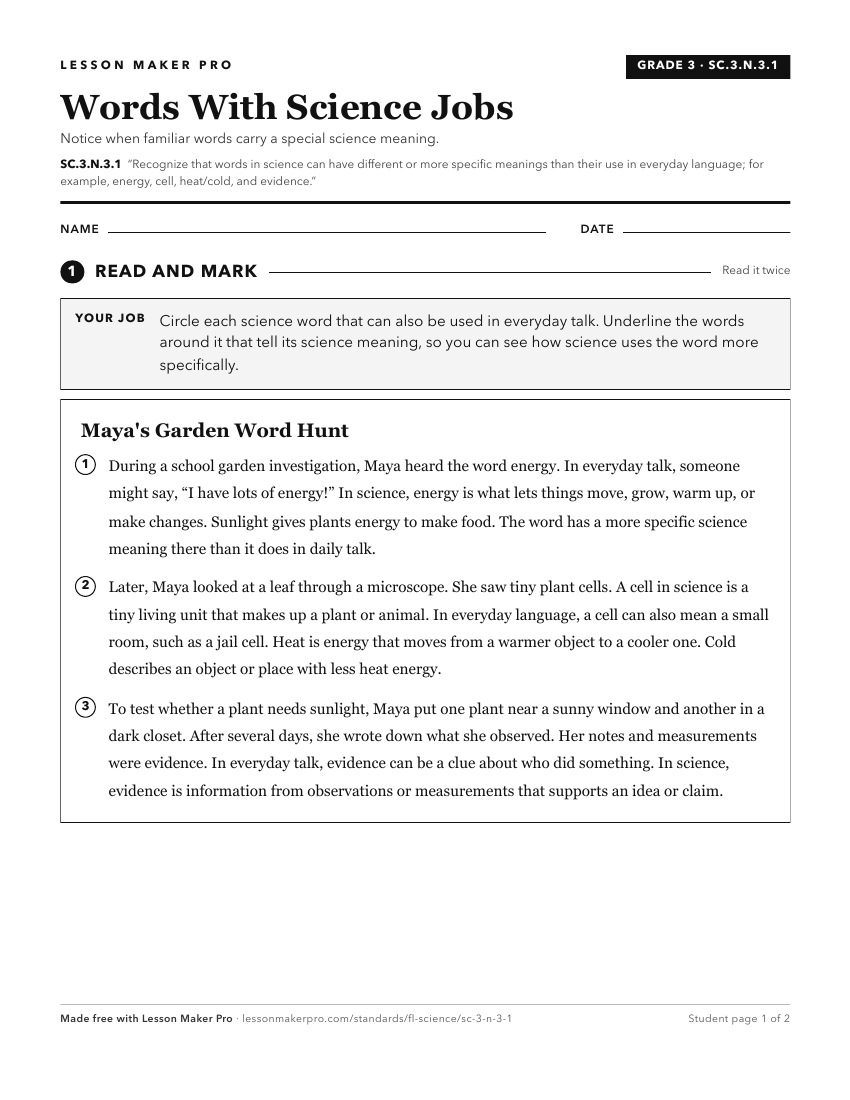
A ready-to-print activity worksheet aligned to SC.3.N.3.1, with an answer key for the teacher on its own page. No account needed.
PDF, US Letter, prints cleanly in black and white.
Download the worksheetKeep exploring
Related Standards
- SC.3.N.1.5
Recognize that scientists question, discuss, and check each other's evidence and explanations.
- SC.5.P.10.1
Investigate and describe some basic forms of energy, including light, heat, sound, electrical, chemical, and mechanical.
- SC.4.N.1.7
Recognize and explain that scientists base their explanations on evidence.
- SC.3.P.10.2
Recognize that energy has the ability to cause motion or create change.
Turn this exact standard into a lesson
Grade, subject, topic, and the complete standard are prefilled. Create one free, no account needed.
Also for this standard:Make a WorksheetMake a QuizMake a Sub Lesson