Florida SC.3.P.10.2
The Standard
Recognize that energy has the ability to cause motion or create change.
Florida Next Generation Sunshine State Standards for Science
Teacher's field guide
What This Standard Means
What Students Need to Do
- Students identify motion or change as evidence that energy is acting. They describe effects such as an object moving, warming, lighting up, making sound, or changing shape.
What Mastery Looks Like
- Students can examine a situation, name what moved or changed, and connect that effect to energy. They can support their answer with visible evidence from the situation.
Common Misconceptions
- Students may think energy is a material found only in food or batteries. They may also confuse energy with motion itself or overlook heating, light, sound, and shape changes.
How to Assess It
- Exit ticket: A battery makes a toy car move, and sunlight melts an ice cube. For each example, name the effect caused by energy.
Lesson moves
Ways to Teach It
Roll toy cars down ramps of two heights, measure travel distance, and record how the ramp setup changes each car’s motion.
Show a picture of a wind turbine and ask, “What is moving or changing, and what provides the energy?”
Sort picture cards into motion, heating, light, sound, shape change, and no visible change groups.
At recess, observe swings, slides, and bouncing balls, then name where energy causes an object to move or change.
Free download
Printable SC.3.P.10.2 Worksheet
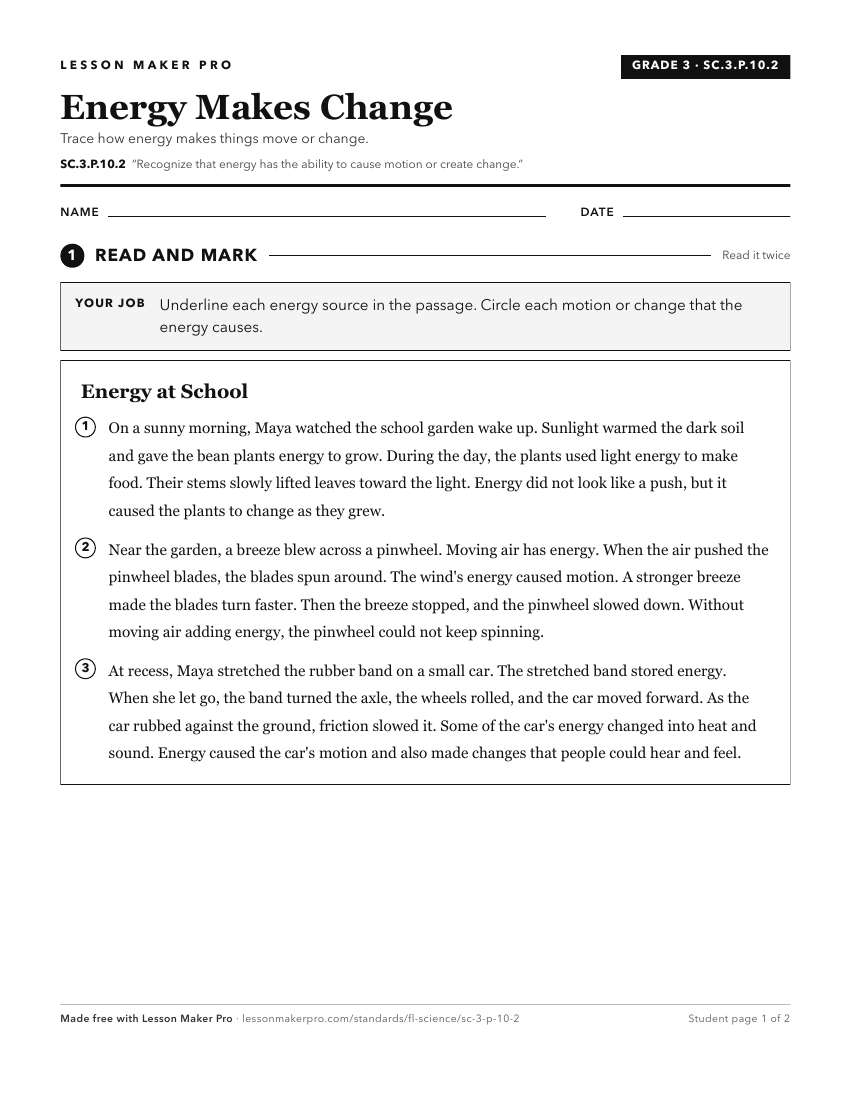
A ready-to-print activity worksheet aligned to SC.3.P.10.2, with an answer key for the teacher on its own page. No account needed.
PDF, US Letter, prints cleanly in black and white.
Download the worksheetKeep exploring
Related Standards
- SC.4.P.12.1
Recognize that an object in motion always changes its position and may change its direction.
- SC.5.P.10.4
Investigate and explain that electrical energy can be transformed into heat, light, and sound energy, as well as the energy of motion.
- SC.4.P.10.2
Investigate and describe that energy has the ability to cause motion or create change.
- SC.5.P.10.2
Investigate and explain that energy has the ability to cause motion or create change.
Turn this exact standard into a lesson
Grade, subject, topic, and the complete standard are prefilled. Create one free, no account needed.
Also for this standard:Make a WorksheetMake a QuizMake a Sub Lesson