Florida SC.4.P.12.1
The Standard
Recognize that an object in motion always changes its position and may change its direction.
Florida Next Generation Sunshine State Standards for Science
Teacher's field guide
What This Standard Means
What Students Need to Do
- Students compare an object's location at different times to decide whether it moved. They trace its path and identify where it turned.
What Mastery Looks Like
- Given pictures or observations, students accurately describe the object's starting location, ending location, and path. They point out any place where its direction changed.
Common Misconceptions
- Students may think an object moved only if it traveled far or moved quickly. They may also confuse a change in speed with a change in direction.
How to Assess It
- Give students a three-frame sketch of a ball moving from left to right, then upward. Ask them to mark evidence of motion and circle the direction change.
Lesson moves
Ways to Teach It
Roll a toy car across a taped grid, mark its location every second, and draw arrows showing its path and turns.
Show a three-frame soccer ball sketch and ask students to explain how they know it moved and where it changed direction.
Play Motion Detective with location cards, asking students to call moved or stayed and identify any turn in the path.
Draw a school bus route with two turns, then describe how the bus location and direction change along the route.
Free download
Printable SC.4.P.12.1 Worksheet
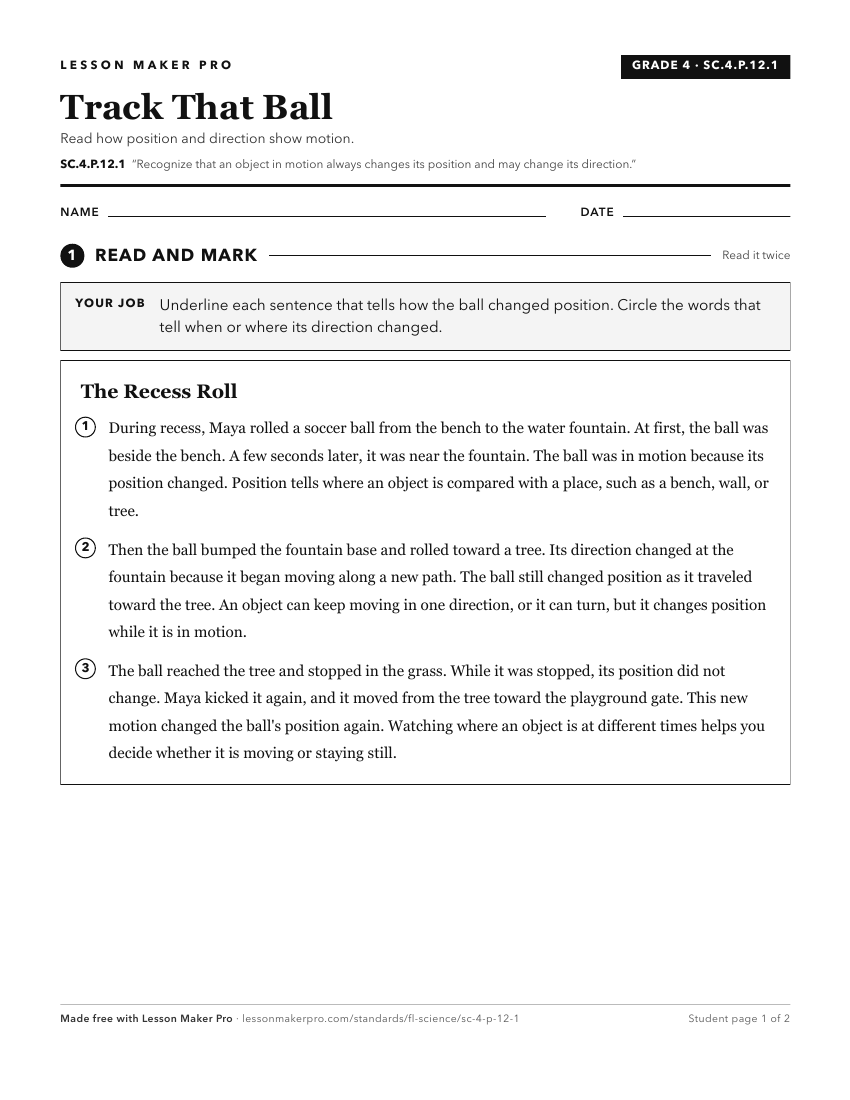
A ready-to-print activity worksheet aligned to SC.4.P.12.1, with an answer key for the teacher on its own page. No account needed.
PDF, US Letter, prints cleanly in black and white.
Download the worksheetKeep exploring
Related Standards
- SC.K.P.13.1
Observe that a push or a pull can change the way an object is moving.
- SC.1.E.6.3
Recognize that some things in the world around us happen fast and some happen slowly.
- SC.6.P.13.3
Investigate and describe that an unbalanced force acting on an object changes its speed, or direction of motion, or both.
- SC.3.P.10.2
Recognize that energy has the ability to cause motion or create change.
Turn this exact standard into a lesson
Grade, subject, topic, and the complete standard are prefilled. Create one free, no account needed.
Also for this standard:Make a WorksheetMake a QuizMake a Sub Lesson