Florida SC.1.E.6.3
The Standard
Recognize that some things in the world around us happen fast and some happen slowly.
Florida Next Generation Sunshine State Standards for Science
Teacher's field guide
What This Standard Means
What Students Need to Do
- Students compare changes by how much time they take. They identify quick changes, such as a rockslide, and gradual changes, such as a river wearing down rock.
What Mastery Looks Like
- Students sort familiar events as fast or slow and explain their choices with time clues. They understand that a gradual change may be hard to notice each day.
Common Misconceptions
- Students may think gradual changes are not happening because they cannot see movement. They may also assume large changes always happen slowly and small changes always happen quickly.
How to Assess It
- Show pictures of a rockslide and a canyon shaped by a river. Ask, “Which happened faster, and what clue supports your answer?”
Lesson moves
Ways to Teach It
Pour water quickly and then drip water slowly over two sand mounds, and compare how each mound changes.
Ask students to explain which takes longer, a wave knocking down a sandcastle or many waves smoothing a rock.
Give pairs event cards to sort into fast and slow groups, then have partners defend one choice.
Visit one schoolyard spot weekly to photograph soil, puddles, plants, or cracks and look for gradual changes.
Free download
Printable SC.1.E.6.3 Worksheet
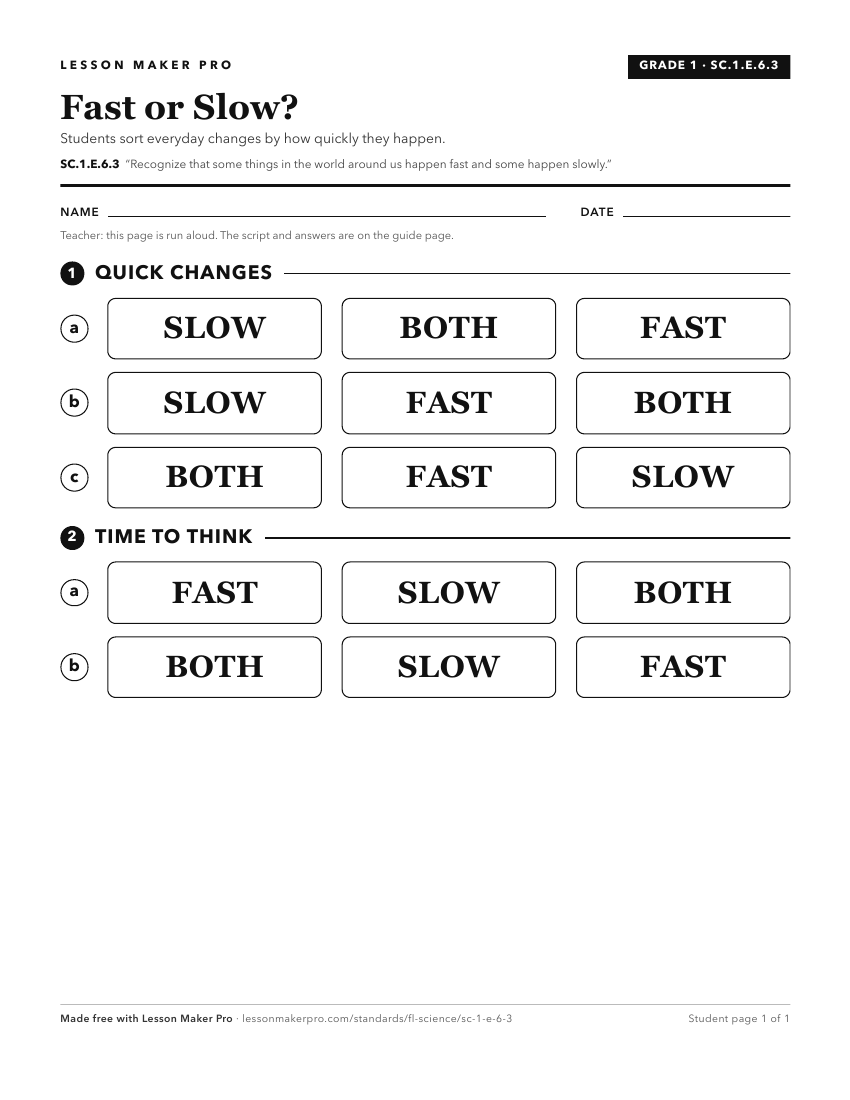
A ready-to-print activity worksheet aligned to SC.1.E.6.3, with an answer key for the teacher on its own page. No account needed.
PDF, US Letter, prints cleanly in black and white.
Download the worksheetKeep exploring
Related Standards
- SC.K.P.12.1
Investigate that things move in different ways, such as fast, slow, etc.
- SC.4.P.12.1
Recognize that an object in motion always changes its position and may change its direction.
- SC.7.P.10.3
Recognize that light waves, sound waves, and other waves move at different speeds in different materials.
- SC.K.E.5.5
Observe that things can be big and things can be small as seen from Earth.
Turn this exact standard into a lesson
Grade, subject, topic, and the complete standard are prefilled. Create one free, no account needed.
Also for this standard:Make a WorksheetMake a QuizMake a Sub Lesson