Florida SC.7.P.10.3
The Standard
Recognize that light waves, sound waves, and other waves move at different speeds in different materials.
Florida Next Generation Sunshine State Standards for Science
Teacher's field guide
What This Standard Means
What Students Need to Do
- Students read tables, diagrams, and test results to decide which wave arrives first. They identify the material as the variable and explain how changing it affects travel time.
What Mastery Looks Like
- Given equal distances and a speed table, a student correctly names which signal reaches the endpoint first. The student supports the choice with data and avoids claiming one material makes every wave faster.
Common Misconceptions
- Students may think all waves travel at one fixed speed, or that denser materials always slow every wave. Some think sound travels through empty space because light does. They may confuse greater frequency or louder volume with greater travel speed.
How to Assess It
- Exit ticket: Sound travels at 340 m/s in air and 1,500 m/s in water. Light travels at 300,000,000 m/s in air and 225,000,000 m/s in water. Circle the faster material for each wave and write one conclusion.
Lesson moves
Ways to Teach It
Have one student place an ear on a long table while a partner taps the far end, then compare the two arrivals.
Show speed data for light and sound in air and water, then ask why the faster material depends on the wave.
Give teams wave and material cards with speed values; teams race to order each set from shortest to longest travel time.
Compare sonar speed data in seawater and air, then have students explain why ship sensors must use the correct value.
Free download
Printable SC.7.P.10.3 Worksheet
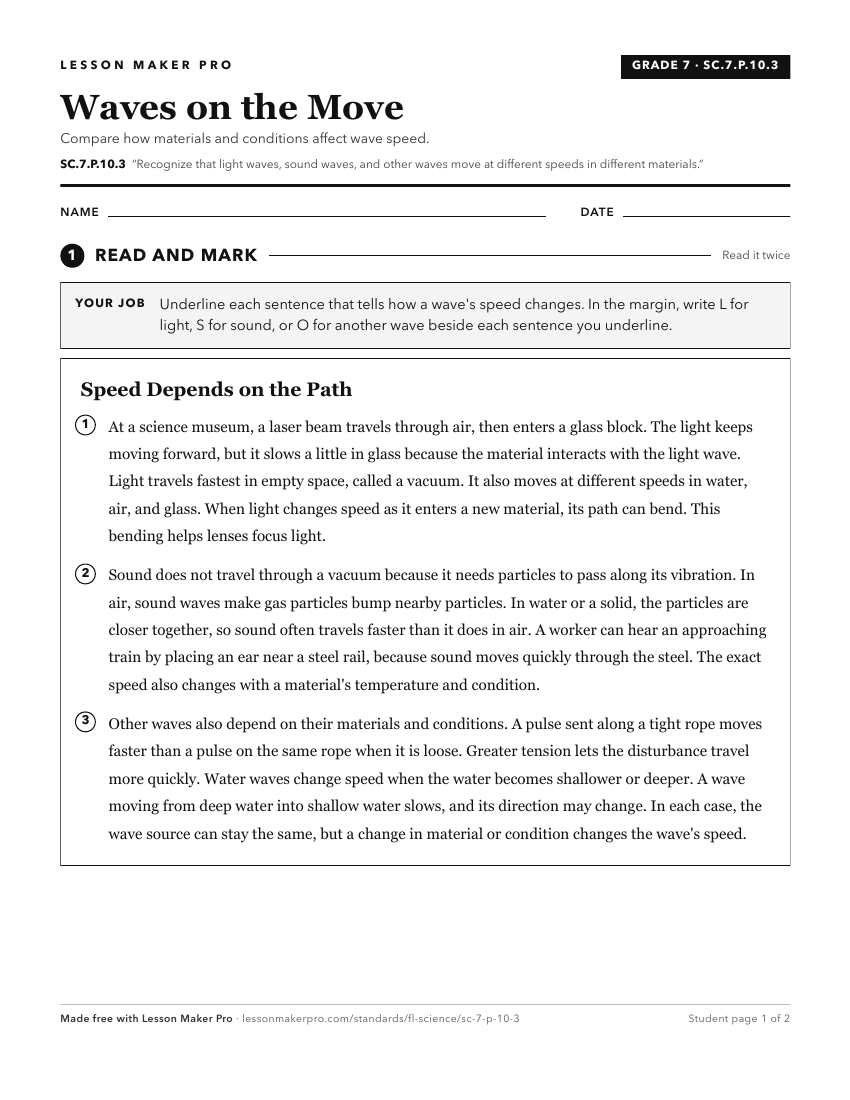
A ready-to-print activity worksheet aligned to SC.7.P.10.3, with an answer key for the teacher on its own page. No account needed.
PDF, US Letter, prints cleanly in black and white.
Download the worksheetKeep exploring
Related Standards
- SC.K.P.12.1
Investigate that things move in different ways, such as fast, slow, etc.
- SC.4.P.12.1
Recognize that an object in motion always changes its position and may change its direction.
- SC.4.P.12.2
Investigate and describe that the speed of an object is determined by the distance it travels in a unit of time and that objects can move at different speeds.
- SC.1.E.6.3
Recognize that some things in the world around us happen fast and some happen slowly.
Turn this exact standard into a lesson
Grade, subject, topic, and the complete standard are prefilled. Create one free, no account needed.
Also for this standard:Make a WorksheetMake a QuizMake a Sub Lesson