Florida SC.1.P.13.1
The Standard
Demonstrate that the way to change the motion of an object is by applying a push or a pull.
Florida Next Generation Sunshine State Standards for Science
Teacher's field guide
What This Standard Means
What Students Need to Do
- Students make an object start, stop, speed up, slow down, or change direction. They identify whether each action uses a push or a pull.
What Mastery Looks Like
- A student can use both a push and a pull to change how an object moves. The student can name the action and describe the change.
Common Misconceptions
- Students may think objects begin moving by themselves. They may confuse pushes and pulls or think touching an object always changes its motion.
How to Assess It
- Give each student a toy car with a string. Say, "Show one push and one pull that change the car's motion, then name each action."
Lesson moves
Ways to Teach It
Have students push and pull toy cars across a flat surface, then compare how each action changes the cars' motion.
Ask, "How could you move a classroom object without picking it up?" and have students draw and label their idea.
Play Push or Pull Charades using picture cards showing actions such as opening drawers, kicking balls, and pulling wagons.
Take a playground walk and identify pushes and pulls used on swings, slides, gates, balls, and wagons.
Free download
Printable SC.1.P.13.1 Worksheet
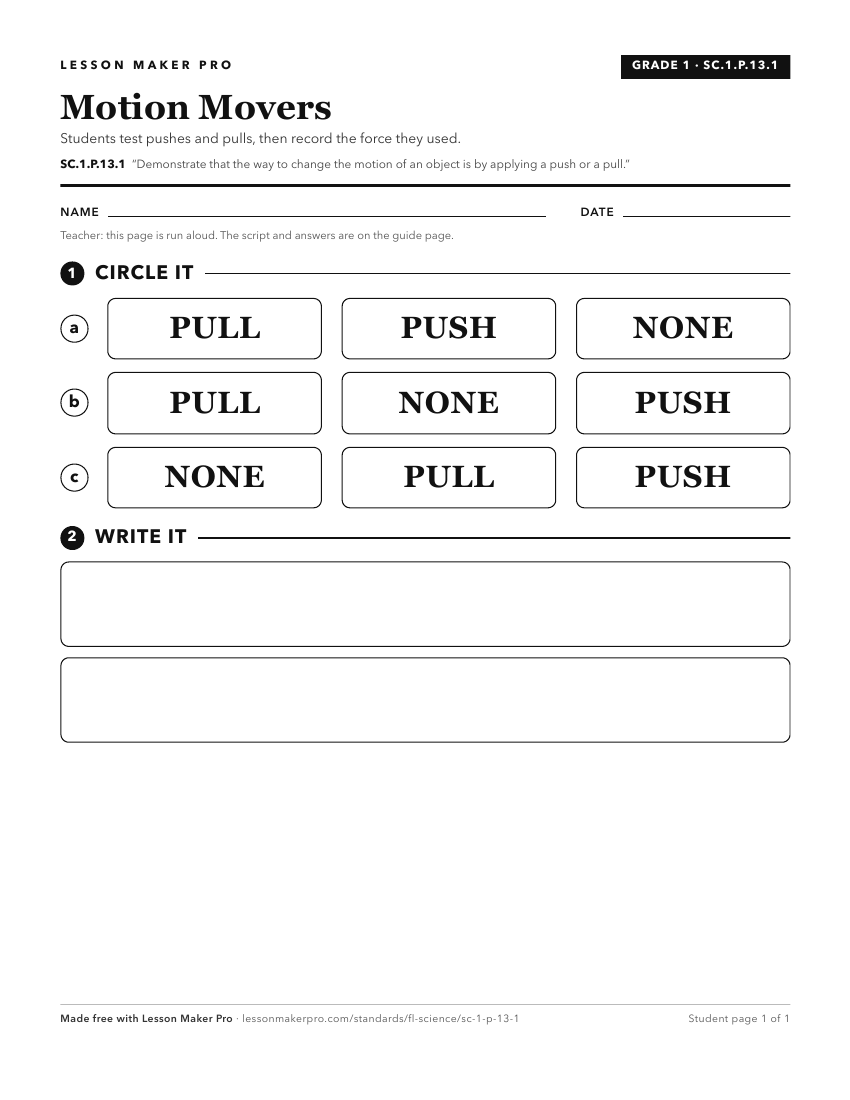
A ready-to-print activity worksheet aligned to SC.1.P.13.1, with an answer key for the teacher on its own page. No account needed.
PDF, US Letter, prints cleanly in black and white.
Download the worksheetKeep exploring
Related Standards
- SC.K.P.13.1
Observe that a push or a pull can change the way an object is moving.
- SC.5.P.13.2
Investigate and describe that the greater the force applied to it, the greater the change in motion of a given object.
- SC.2.P.13.1
Investigate the effect of applying various pushes and pulls on different objects.
- SC.2.P.13.4
Demonstrate that the greater the force (push or pull) applied to an object, the greater the change in motion of the object.
Turn this exact standard into a lesson
Grade, subject, topic, and the complete standard are prefilled. Create one free, no account needed.
Also for this standard:Make a WorksheetMake a QuizMake a Sub Lesson