Florida B.E.S.T. MA.K.M.1.1
The Standard
Identify the attributes of a single object that can be measured such as length, volume or weight.
Florida B.E.S.T. Standards for Mathematics
Teacher's field guide
What This Standard Means
What Students Need to Do
- Students examine one object and name features that can be measured. They identify its length, weight, or how much space it takes up or holds.
What Mastery Looks Like
- Given a water bottle, a student can name its height, weight, and capacity as measurable features. The student can explain that color and pattern are described, not measured.
Common Misconceptions
- Students may name color, pattern, or texture as measurements. They may assume a larger-looking object always weighs more. They may use “size” instead of naming length, weight, or volume.
How to Assess It
- Show a lunchbox and ask, “Name two features we could measure and one feature we would describe without measuring.”
Lesson moves
Ways to Teach It
Give pairs a water bottle, linking cubes, a balance scale, and a measuring cup to match with length, weight, or capacity.
Display a backpack and ask students to name measurable features, then sort their answers under length, weight, or volume.
Play Attribute Match by having students draw an object card and place it beside every measurement card that applies.
Set up a packing task where students decide what to measure before checking whether a box can hold and carry a classroom item.
Free download
Printable MA.K.M.1.1 Worksheet
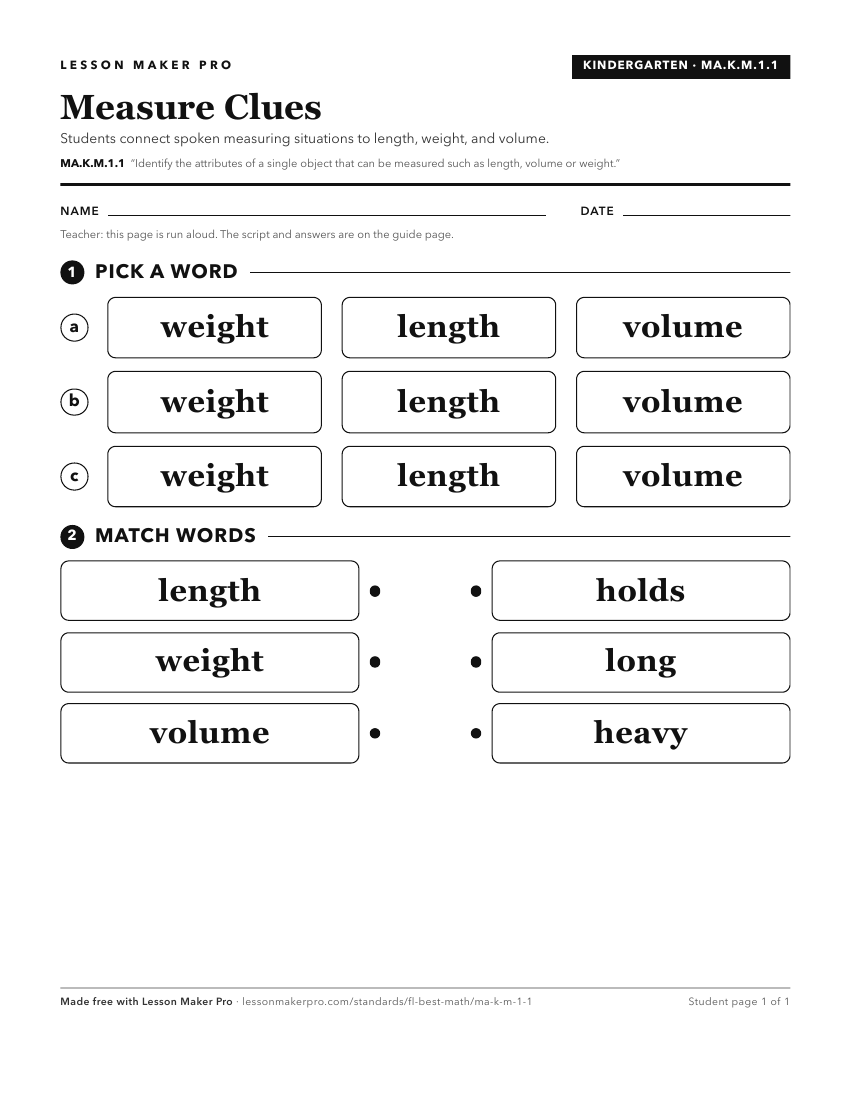
A ready-to-print activity worksheet aligned to MA.K.M.1.1, with an answer key for the teacher on its own page. No account needed.
PDF, US Letter, prints cleanly in black and white.
Download the worksheetKeep exploring
Related Standards
Turn this exact standard into a lesson
Grade, subject, topic, and the complete standard are prefilled. Create one free, no account needed.
Also for this standard:Make a WorksheetMake a QuizMake a Sub Lesson