Florida B.E.S.T. MA.1.M.1
B.E.S.T. Standard (Benchmark Cluster)
Compare and measure the length of objects.
Florida B.E.S.T. Standards for Mathematics
Cluster contents
Benchmarks in This Standard
MA.1.M.1 is a B.E.S.T. standard. These are the benchmarks under it.
Teacher's field guide
What This Cluster Means
What Students Need to Do
- Students compare objects by lining up their endpoints and deciding which is longer, shorter, or the same length. They measure by placing equal-sized units end to end without gaps or overlaps.
What Mastery Looks Like
- Students line up objects at the same starting point and correctly name which is longer or shorter. They measure with equal units placed end to end and report the result with a unit.
Common Misconceptions
- Students may compare objects without lining up one end. They may leave gaps, overlap units, or use units of different sizes. Some give a number without naming the unit.
How to Assess It
- Give each student a pencil, a crayon, and linking cubes. Ask them to identify the longer object, then measure the pencil and record the number and unit.
Lesson moves
Ways to Teach It
Have pairs line up classroom objects at one endpoint, order them from shortest to longest, and check each length with linking cubes.
Show two objects with uneven starting points and ask, "Can we compare these fairly? Explain how you would fix the setup."
Play Length Match by having students find classroom objects that are shorter than, longer than, or equal to a given strip.
Measure items for a pretend desk organizer, then decide which pencils, books, and tools will fit inside each labeled space.
Free download
Printable MA.1.M.1 Worksheet
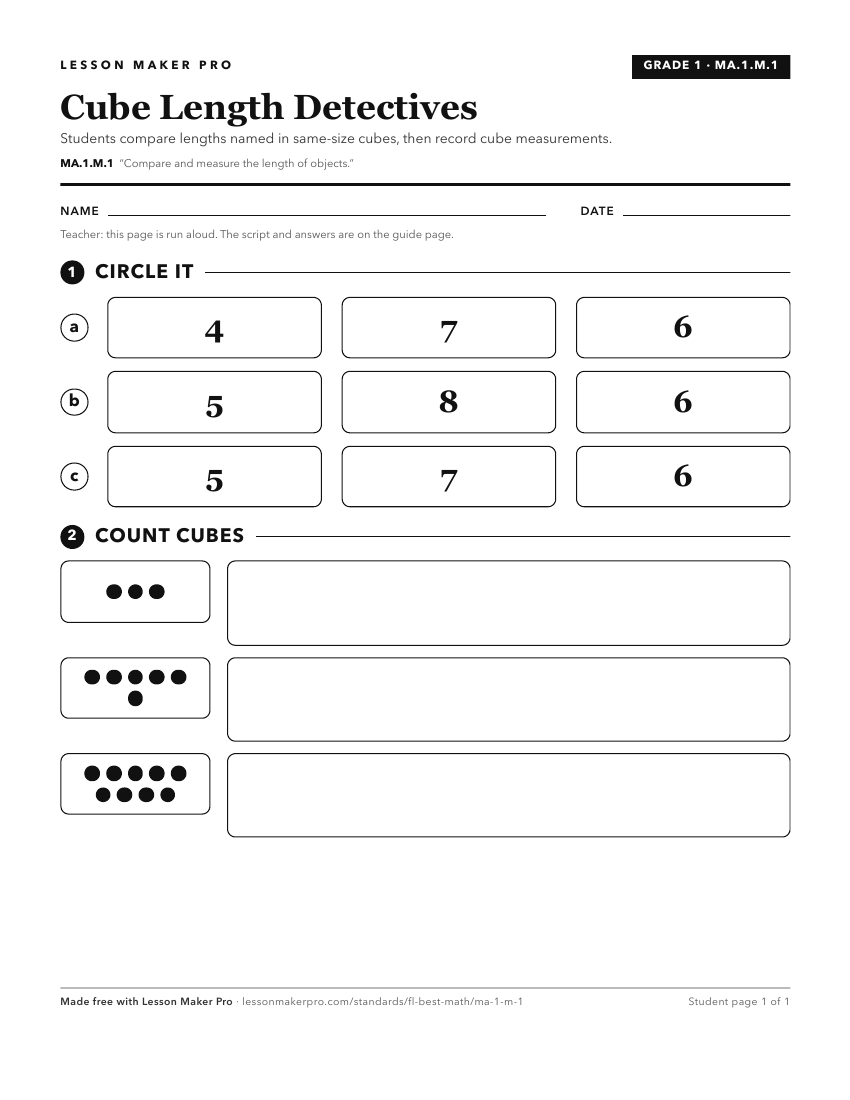
A ready-to-print activity worksheet aligned to MA.1.M.1, with an answer key for the teacher on its own page. No account needed.
PDF, US Letter, prints cleanly in black and white.
Download the worksheetKeep exploring
Related Standards
Turn this cluster into a lesson
Grade, subject, topic, and the complete cluster are prefilled. Create one free, no account needed.
Also for this cluster:Make a WorksheetMake a QuizMake a Sub Lesson