Florida B.E.S.T. MA.912.FL.3
B.E.S.T. Standard (Benchmark Cluster)
Describe the advantages and disadvantages of short-term and long-term purchases.
Florida B.E.S.T. Standards for Mathematics
Cluster contents
Benchmarks in This Standard
MA.912.FL.3 is a B.E.S.T. standard. These are the benchmarks under it.
- MA.912.FL.3.1
Compare simple, compound and continuously compounded interest over time.
- MA.912.FL.3.10
Analyze credit scores qualitatively. Explain how short-term and long-term purchases, including deferred payments, may increase or decrease credit scores. Explai...
- MA.912.FL.3.11
Given a real-world scenario, establish a plan to pay off debt.
- MA.912.FL.3.12
Given fixed costs, per item costs and selling price, determine the break-even point for sales volume.
- MA.912.FL.3.2
Solve real-world problems involving simple, compound and continuously compounded interest.
- MA.912.FL.3.3
Solve real-world problems involving present value and future value of money
- MA.912.FL.3.4
Explain the relationship between simple interest and linear growth. Explain the relationship between compound interest and exponential growth and the relationsh...
- MA.912.FL.3.5
Compare the advantages and disadvantages of using cash versus personal financing options.
- MA.912.FL.3.6
Calculate the finance charges and total amount due on a bill using various forms of credit using estimation, spreadsheets and other technology.
- MA.912.FL.3.7
Compare the advantages and disadvantages of different types of student loans by manipulating a variety of variables and calculating the total cost using spreads...
- MA.912.FL.3.8
Calculate using spreadsheets and other technology the total cost of purchasing consumer durables over time given different monthly payments, down payments, fina...
- MA.912.FL.3.9
Compare the advantages and disadvantages of different types of mortgage loans by manipulating a variety of variables and calculating fees and total cost using s...
Teacher's field guide
What This Cluster Means
What Students Need to Do
- Students compare buying choices that meet immediate needs with choices meant to last longer. They weigh price, total cost, durability, flexibility, and future needs.
What Mastery Looks Like
- Students compare upfront cost, total cost, useful life, and flexibility. They support a choice with calculations and explain how the buyer’s needs affect the decision.
Common Misconceptions
- Students may assume the lowest upfront price is always the best deal. They may ignore maintenance, replacement costs, resale value, changing needs, or the risk of a long commitment.
How to Assess It
- Give this exit ticket: “A monthly bus pass costs $80, while a yearly pass costs $840. List one advantage and one disadvantage of each, then choose one for a student who may move in six months.”
Lesson moves
Ways to Teach It
Have pairs sort purchase cards into short-term and long-term choices, then label each card with one benefit and one drawback.
Ask students to write: “When might renting a laptop be better than buying one, even if buying costs less over time?”
Play a budget challenge where teams choose between monthly and annual plans for five scenarios and earn points for evidence-based decisions.
Students compare real prices for monthly and annual gym memberships, including fees, cancellation rules, and the cost of ending early.
Free download
Printable MA.912.FL.3 Worksheet
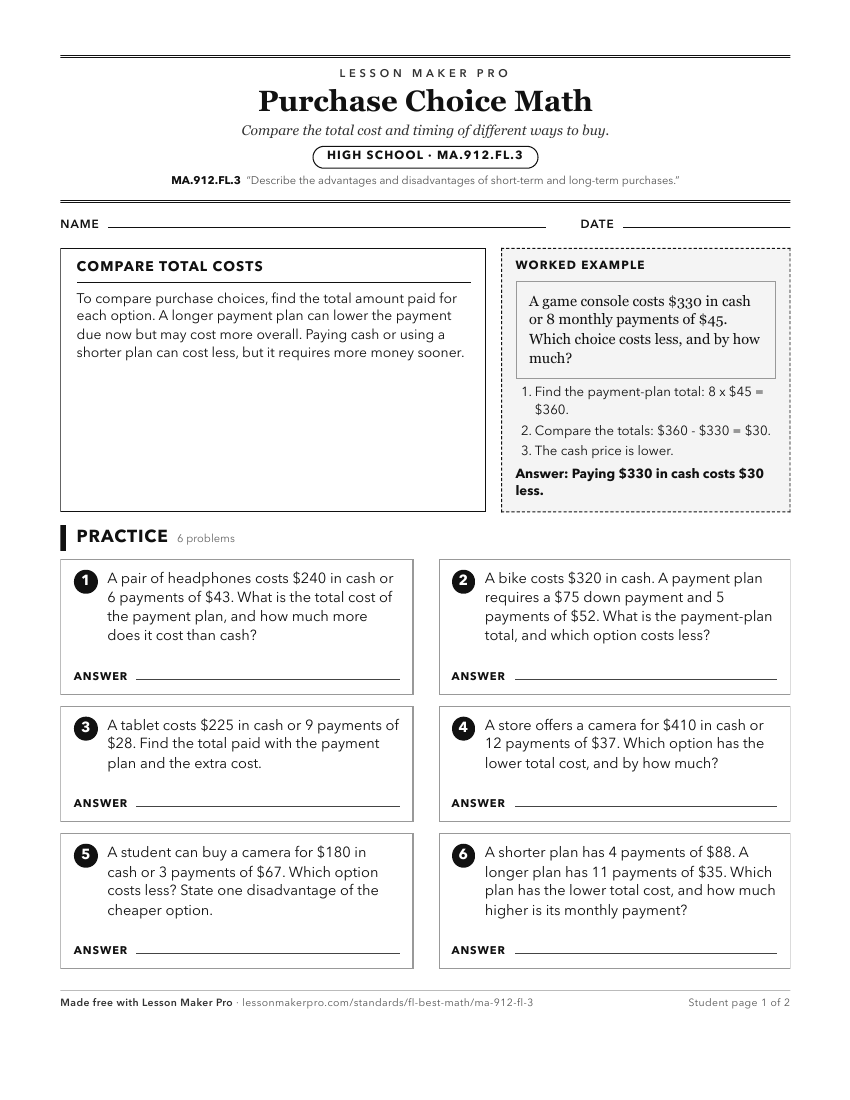
A ready-to-print activity worksheet aligned to MA.912.FL.3, with an answer key for the teacher on its own page. No account needed.
PDF, US Letter, prints cleanly in black and white.
Download the worksheetKeep exploring
Related Standards
Turn this cluster into a lesson
Grade, subject, topic, and the complete cluster are prefilled. Create one free, no account needed.
Also for this cluster:Make a WorksheetMake a QuizMake a Sub Lesson