Florida B.E.S.T. MA.912.FL.3.1
The Standard
Compare simple, compound and continuously compounded interest over time.
Florida B.E.S.T. Standards for Mathematics
Teacher's field guide
What This Standard Means
What Students Need to Do
- Students calculate how the same starting amount grows under different interest methods. They compare balances across several time periods and explain why the differences widen over time.
What Mastery Looks Like
- A student chooses the correct formula and calculates each balance accurately for the same principal, rate, and time. The student ranks the results and explains how repeated interest on interest changes growth.
Common Misconceptions
- Students may apply the simple interest formula to every account or compound only the interest earned in the latest period. They may think continuous compounding produces unlimited money or confuse a higher compounding frequency with a higher annual rate.
How to Assess It
- Exit ticket: Find the value of $1,000 at 5% for 10 years using simple interest, annual compounding, and continuous compounding. Rank the results and explain the differences.
Lesson moves
Ways to Teach It
Have groups build year-by-year balance tables with index cards for a $500 investment under three interest methods.
Ask students to write which interest method benefits a saver and which benefits a borrower, then defend each answer with numbers.
Run a formula sort where teams match account scenarios to simple, periodic compound, or continuous compound formulas and calculate the balances.
Compare three savings account offers using current advertised rates, equal deposits, and a fixed ten-year term.
Free download
Printable MA.912.FL.3.1 Worksheet
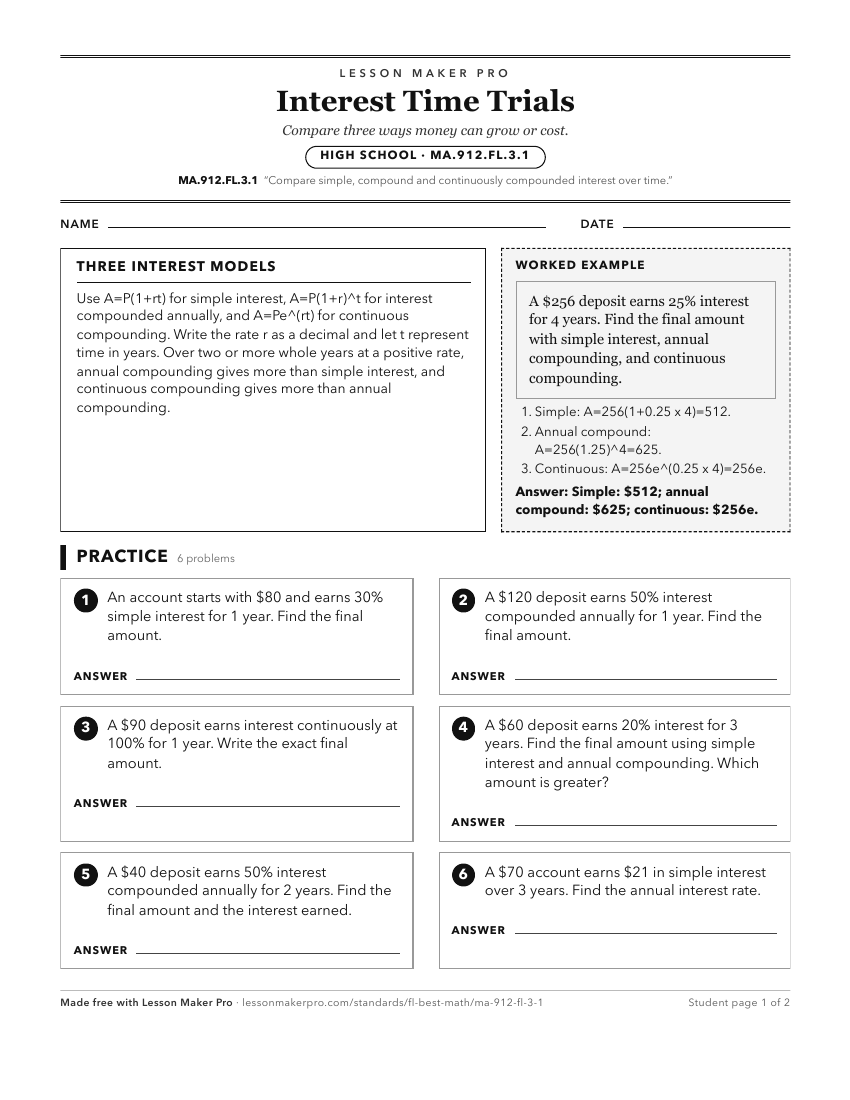
A ready-to-print activity worksheet aligned to MA.912.FL.3.1, with an answer key for the teacher on its own page. No account needed.
PDF, US Letter, prints cleanly in black and white.
Download the worksheetKeep exploring
Related Standards
- MA.912.FL.3.6
Calculate the finance charges and total amount due on a bill using various forms of credit using estimation, spreadsheets and other technology.
- MA.912.FL.3.2
Solve real-world problems involving simple, compound and continuously compounded interest.
- MA.912.FL.3.9
Compare the advantages and disadvantages of different types of mortgage loans by manipulating a variety of variables and calculating fees and total cost using s...
- MA.912.FL.3.4
Explain the relationship between simple interest and linear growth. Explain the relationship between compound interest and exponential growth and the relationsh...
Turn this exact standard into a lesson
Grade, subject, topic, and the complete standard are prefilled. Create one free, no account needed.
Also for this standard:Make a WorksheetMake a QuizMake a Sub Lesson